
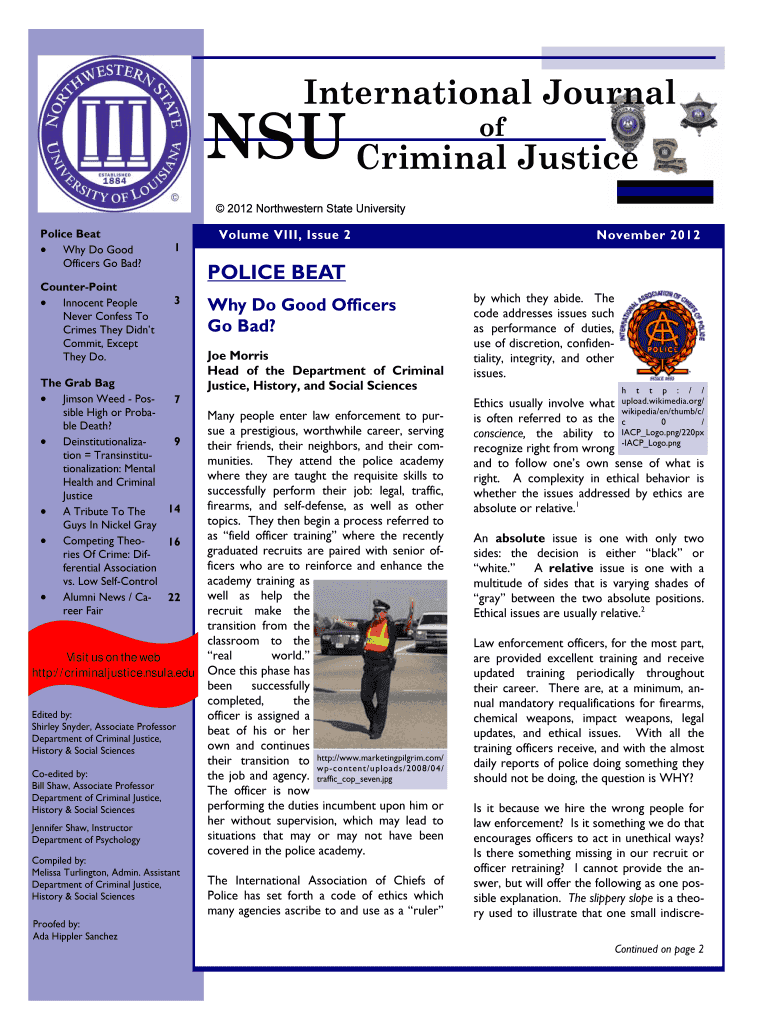







Definition and Meaning
Volume VIII, Issue 2 of the Criminal Justice journal from Northwestern State University represents a scholarly publication focused on the field of criminal justice. This issue highlights academic discussions, research findings, and significant developments in criminal justice practices, theories, and policies. Contributors include experts, researchers, and practitioners who provide insights into contemporary challenges and innovations in the field.
Key Articles and Insights
- Ethical Dilemmas in Policing: Explores reasons behind ethical breaches by police officers and suggestions for preventive measures.
- False Confessions: Analyzes the causes and consequences of false confessions within the legal system.
- Deinstitutionalization Impact: Discusses the effects of mental health policy changes on criminal justice systems.
- Crime Theories: Compares differential association theory with low self-control theory, examining their applicability in modern contexts.
How to Use the Journal
The journal is a critical resource for students, educators, and professionals in the field of criminal justice. Readers can use it to:
- Stay Informed: Keep up-to-date with the latest research and trends in criminal justice.
- Academic Research: Utilize articles for citations in scholarly papers and projects.
- Professional Development: Enhance understanding of complex criminal justice issues and practices.
How to Obtain the Journal
To access Volume VIII, Issue 2 of the Criminal Justice journal from Northwestern State University, follow these steps:
- Library Access: Check availability through university or public libraries.
- Online Platforms: Search academic databases for digital copies.
- University Bookstore: Purchase physical copies directly from the university’s bookstore.
Steps to Complete the Volume VIII, Issue 2
This term generally pertains to tasks related to either contributing to the journal or utilizing its content:
- For Contributors: Ensure manuscript submissions comply with journal guidelines.
- For Readers: Read and critically analyze articles, taking notes on key findings and discussions.
Submission Guidelines for Contributors
- Format Requirements: Adhere to specific formatting guidelines provided by the journal.
- Review Process: Undergo peer review, responding to feedback and revising as necessary.
Importance of the Journal
The journal serves as a critical platform for exploring theoretical and practical aspects of criminal justice:
- Facilitates Knowledge Sharing: Encourages exchange of ideas among academics, students, and professionals.
- Influence on Policy: Contributions can impact criminal justice policies and practices on a broader scale.
Typical Users of the Journal
- Students: Undergraduate and graduate students in criminal justice programs.
- Researchers: Academics conducting studies in related fields.
- Practitioners: Law enforcement officers, legal professionals, and policymakers.
Key Elements of the Journal
Volume VIII, Issue 2 includes several elements essential for a comprehensive understanding of criminal justice:
- In-Depth Articles: Detailed research papers covering various aspects of criminal justice.
- Case Studies: Real-world examples illustrating theories and practices.
- Alumni Features: Highlights achievements of graduates and their contributions to the field.
Legal Use of the Journal
The content within this journal can be critically analyzed and utilized within:
- Academic Contexts: For research papers, theses, and academic projects.
- Professional Environments: As a reference for policy formulation and law enforcement strategies.
- Educational Programs: Curriculum development for criminal justice courses.
Copyright and Usage
- Citation Requirements: Proper citation is necessary when referencing articles from the journal.
- Reproduction Rights: Obtain permission for any reproduction beyond personal or academic use.
State-Specific Rules and Examples
While the journal itself is a national publication, discussions within it may address state-specific issues, such as variations in:
- Criminal Laws: Differences in legal practices and implications across states.
- Policy Implementation: How local regulations affect criminal justice policies.
Examples illustrate how different states approach similar criminal justice challenges, showcasing diverse solutions and outcomes.




