







Definition & Meaning
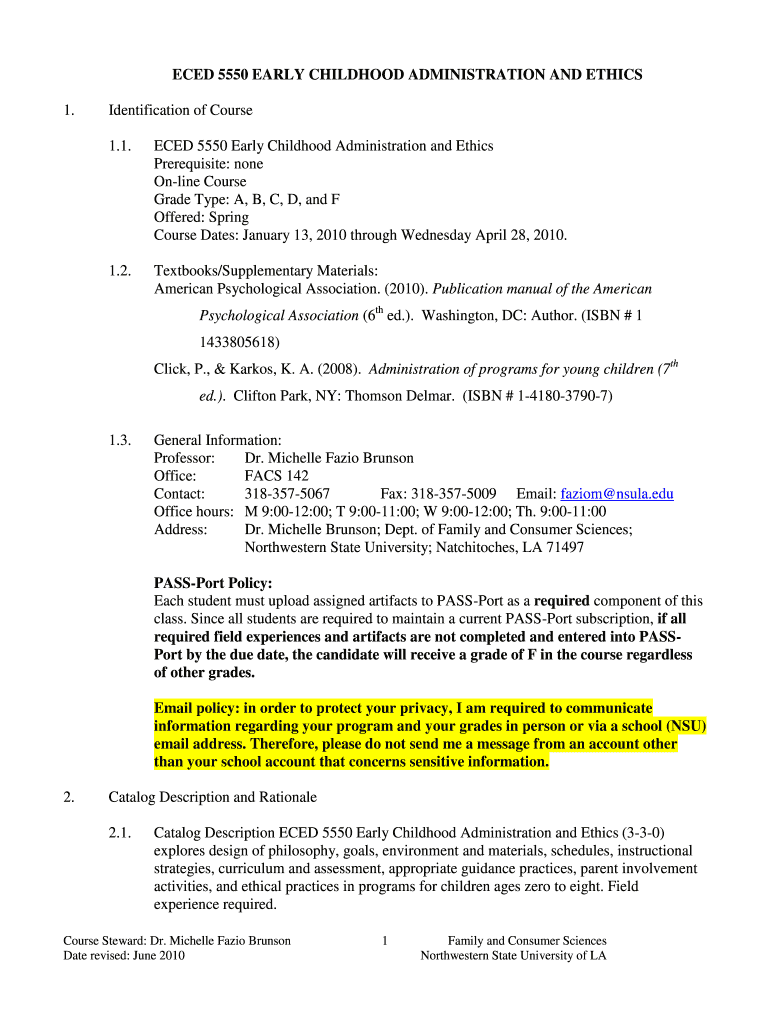
The ECED 5550 Early Childhood Administration and Ethics course is a specialized program designed for inservice teachers aiming to enhance their administrative capabilities in early childhood education settings. This course provides a comprehensive understanding of managing early childhood programs while emphasizing ethical practices. It covers critical aspects such as designing developmentally appropriate programs for children aged zero to eight, understanding professional development, and maintaining ethical standards in administrative roles.
Key Elements of the ECED 5550 Early Childhood Administration and Ethics
This course includes several pivotal elements that form the core of its curriculum:
- Course Prerequisites: Before enrolling, potential students must fulfill specific prerequisites, ensuring they have the foundational knowledge necessary for advanced study.
- Textbooks and Materials: A range of textbooks and supplementary materials are required, providing a comprehensive resource base for the course content.
- Instructor Information: Details about the instructor, including qualifications and contact information, are provided to support student learning and engagement.
- Course Goals and Objectives: The course aims to develop skills in program design and ethical administration. Objectives include understanding administrative roles and fostering environments conducive to children's growth.
- Assignments and Evaluation Policies: Students are evaluated through a combination of assignments aimed at applying theoretical knowledge to practical scenarios in early childhood education settings.
How to Use the ECED 5550 Early Childhood Administration and Ethics
The course is utilized as an educational tool to equip inservice teachers with administrative skills specifically tailored to early childhood settings. It involves:
- Participation in Online Learning: Engaging with course materials and assignments through an online platform enables flexibility and accessibility.
- Application of Ethics in Real-world Scenarios: Students learn to apply ethical considerations in administrative decision-making processes.
- Program Design: Practical assignments involve creating developmentally appropriate programs, encouraging the application of learned theories.
Steps to Complete the ECED 5550 Early Childhood Administration and Ethics
- Enrollment: Begin the process by meeting prerequisite requirements and enrolling through Northwestern State University.
- Course Engagement: Consistently participate in lectures, discussions, and complete all required readings and assignments.
- Assessments: Complete and submit all assignments by their deadlines to meet evaluation criteria.
- Final Project: Often involves a comprehensive demonstration of skills acquired, emphasizing ethical administration and program design.
Who Typically Uses the ECED 5550 Early Childhood Administration and Ethics
The course is primarily designed for:
- Inservice Teachers: Professionals already working in early childhood settings looking to advance their administrative capabilities.
- Educational Administrators: Individuals aiming to transition into early childhood program administration roles.
- Graduate Students: Those pursuing advanced degrees in education with a focus on administration and ethics.


Legal Use of the ECED 5550 Early Childhood Administration and Ethics
Understanding the legal landscape is crucial for administrators. The course delves into:
- Compliance with Child Care Regulations: Ensuring that programs meet federal and state standards.
- Ethical Decision Making: Emphasizing the importance of ethics in navigating legal challenges in educational settings.
- Data Privacy Laws: Covering the protection of children's and families' data within administrative frameworks.
Examples of Using the ECED 5550 Early Childhood Administration and Ethics
- Case Study Analyses: Students engage with real-world scenarios, applying theoretical knowledge to solve administrative challenges.
- Program Development Projects: Practical assignments include designing a program for a specific age group, addressing both developmental needs and ethical considerations.
- Ethical Dilemmas: Situations where students must navigate complex ethical issues commonly faced by administrators in early childhood education settings.
Software Compatibility
For seamless interaction with course materials and submissions, compatibility with various software is crucial:
- Online Learning Platforms: Ensures students can access materials using platforms like Canvas.
- Document Editing: Software such as Microsoft Office or Google Workspace is essential for preparing assignments.
- Ethical Software: Tools for managing privacy and data security are explored, relevant to contemporary administrative practices.
Application Process & Approval Time
- Submit Application: Complete the application form, ensuring all sections are accurately filled.
- Documentation: Provide necessary academic transcripts and evidence of meeting prerequisites.
- Approval Timeline: Generally involves several weeks for review, post which students receive confirmation and further instructions for course commencement.
By providing extensive insight into the ECED 5550 Early Childhood Administration and Ethics course, participants gain a thorough understanding of its multifaceted approach to developing skilled, ethical early childhood administrators.




