
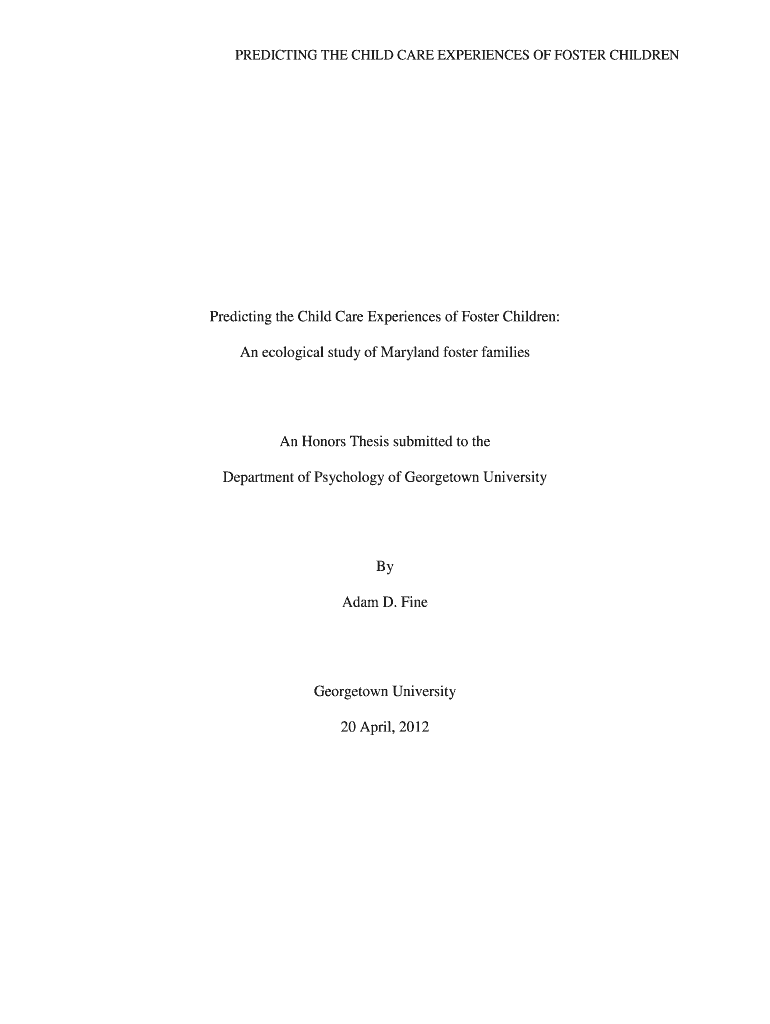







Definition and Purpose of the FINE HONORS THESIS FINAL
The "FINE HONORS THESIS FINAL" refers to the completed version of an academic thesis written by Adam D. Fine from Georgetown University. This document constitutes the final step in the academic process required for achieving honors in Fine's educational program, focusing on child care experiences of foster children in Maryland. The thesis examines ecological factors influencing these experiences and contrasts kinship foster care with non-relative foster care.
How to Use the FINE HONORS THESIS FINAL
To effectively utilize the "FINE HONORS THESIS FINAL," readers should delve into the research's main themes and findings. It provides valuable insights into ecological influences on child care practices among foster care families. Researchers, social workers, and policymakers can apply these findings to develop targeted support for kinship caregivers and address disparities caused by socioeconomic factors.
Steps to Complete the FINE HONORS THESIS FINAL
Completing a document like the "FINE HONORS THESIS FINAL" involves several steps:
- Research Planning: Outline research objectives centered on specific questions relevant to foster care systems.
- Data Collection: Gather information using surveys, interviews, or existing research data on foster care experiences in Maryland.
- Analysis: Examine variations and risk factors among different foster families, identifying trends and patterns associated with kinship and non-relative care.
- Drafting: Develop a structured thesis draft, incorporating an introduction, methodology, findings, discussion, and conclusion.
- Review and Revision: Seek feedback from mentors or peers to refine and improve the thesis.
- Finalization: Make the necessary adjustments and edits to produce the final version as per academic standards.
Key Elements of the FINE HONORS THESIS FINAL
The thesis is structured around several key elements:
- Introduction: Establishes the research context and significance of the study.
- Literature Review: Discusses existing studies on foster care and highlights gaps that this research aims to fill.
- Methodology: Describes the approach used for data collection and analysis.
- Findings: Presents the core results, emphasizing factors like poverty and education that influence foster care choices.
- Discussion: Interprets the findings, suggesting implications and potential interventions for improved foster care outcomes.
- Conclusion and Recommendations: Offers a summary and proposes actionable steps for stakeholders.
Who Typically Uses the FINE HONORS THESIS FINAL
Primarily, the document is of interest to academics, child welfare policymakers, social workers, and foster care advocates. It serves as a resource for those aiming to enhance the understanding and practices within foster care systems, particularly in Maryland. The insights can influence policy-making and the development of programs that support kinship caregivers.


Important Terms Related to the FINE HONORS THESIS FINAL
When discussing the "FINE HONORS THESIS FINAL," several terms are significant:
- Kinship Care: Foster care provided by relatives of the child.
- Non-Relative Foster Care: Care given by individuals who are not biologically related to the child.
- Early Care and Education (ECE): Services focused on child development and education before traditional schooling begins.
- Ecological Factors: Environmental and societal influences impacting family and child welfare dynamics.
Examples of Using the FINE HONORS THESIS FINAL
An example of practical application would be a local government agency reviewing the thesis findings to amend policies supporting kinship foster families. Another scenario might involve a nonprofit using the research to develop advocacy materials or training programs for foster care providers focusing on educational disparities.
Legal Use of the FINE HONORS THESIS FINAL
While the thesis itself serves an academic purpose, its findings can legally inform policy changes and support advocacy efforts. Understanding the ecological factors affecting foster care can help in crafting equitable legal frameworks that prioritize the welfare of foster children through effective educational and social strategies.


