
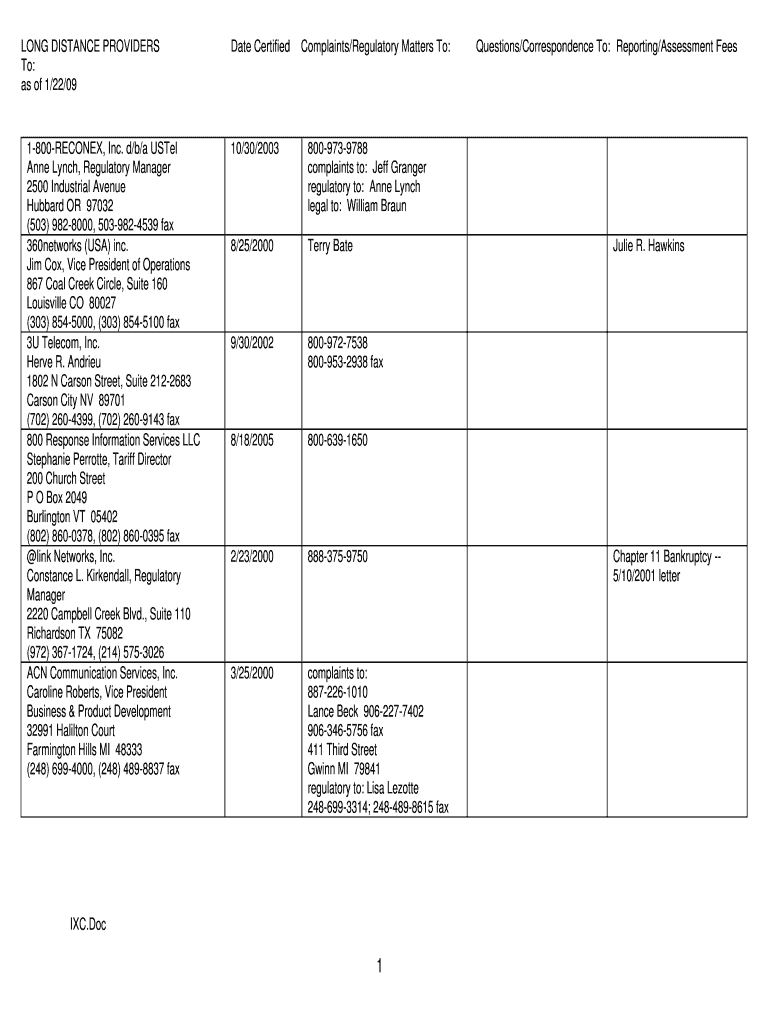







Definition and Meaning of Long Distance Providers
Long distance providers are telecommunications companies that offer services to connect voice and data communication beyond local areas. These providers enable users to make calls over longer distances, often nationally or internationally, by routing calls through networks that cover extensive geographic areas. Long distance service typically involves additional charges compared to local calls, reflecting the infrastructure needed to maintain network links across these distances. Understanding the role and offerings of these providers is crucial for selecting the best service for personal or business communication needs.
Key Functions of Long Distance Providers
- Network Coverage: Providers maintain extensive telecommunications infrastructure to support nationwide and global communication.
- Service Packages: They offer various call plans tailored to different needs, such as unlimited calling or pay-per-minute options.
- Business Solutions: Many providers offer features like conference calling, virtual numbers, and VoIP services to cater to business users.
How to Use the Long Distance Providers Form
The Long Distance Providers form helps users assess and select telecommunication companies based on detailed information about their offerings and compliance status. This form acts as a resource for understanding the landscape of providers and choosing a service that best meets specific needs.
- Review Provider Information: Look for company names, contact details, and available services.
- Assess Regulatory Compliance: Check certification dates and any regulatory issues or complaints associated with each provider.
- Compare Service Offerings: Evaluate features like call rates, network reliability, and special packages.
How to Obtain the Long Distance Providers Form
To acquire the Long Distance Providers form, users can typically access it through telecommunications resources or regulatory bodies overseeing telecommunications, such as the Federal Communications Commission (FCC) in the United States.
- Visit Official Websites: Check the website of the FCC or similar entities for downloadable forms.
- Contact Regulatory Bodies: Reach out directly to telecommunications authorities for guidance on obtaining the form.
- Telecommunications Resource Centers: These centers may provide access to such forms for public use.
Steps to Complete the Long Distance Providers Form
Completing the Long Distance Providers form involves careful attention to detail, ensuring all sections adequately capture necessary information.
- Gather Provider Information: Collect company details, including full name, address, and contact information.
- Document Regulatory Compliance: Note certification dates and any pertinent compliance issues.
- Detail Service Offerings: Include information on call plans, pricing, and any additional features.
Tips for Accurate Completion
- Verify Data: Cross-check information with official records to ensure accuracy.
- Use Clear Language: Present information in a straightforward and organized manner.
- Highlight Key Points: Use bullet points or lists for clarity in extensive sections.
Important Terms Related to Long Distance Providers
Understanding specific terminology can enhance comprehension of the form and related communications services.
- VoIP (Voice over Internet Protocol): A technology that allows voice communication over the internet rather than traditional phone networks.
- PSTN (Public Switched Telephone Network): The traditional telephone network infrastructure used worldwide.
- Interconnected Facilities: Networks that enable communication across multiple providers and geographies.
Glossary of Common Terms
- Carrier Access Charges: Fees paid by users or other telecommunications companies for access to network services.
- International Direct Dialing: A feature that allows users to make international calls without operator assistance.
- Bundled Services: Package deals that combine different communication services, often for a reduced rate.
Legal Use of the Long Distance Providers Form
Using the Long Distance Providers form responsibly is essential for compliance and decision-making related to telecommunications services.
- Ensure Compliance: Follow regulatory guidelines set by telecommunications authorities.
- Use for Intended Purposes: The form should be used for evaluating provider services, compliance, and certifications.
- Privacy Considerations: Handle sensitive information with care to maintain confidentiality.
Regulatory Standards
- FCC Guidelines: Adhere to Federal Communications Commission regulations governing telecommunications.
- State Laws: Consider state-specific rules that may affect provider operations and user rights.
Key Elements of the Long Distance Providers Form
The form encompasses several critical components vital for assessing telecommunications providers.
- Provider Credentials: Include name, address, contact information, and official communications channels.
- Service Descriptions: Detail available services, network coverage, and unique offerings.
- Regulatory Compliance: Highlight certification statuses and any ongoing regulatory matters.
Components for Thorough Evaluation
- Pricing Models: Understand various rate structures, including peak and off-peak rates.
- Network Performance: Evaluate reliability, uptime statistics, and customer support quality.
- Consumer Feedback: Consider customer reviews and known issues when choosing a provider.
State-Specific Rules for Long Distance Providers
In the United States, telecommunications regulations can vary by state, impacting the operations and service provisions of long distance providers.
- Licensing Requirements: Each state may require specific licensing for providers to operate within its jurisdiction.
- Consumer Protection Laws: States might have additional laws to safeguard consumer interests beyond federal regulations.
- Tax Implications: Tax rates on telecommunication services can differ, affecting the overall cost for users.
Notable Variations
- California's Strict Consumer Protections: The state’s stringent laws may influence provider operations and service agreements.
- Texas Telecommunications Law: Understanding unique aspects of local regulations can affect provider choices and compliance.
Examples of Using the Long Distance Providers Form
Practical examples illustrate the form's application in real-world scenarios.
Case Study: Small Business Communication Needs
- Scenario: A small business owner reviews long distance providers to optimize communication costs.
- Process: Uses the form to compare pricing models, service features, and network reliability.
- Outcome: Selects a provider offering competitive rates and robust business solutions.
Case Study: Consumer Advocacy Organization
- Scenario: An organization assesses telecommunications providers to make informed recommendations to its members.
- Process: Compiles data from the form to analyze consumer reviews, regulatory compliance, and service quality.
- Outcome: Provides a comprehensive report guiding member choices based on independent evaluations.




