






Definition & Meaning
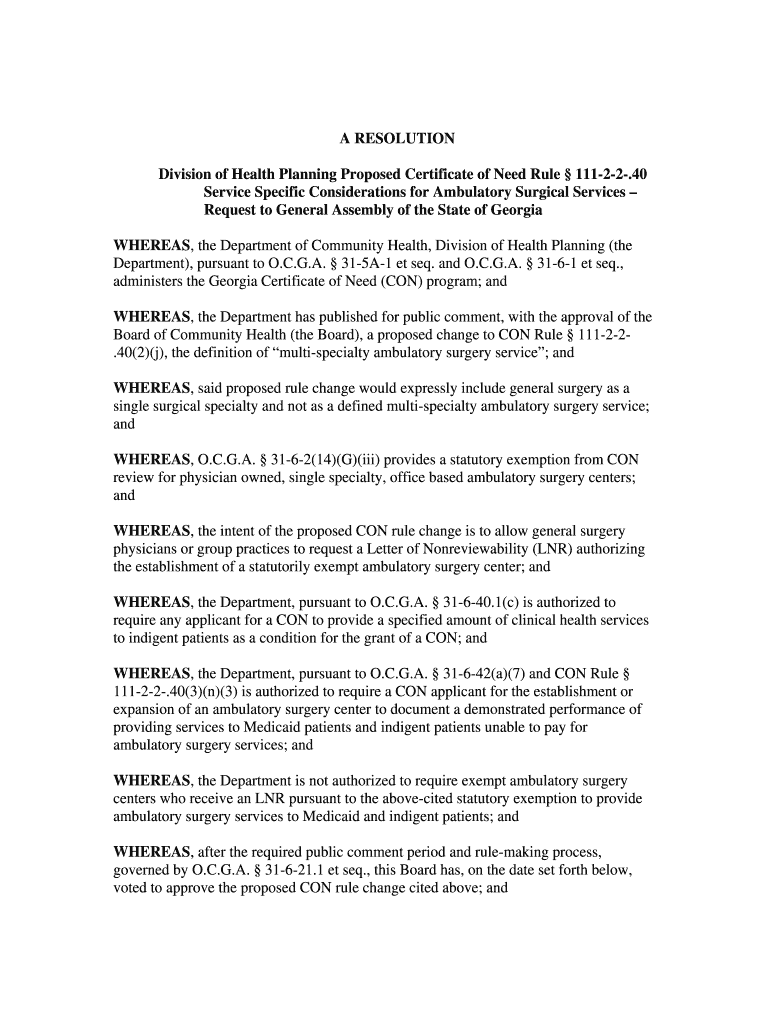
The "A RESOLUTION Division of Health Planning Proposed Certificate of - dch georgia" refers to a formal proposal aimed at modifying existing healthcare regulations within the Division of Health Planning in Georgia. This resolution specifically focuses on the Certificate of Need (CON) rule concerning ambulatory surgical services. It seeks to redefine general surgery as a single specialty, which would permit general surgery practices to establish ambulatory surgery centers without undergoing the traditional CON review process. This initiative is designed to enhance healthcare accessibility by facilitating the establishment of such centers, aiming to extend critical healthcare services to Medicaid and indigent patients.
How to Obtain the Certificate
To obtain the proposed Certificate from the Division of Health Planning in Georgia, healthcare providers must initially demonstrate compliance with the revised guidelines stipulated in the resolution. The process typically involves:
- Application Submission: Submit a detailed application to the Division, outlining the proposed surgical center's operations and its commitment to community health.
- Review Process: The application undergoes thorough evaluation by the Division to ensure it aligns with the new single specialty criteria.
- Approval: If the application meets all criteria, the approval is granted, allowing the setup of the surgical center without the conventional CON review.
Providers are encouraged to understand the resolution's legal requirements and adhere to all specified procedures to facilitate application approval.
Steps to Complete the Certificate Requirements
- Read the Resolution: Thoroughly understand the resolution details and its implications on practice.
- Prepare Documentation: Collect all relevant documents, including proof of the practice’s specialization in general surgery.
- Develop a Community Health Plan: Outline how the proposed center will service Medicaid and indigent patients.
- Submit Application: Follow the formal submission process, ensuring all required information is accurate and complete.
- Engage in Review Meetings: Be prepared to attend any requested meetings or hearings during the review process.
- Amend as Needed: Respond promptly to any requests for additional information or amendments from the reviewing body.
Complying with these steps ensures a smooth application process and increases the likelihood of approval.
Key Elements of the Certificate
The proposed certificate includes several crucial elements:
- Specialty Definition: Defines general surgery as a single specialty within the resolution.
- Exemption Criteria: Outlines criteria for exemption from the traditional CON review process for new ambulatory surgery centers.
- Community Service Requirement: Requires centers to demonstrate a commitment to providing services to Medicaid and indigent patients.
- Legislative Recommendations: Suggests legislative actions to ensure compliance and community service commitments by the centers.
Each element plays a vital role in the resolution's objective to improve healthcare delivery within Georgia, making it essential for healthcare providers to comprehend and implement these aspects.
Legal Use of the Certificate
The certificate provides a legal framework for establishing ambulatory surgery centers exempt from traditional review processes. It emphasizes compliance with community health commitments and legislative requirements. Legally, this means:
- Obligation to Serve: Centers must provide services to designated patient groups, such as Medicaid recipients.
- Regulatory Adherence: Compliance with state and federal healthcare laws is mandatory.
- Audit Preparedness: Centers should be ready for possible audits to ensure legal and regulatory adherence.
By understanding these legal implications, providers can maintain compliance and avoid penalties.
State-Specific Rules
Georgia's approach to the Certificate of Need is unique, necessitating understanding of state-specific rules:
- Healthcare Needs Assessment: Centers must align with the state's assessment of healthcare needs.
- State Health Plan Compliance: Conformance with the Georgia State Health Plan is required.
- Annual Reporting: Regular submission of reports demonstrating adherence to the certificate’s requirements is mandated.
Adhering to these state-specific rules helps facilitate successful participation in Georgia’s healthcare system.
Examples of Using the Certificate
Successful cases where the certificate has made an impact include:
- Small Surgical Practices Expanding Services: By establishing new centers under the certificate’s guidelines, small practices could offer more comprehensive surgical services.
- Community Health Initiatives: Through the certificate, centers have partnered with local organizations to improve health outcomes for underserved populations.
These examples illustrate the certificate's potential to significantly enhance healthcare access and quality.
Important Terms Related to the Certificate
Understanding key terms is crucial:
- Certificate of Need (CON): A regulatory process aimed at preventing unnecessary healthcare facility proliferation.
- Ambulatory Surgical Services: Medical procedures that do not require an overnight hospital stay.
- Indigent Patients: Individuals lacking sufficient income to afford medical services.
Familiarity with these terms enhances comprehension of the certificate’s scope and requirements.
Penalties for Non-Compliance
Failure to adhere to the resolution’s terms can result in:
- Revocation of Certificate: The loss of the ability to operate under the certificate.
- Financial Penalties: Imposition of fines for non-compliance.
- Legal Action: Potential for lawsuits due to regulatory breaches.
Compliance ensures that centers maintain their operational status and avoid these penalties.