







Definition and Meaning of the Senate Journal Entry
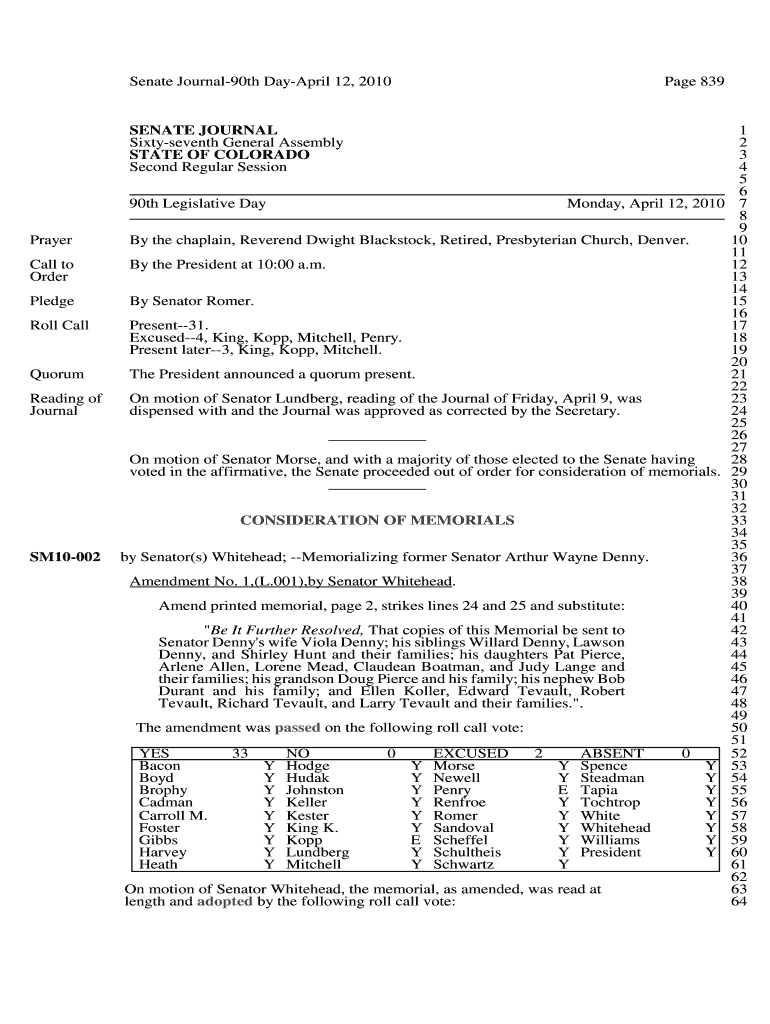
The Senate Journal for the 90th Legislative Day on April 12, 2010, is a record that documents the formal proceedings of the Sixty-seventh General Assembly of Colorado. This particular journal entry includes a variety of legislative activities such as prayers, roll call, approval of previous journal entries, and consideration of both memorials and resolutions. It acts as an official record, preserving the legislative history and actions that took place on that specific day.
Key Components
- Prayer and Roll Call: The session begins with a prayer, followed by a roll call to establish the presence of the senators.
- Approval of Journal Entries: The minutes from previous sessions are reviewed and approved to ensure accuracy and completeness.
- Memorials and Resolutions: The journal lists discussions and decisions on notable memorials, such as the one honoring former Senator Arthur Wayne Denny, and resolutions, including declarations of special weeks and months.
How to Use the Senate Journal Entry
Engaging with the Senate Journal provides citizens, researchers, and legislators insights into legislative actions and decisions. Understanding how to use this document effectively can enhance transparency and civic participation.
Practical Applications
- Research and Analysis: Scholars and political analysts can use the journal entry to analyze legislative trends and shifts in political priorities.
- Legal Reference: Lawyers and legal professionals might reference the journal for precedents or to understand legislative intent.
- Public Engagement: Citizens interested in political processes can refer to the journal to be more informed about legislative activities and decisions.
How to Obtain the Senate Journal Entry
Accessing the Senate Journal for the 90th Legislative Day of the Colorado General Assembly can be done through several channels. Both physical and digital copies are available for those interested in examining these legislative records.
Steps to Access
- State Archives: Visit the Colorado State Archives or their official website where legislative records are often stored and made accessible to the public.
- Library Resources: Many public and university libraries maintain collections of legislative records. Checking their catalogs or databases can be a valuable starting point.
- Online Platforms: Some government websites and third-party platforms like DocHub may host scanned versions of these journals for easy download and review.
Steps to Interpret the Senate Journal Entry
Understanding the Senate Journal requires a systematic approach to identify relevant information and implications. Here is a structured method to interpret this document effectively.
Detailed Process
- Identify Key Sections: Begin by noting sections such as resolutions and bills discussed to focus on the topics of interest.
- Analyze Legislative Language: Pay attention to the legislative language used to understand the nuances and intents behind resolutions and memorials.
- Cross-reference with Other Documents: Compare entries with other legislative records or statutes to gain a deeper understanding of discussions and decisions.
Importance of the Senate Journal Entry
The Senate Journal serves multiple critical purposes, providing extensive value to various stakeholders. Its role goes beyond a simple record-keeping mechanism by serving as an essential tool for accountability and transparency.
Benefits and Significance
- Legislative Accountability: Offers an official record of actions and discussions, enabling legislators to uphold their roles responsibly.
- Historical Preservation: Ensures that future generations have access to the legislative history and can understand the governance context of the period.
- Informed Decision-Making: Allows stakeholders to review past proceedings to inform current and future legislative practices.
Who Typically Uses the Senate Journal Entry
Various groups and individuals utilize the Senate Journal, each with distinct purposes suited to their professional or civic roles. Understanding who uses this document provides insights into its broad applicability.


Common Users
- Lawmakers and Aides: Use the journal to track legislative progress and strategize upcoming initiatives.
- Historians and Educators: Incorporate the document into academic curricula and research on governmental history.
- Journalists: Use it as a reliable source to report on past legislative sessions and evaluate policy shifts.

Key Elements of the Senate Journal Entry
The journal is composed of several crucial components that collectively capture the essence of legislative sessions. Recognizing these elements allows for a clearer interpretation and analysis of the document.
Essential Parts
- Session Details: Information such as date, legislative day number, and the general assembly session.
- Participants: Lists of senators present, absent, and participating members in discussions.
- Legislative Actions: Detailed enumeration of bills, amendments, and motions considered and voted upon.
Examples of Using the Senate Journal Entry
Real-world scenarios demonstrate the utility and practical applications of the Senate Journal. These examples illustrate how this document can be employed across different contexts.
Case Studies
- Policy Development: A policymaker referencing past debates on similar bills to craft new legislation.
- Educational Purpose: A university course using journals to teach students about legislative procedures and government function.
- Public Awareness Campaigns: Advocacy groups accessing the journal to understand legislative stances on social issues, like the Holocaust Awareness Week resolution, to form outreach initiatives.




