
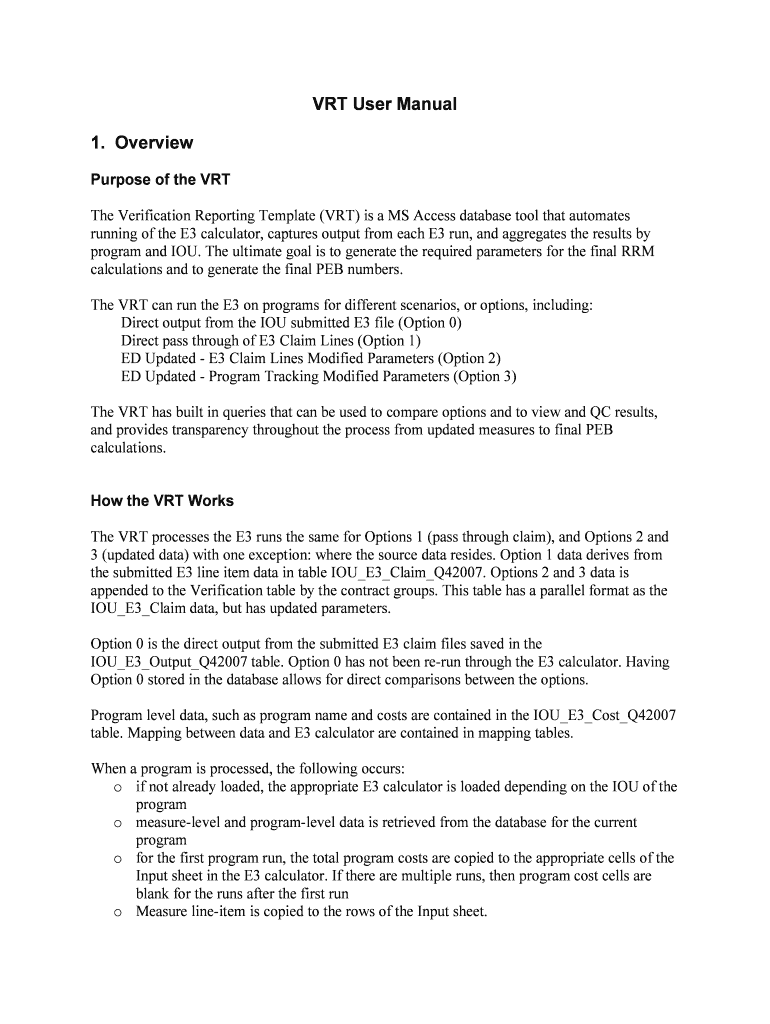







Definition and Purpose of the VRT User Manual 1 Overview
The VRT User Manual 1 Overview comprehensively outlines the use of the Verification Reporting Template (VRT), a robust tool integrated with the MS Access database framework. The primary objective of the VRT is to automate E3 calculator runs for efficient data processing and result aggregation necessary for final RRM calculations. This manual acts as a vital resource for users who require structured guidance to ensure precision and consistency while operating within the VRT environment.
Features and Functionality
- E3 Calculator Automation: The VRT automates repetitive tasks, enhancing the user’s productivity and reducing manual errors.
- Data Capture and Output: The template supports capturing complex data outputs, facilitating a streamlined workflow leading to reliable calculations.
- Aggregation of Results: It unifies various data sources, providing an aggregate output which essential for the final reporting needs.
How to Use the VRT User Manual 1 Overview
The manual provides a step-by-step instruction framework guiding users through the initiation and operation fronts of the VRT.
Step-by-Step Instructions
- Familiarization with Interface: Understand the layout and initial setup necessary for VRT operation.
- Running Calculations: Execute E3 calculator runs through detailed procedures described for each variation.
- Data Import/Export: Learn how to efficiently import source data and export final results for integration in reports.
- Quality Control Processes: Implement checks and balances as described to maintain data integrity and accuracy.
Practical Tips
- Interface Interaction: Utilize the navigation panel for accessing frequently utilized features.
- Efficient Data Handling: Break down large data sets into manageable segments using the VRT’s partition functions.
Key Elements of the VRT User Manual 1 Overview
The manual is structured to cover crucial elemental aspects that users must understand effectively to leverage the use of VRT fully.
Core Components
- Installation Guidelines: Provides instructions for setting up the software in environments compatible with MS Access.
- Operational Commands: Details specific commands and shortcuts that expedite workflow efficiency.
- Database Structuring: Offers insights into organizing the database to maximize performance output.
Important Terms Explained
Understanding the terminology associated with the VRT User Manual 1 Overview is crucial for new users and seasoned practitioners alike.
Glossary of Essential Terms
- E3 Calculator: A computational tool integrated within the VRT for running automated calculations.
- RRM Calculations: Refers to the final reporting process outputs aggregated by the VRT.
- Data Aggregation: The process of compiling multiple data entries into a summarized report necessary for strategic analysis.
Who Typically Uses the VRT User Manual 1 Overview
This manual is crafted for a diverse user base engaged in activities requiring precise and efficient data reporting.


Primary Audience
- Data Analysts: Seeking systematic tools for comprehensive data management and reporting.
- Finance Professionals: Reliant on accurate data aggregation to inform business decisions.
- Quality Assurance Engineers: Implementing the verification strategies to test data integrity and reliability.
Steps to Complete the VRT User Manual 1 Overview
Completing the tasks outlined in the VRT User Manual 1 involves a series of structured procedures aimed at effective template usage.
Procedural Outline
- Initial Setup: Load the necessary software and ensure all prerequisites are met.
- Data Input: Enter required datasets into appropriate fields as guided in the manual.
- Running the Process: Follow systematic steps to initiate data processing and run the E3 calculator.
- Result Verification: Cross-check outputs against expected results to confirm data accuracy.
- Finalizing: Export and document results as completed.
Examples of Using the VRT User Manual 1 Overview
Real-world scenarios help contextualize the manual’s application, illustrating its versatility.
Scenarios
- Corporate Reporting: Utilized for generating quarterly financial assessments with high reliability.
- Regulatory Compliance: Employed in compliance checks where accurate data first computation is mandatory.
- Academic Research: Facilitates data analysis processes in research projects requiring verified reporting protocols.
Application Process and Approval Time
While the VRT User Manual 1 Overview is primarily a tool for internal efficiency enhancement, understanding its implementation timelines ensures seamless integration.
Integration Steps
- Preparation Phase: Collate all required materials and understand guides comprehensively.
- Execution Timeline: Typically, one to three days depending on user familiarity.
- Approval: Usage does not demand external approvals but requires internal alignment with IT protocols.
Software Compatibility and Integration
Adopting VRT necessitates understanding its compatibility with prevalent software solutions to enhance utility.
Compatible Systems
- MS Access: Primary platform for VRT, leveraging its database capabilities.
- Data Analytics Tools: Ensures seamless data transfers between VRT and analytical software like Excel and SPSS.
Integration with these systems ensures smooth transitions between different stages of data processing and reporting.




