
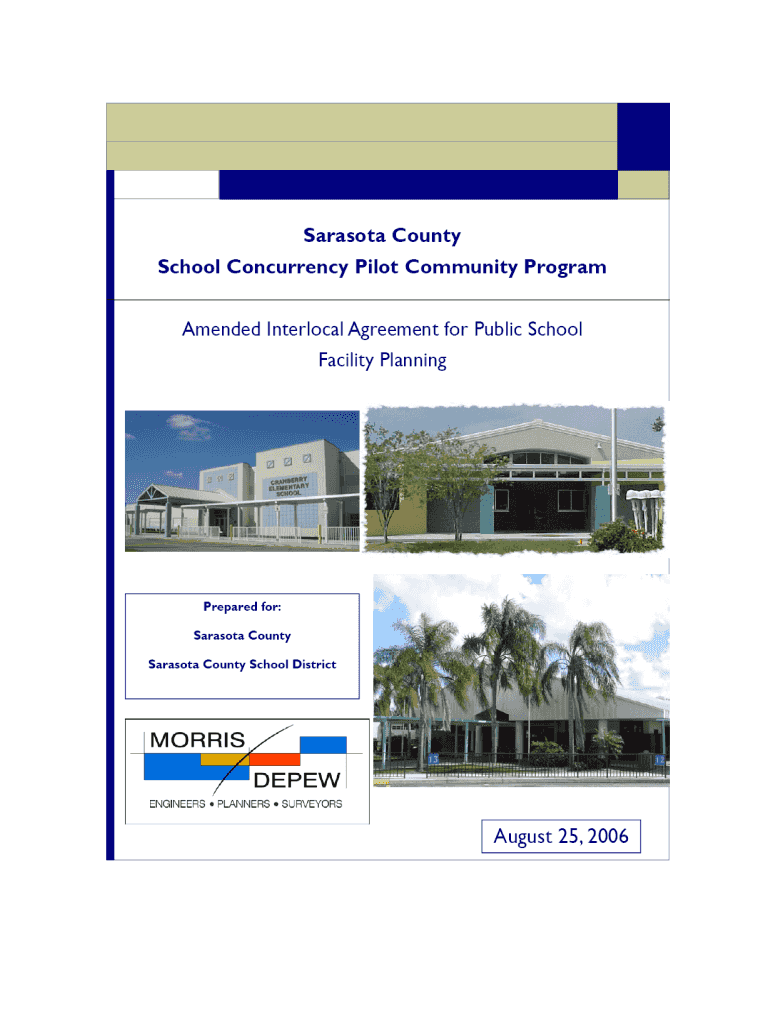







Definition and Meaning
The "Working Draft of Revisions to the Sarasota County School Interlocal" serves as a foundational document in the context of public school facility planning in Sarasota County. It primarily outlines the collaborative framework between the Sarasota County Commission, local municipalities, and the School Board of Sarasota County. By focusing on coordinated land use and school facility planning, it seeks to enhance and ensure educational resources align with the needs of residents efficiently. The document is used for structuring joint meetings, projecting student enrollments, and sharing essential information.
How to Use the Working Draft
Utilizing the "Working Draft of Revisions to the Sarasota County School Interlocal" involves several steps aimed at maximizing its intended purpose. First, stakeholders need to understand its role in coordinating local educational facility planning and how it impacts land use decisions. For practical purposes, users should engage with the sections detailing guidelines for preparing and submitting enrollment projections, participating in joint meetings, and applying concurrency requirements for school capacity. These components are crucial for integrating long-term planning strategies effectively.
Steps to Complete the Document
-
Identify Stakeholders: Determine the appropriate representatives from the county commission, municipalities, and school board who will be involved in the drafting process.
-
Review Existing Data: Gather and assess current data related to land use, school capacities, and enrollment trends.
-
Draft Revisions: Carefully edit and propose updates to existing clauses regarding site selection and infrastructure support.
-
Conduct Joint Meetings: Organize collaborative meetings with all relevant parties to deliberate over the proposed changes.
-
Finalize Document: Incorporate agreed-upon revisions into the final draft, ensuring that every section aligns with updated policy requirements.
-
Submit for Approval: Present the finalized draft to the respective authorities for validation and implementation.
Key Elements of the Document
The "Working Draft of Revisions to the Sarasota County School Interlocal" includes several critical elements:
-
Guidelines on School Concurrency: Procedures to ensure that school capacities meet the demands of growing populations and new developments.
-
Joint Meetings Protocol: Structure and timing for mandated meetings between stakeholders to discuss ongoing and future planning.
-
Enrollment Projections: Methodologies for creating accurate and complete student number forecasts.
-
Site Selection Criteria: Standards and processes for choosing new school locations, taking into account geographical and demographic factors.
Legal Use and Compliance
Ensuring legal compliance while using the "Working Draft" involves adherence to established regulations concerning educational facility planning. The document should be used as a guide for lawful distribution of resources and facilities planning. Additionally, it supersedes any previous agreements, thereby becoming a legal reference point for resolving disputes and implementing changes.
Important Terms and Definitions
Familiarity with several key terms is essential for effective use:
-
Concurrency: The principle of matching school capacity with enrollment demands prompted by new land development.
-
Infrastructure Support: The role of local infrastructure in supporting current and planned educational facilities.
-
Site Selection: The process of choosing appropriate locations for new school facilities.
Who Typically Uses the Document
The primary users of the "Working Draft" include:
-
Government Officials: Members of the Sarasota County Commission and local municipalities involved in planning and development.
-
School Administrators: School Board members who need to understand and implement educational resource planning guidelines.
-
Urban Planners: Professionals engaged in land use planning who must account for educational facility needs.


Examples of Using the Document
Real-world application scenarios demonstrate the utility of the document:
-
Enrollment Adjustment: When significant population shifts are projected, the document guides the necessary adjustments to school capacities.
-
Infrastructure Expansion: Use of the document helps plan new road networks or facilities according to increased school demands.
-
Dispute Resolution: When disagreements arise over land use, the document serves as the guideline for resolving differences through established protocols.
Versions or Alternatives to the Document
While the "Working Draft" is a current iteration, it is vital to understand historical alternatives or earlier versions. These documents offer a reference for how the interlocal agreement has evolved and aid comparative analysis for improving future revisions.
Digital vs. Paper Version
Given the convenience and security of digital documentation, this draft is usually handled electronically. Digital versions allow for efficient editing, sharing, and collaboration among multiple parties involved. However, paper versions are maintained for official record-keeping and situations where traditional methods are preferred or required.




