
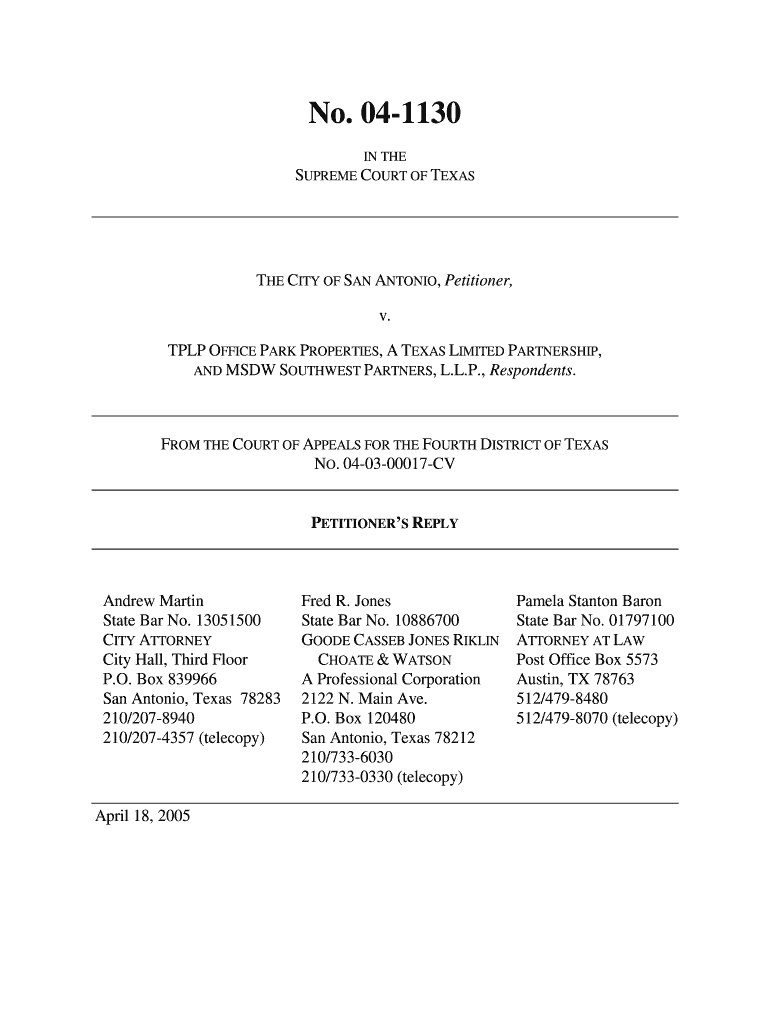







Definition and Meaning of PFR Reply# - Supreme Court of Texas
The "PFR Reply# - Supreme Court of Texas" refers to a legal document used in the Texas judicial system. Specifically, it is a reply submitted by a litigant in response to a petition for review (PFR) filed with the Supreme Court of Texas. This reply plays a critical role in the legal proceedings, enabling the respondent to address the claims made by the petitioner and argue why the Court should or should not review the lower court's decision. Understanding the precise format and content requirements of this document is essential for effectively conveying the respondent's stance.
Key Elements of the PFR Reply# - Supreme Court of Texas
Effective replies to a petition for review must contain specific elements that ensure clarity and adherence to legal standards:
- Issue Identification: Clearly outline the legal issues that the Court should consider.
- Argument Development: Develop a logical and compelling argument that refutes or supports the petition.
- Supporting Evidence: Include relevant case law, statutes, or facts that bolster the reply’s position.
- Conciseness and Clarity: Ensure the reply is concise yet comprehensive, allowing the Court to quickly ascertain the critical arguments.
Each of these elements must be meticulously crafted to make a persuasive case to the Supreme Court of Texas.
Steps to Complete the PFR Reply# - Supreme Court of Texas
- Identify Key Issues: Start by pinpointing the primary legal issues raised in the petitioner’s brief.
- Develop Your Argument: Construct a coherent narrative that supports your position, addressing each of the petitioner’s claims.
- Gather Supporting Information: Compile relevant legal precedents, statutes, and factual data that substantiate your arguments.
- Draft the Reply: Write the reply document, ensuring clarity, precision, and compliance with formatting rules.
- Review and Edit: Critically review and revise the draft to correct any errors and enhance its persuasive impact.
- Submit the Reply: File the completed reply with the Supreme Court of Texas, adhering to any deadlines and submission guidelines.
Following this step-by-step process ensures a well-organized and effective response.
Legal Use of the PFR Reply# - Supreme Court of Texas
The primary legal purpose of the PFR Reply is to engage the Supreme Court of Texas in reevaluating a decision made by a lower court. It functions as a pivotal document in appellate litigation, aiming to counter the petitioner’s arguments and dissuade the Court from granting the petition for review. This reply must align with the procedural rules mandated by the Texas Rules of Appellate Procedure to be considered valid.
State-Specific Rules for the PFR Reply# - Supreme Court of Texas
The Texas judicial system mandates specific procedural requirements for filing a PFR Reply. Adhering to these rules is crucial:
- Formatting: Responses must follow strict formatting guidelines, including font size, margins, and pagination.
- Length: The document should not exceed the page or word limits set forth by the Texas appellate rules.
- Filing Deadlines: Timely submission is mandatory, and extensions are granted only under exceptional circumstances.
Compliance with these rules ensures that the document is accepted and reviewed by the Court.
Who Typically Uses the PFR Reply# - Supreme Court of Texas
This form is frequently utilized by attorneys representing parties in civil or criminal cases where a petition for review has been filed with the Supreme Court of Texas. It is commonly used by:
- Individual Litigants: Parties engaged in personal lawsuits that progress to the appellate stage.
- Corporate or Business Entities: Businesses involved in complex litigation that requires appellate review.
- Government Agencies: Public bodies or officials defending their actions or regulations in court.
Each user group must tailor the reply to their specific context and legal strategy.


Examples of Using the PFR Reply# - Supreme Court of Texas
Real-world examples of PFR Reply usage illustrate its importance:
- Municipal Disputes: Cities may file replies in cases challenging local ordinances, such as the City of San Antonio’s defense of its 2001 Ordinance.
- Contractual Disagreements: Businesses can respond to claims regarding commercial contracts or agreements.
- Regulatory Compliance Cases: Government departments may use the reply to support actions taken under specific legislative frameworks.
These examples highlight the diverse applications of the PFR Reply in Texas’s legal landscape.
Filing Deadlines and Important Dates
Timely filing of the PFR Reply is crucial for maintaining legal rights. Important considerations include:
- Initial Filing Period: Respondents typically have a set timeframe from the petition’s service date to submit their reply.
- Extension Requests: Requests for deadline extensions must be formally filed and justified.
- Court Holidays: Account for any court holidays that may affect the submission window.
Adherence to these schedules is vital to ensure the reply is considered by the Supreme Court of Texas.
Software Compatibility with the PFR Reply# - Supreme Court of Texas
Utilizing document management software like DocHub can streamline the preparation and submission of the PFR Reply. Features such as:
- Real-Time Collaboration: Allows multiple users to work simultaneously on a single document.
- Secure File Sharing: Ensures the confidentiality and integrity of legal documents during the submission process.
- Cloud Integration: Facilitates easy access and storage of documents from cloud services like Google Drive.
Leveraging these tools can enhance efficiency and accuracy in preparing the PFR Reply.
Required Documents for the PFR Reply# - Supreme Court of Texas
When preparing the PFR Reply, include essential documentation to support your case:
- Original Petition for Review: A copy of the petition that prompted the reply.
- Lower Court Opinions: Attach relevant opinions or orders from lower court proceedings.
- Documentary Evidence: Any additional records, such as affidavits or transcripts, that validate your claims.
Compiling the necessary documentation ensures completeness and transparency in your reply.




