







Definition and Meaning
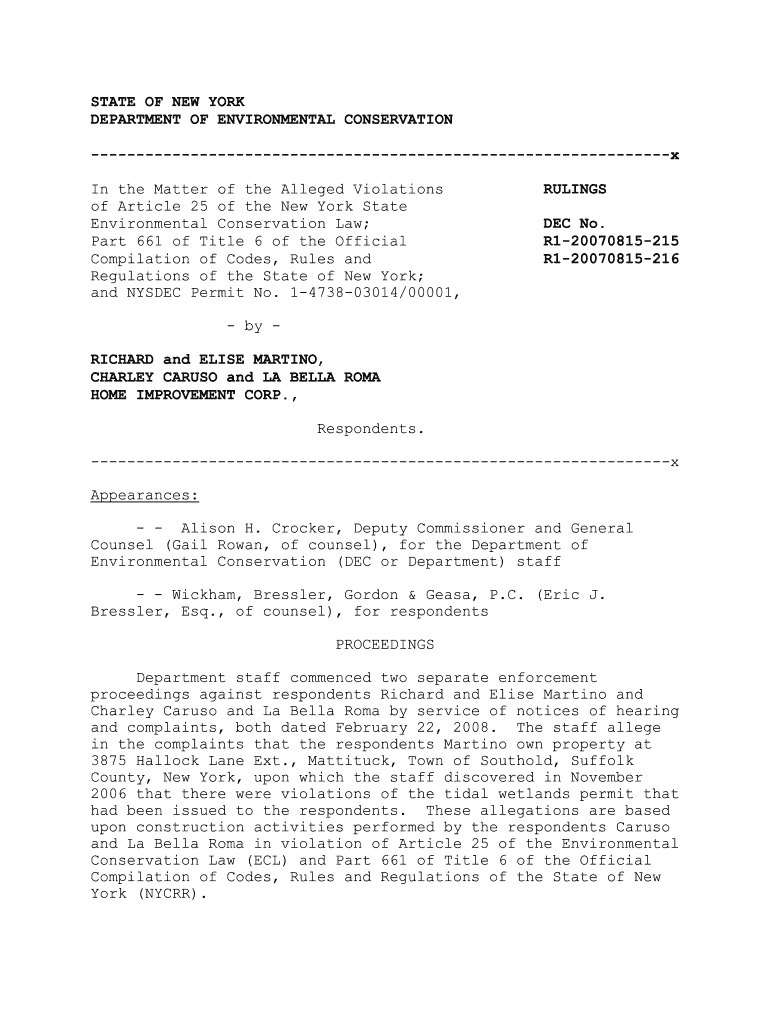
The "Richard and Elise Martino - New York State Department of - dec ny" form pertains to proceedings initiated by the New York State Department of Environmental Conservation. This document is pivotal in outlining the enforcement actions regarding compliance with environmental laws. It serves as a legal framework for addressing alleged violations and implementing corrective measures.
- Purpose: The primary purpose of this form is to document and manage enforcement actions related to environmental compliance by the involved parties.
- Legal Context: It is used in situations where individuals or organizations are accused of not adhering to environmental laws and regulations.
- Involvement: Typically, such forms are filled by legal representatives or by the parties involved in the proceedings, including administrative law judges and legal counsel.
Key Elements of the Form
Understanding the essential components of the "Richard and Elise Martino - New York State Department of - dec ny" form ensures accurate completion and compliance.
- Respondents' Information: Includes details of the respondents involved, such as names, addresses, and the nature of their involvement.
- Allegations Description: A detailed narrative of the alleged environmental law violations.
- Affirmative Defenses: Space where respondents can provide their defenses against allegations, commonly citing legal protections like estoppel.
- Administrative Sections: Columns for comments by administrative law judges (ALJs) regarding proceedings and motions.
Steps to Complete the Form
Filling out the form involves several vital steps to ensure accuracy and compliance with legal standards.
- Identify Respondents: Clearly list the names and contact information of all parties involved.
- Detail Alleged Violations: Provide a comprehensive description of the suspected violations of environmental law.
- State Defenses: Respondents should state any affirmative defenses, such as estoppel, clearly justifying their stance.
- ALJ Clarifications: Administrative Law Judges may need to add clarifications or directives, which must be included in the form.
- Review and Submit: Double-check all information for accuracy before submission to the New York State Department of Environmental Conservation.
Legal Use of the Form
Using this form correctly is crucial as it involves legally binding documentation.
- Enforcement Actions: Outlines legal actions taken by the Department of Environmental Conservation for law enforcement.
- Court Proceedings: Serves as a record in administrative hearing processes, detailing motions, defenses, and outcomes.
- Document Security: Given the legal weight, the form should be handled carefully, ensuring that all security protocols for sensitive legal documents are followed.
Penalties for Non-Compliance
Failing to adhere to the guidelines or inaccurate filing of this form can result in severe legal consequences.
- Fines and Penalties: There could be monetary fines imposed by the New York State Department of Environmental Conservation.
- Legal Action: Courts might pursue additional enforcement actions, including orders for compliance or remedial actions.
- Reputational Damage: Both individuals and businesses may suffer reputational harm that can impact their operations and stakeholder relationships.
Form Submission Methods
The submission process for this form is crucial to ensure timely and secure delivery.
- Online Submission: If available, use secure platforms provided by the New York State Department for electronic submissions.
- Mail: Send via certified mail to ensure documentation of submission and receipt.
- In-Person Submission: Depending on specific circumstances, submission directly to the department's offices may be necessary for certain cases.
Required Documents
Alongside the form, various documents may be necessary to corroborate and support the information provided.
- Proof of Identity: Legal identification documents for all respondents.
- Legal Documentation: Any prior legal documentation relevant to the case, including previous rulings or judgments.
- Environmental Reports: Technical reports or assessments that provide context or evidence regarding the alleged violations.
Examples of Using the Form
Real-world scenarios highlight the practical applications of the form in various legal contexts.
- Case Study 1: A company accused of violating tidal wetlands permits uses the form to submit their defense and cooperate with the New York State Department.
- Case Study 2: A legal team utilizes the form to consolidate multiple related cases involving separate alleged environmental infractions by the same parties.
Important Terms Related to the Form
Understanding the jargon and terminology associated with this form is essential for proper completion and comprehension.
- Estoppel: A legal defense against allegations used when a party is prevented from making assertions contrary to their past actions or statements.
- Interrogatories: Formal sets of written questions required to be answered as part of legal proceedings.
- Consolidation of Cases: A process where separate but related cases are combined into a single proceeding for efficiency and coherence.




