







Definition & Meaning
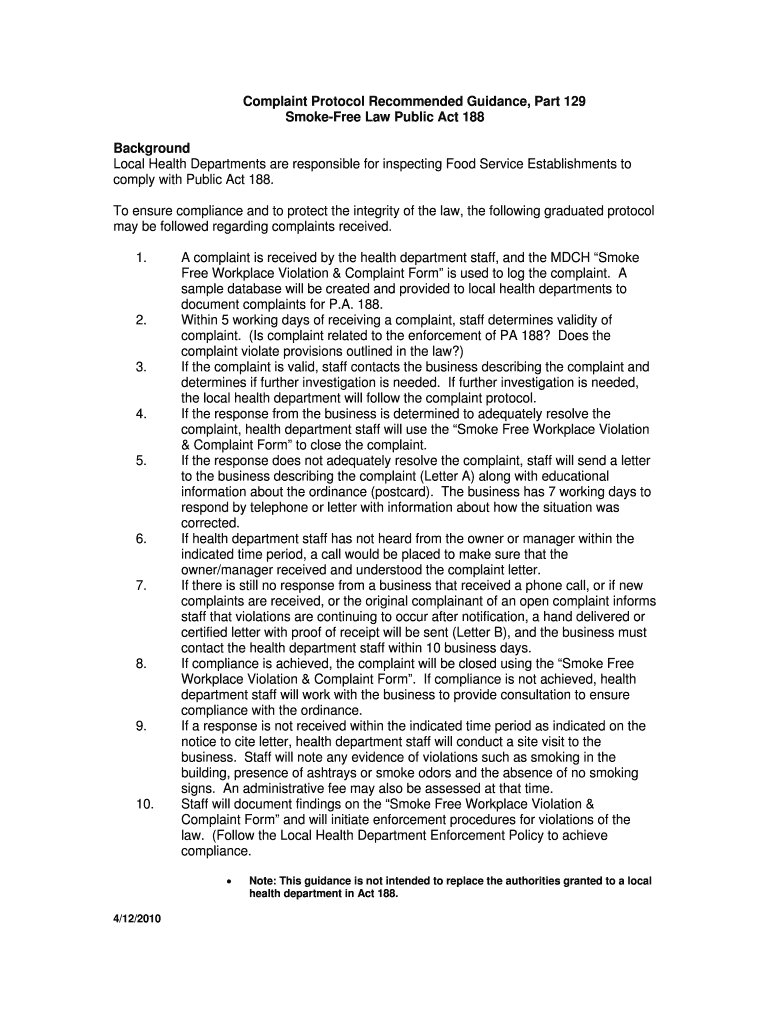
The "Complaint Protocol Recommended Guidance, Part 129 SmokeFree Law Public Act 188 Background Local Heal" refers to a set of guidelines designed to ensure compliance with Michigan's Smoke-Free Law (Public Act 188). This regulation specifically targets health departments and outlines the procedures they must follow when addressing complaints related to the law in food service establishments. The guidance includes detailed steps such as logging complaints, evaluating their validity, and conducting follow-ups to ensure businesses adhere to smoke-free regulations.
How to Use the Complaint Protocol Recommended Guidance
To effectively use the Complaint Protocol, local health departments should first familiarize themselves with the specific steps outlined in the guidance. The protocol begins with the reception of a complaint, after which it is important to log the details accurately. Health departments must determine the legitimacy of the complaint before proceeding to contact the concerned establishment. The protocol also involves sending educational materials to violators and conducting site visits if necessary.
Logging Complaints
- Receive and document all relevant information from the complainant.
- Confirm details such as the location, time, and nature of the violation.
Evaluating Validity
- Assess the complaint against current legal standards to ensure it falls under the jurisdiction of the Smoke-Free Law.
- Cross-check past records for any patterns or history of non-compliance by the establishment.
Steps to Complete the Complaint Protocol
- Receive and Log the Complaint: Use a standardized form to record necessary details.
- Validate the Complaint: Compare against the Smoke-Free Law criteria.
- Contact the Establishment: Notify them of the complaint and provide educational resources.
- Conduct a Site Visit: If required, perform inspections to verify compliance.
- Follow-Up: Re-check compliance and take additional steps if violations persist.
Conducting Site Visits
- Arrange an inspection at a mutually agreeable time.
- Ensure transparency by explaining the purpose and criteria of the inspection.
Key Elements of the Complaint Protocol
The Complaint Protocol includes several key components critical for maintaining compliance with the Smoke-Free Law:
- Complaint Logging: Accurate record-keeping is essential for tracking compliance.
- Educational Outreach: Informing establishments about legal obligations and best practices.
- Enforcement Measures: Applying penalties or sanctions as necessary to address violations.
- Sample Communication: Template letters are included to facilitate communication with businesses.
Important Terms
Smoke-Free Law
A regulation enforced to prohibit smoking in specified areas, especially public spaces and food service establishments, to protect public health.
Public Act 188
The legislative act that formalizes the Smoke-Free Law in the state of Michigan, outlining specific requirements for compliance.
Legal Use of the Complaint Protocol
The protocol serves as a legal framework for health departments to address and resolve complaints effectively. It upholds public health standards by ensuring that food service establishments comply with smoke-free regulations. Legal use also relies on thorough documentation and proper communication with the businesses involved, adhering to privacy and regulatory standards.
State-Specific Rules
Michigan Focus
The protocol specifically applies to Michigan, where Public Act 188 governs smoke-free laws. Differences in other states' regulations mean that these guidelines are tailored for local application, emphasizing compliance in Michigan-based establishments.
Who Typically Uses the Complaint Protocol
Local health department officials are the primary users of this protocol. They are responsible for managing compliance with the Smoke-Free Law within their jurisdictions. Additionally, staff members in these departments play a pivotal role in executing the protocol efficiently.


Examples of Using the Complaint Protocol
Case Study: Successful Complaint Resolution
A local restaurant received multiple complaints about non-compliance with smoke-free regulations. After following the protocol, a site visit confirmed the infractions. The establishment was then guided through corrective actions and educational outreach, ultimately achieving compliance. This case underscores the efficacy of the protocol in maintaining public health standards.
Checklist for Compliance
- Ensure thorough documentation of each complaint.
- Utilize provided templates for effective communication.
- Schedule periodic follow-ups post-initial resolution to maintain compliance.
- Regularly update educational materials to reflect any legislative changes.
Conclusion on Utility
Utilizing the Complaint Protocol Recommended Guidance ensures a structured approach to managing smoke-free law compliance. By adhering to these detailed guidelines, health departments can protect public health while supporting establishments in meeting legal requirements.




