
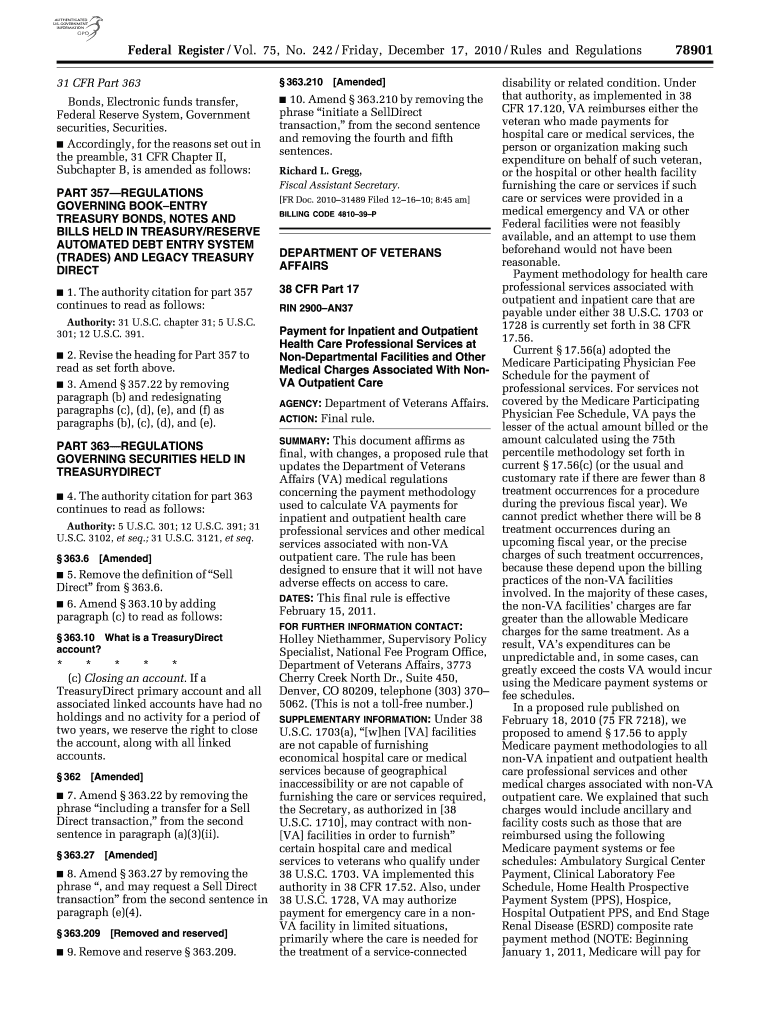







Definition & Meaning
The "Payment for Inpatient and Outpatient Health Care Professional - gpo" form primarily addresses how payments are structured for healthcare services provided to both inpatients and outpatients by medical professionals. This form is significant in standardizing payment methodologies, often aligning with Medicare rates. The form is crucial for ensuring that healthcare providers receive appropriate compensation while maintaining compliance with governmental regulations. In the context of Veterans Affairs, this form is instrumental in administering payments for non-VA health care services provided to veterans.
Key Elements of the Form
Understanding the essential components of the "Payment for Inpatient and Outpatient Health Care Professional - gpo" form is vital for healthcare professionals and organizations. The form typically includes sections detailing the type of services provided, such as inpatient or outpatient care, and the specific payment rates applicable to these services. Other key elements are:
- Service Provider Information: Details about the healthcare provider, including their identification and qualification.
- Service Type: Clearly identifying whether the service is inpatient or outpatient, affecting the payment rates.
- Payment Rates: Breakdown of the payment structure, often tied to Medicare rates to ensure consistency and fairness.
Steps to Complete the Form
Filling out the "Payment for Inpatient and Outpatient Health Care Professional - gpo" requires careful attention to detail to ensure accuracy and compliance. Below are the general steps involved:
- Gather Necessary Information: Collect all relevant data about the healthcare services provided, including patient information and service dates.
- Complete Provider Details: Enter the healthcare provider's identification and contact information accurately.
- Specify Service Type: Indicate whether the services were inpatient or outpatient, as this affects payment calculations.
- Enter Payment Information: Use the form to input the appropriate payment rates, typically aligned with Medicare standards.
- Review and Submit: Double-check all entries for accuracy and submit the form through the designated method.
Why It Matters
Utilizing the "Payment for Inpatient and Outpatient Health Care Professional - gpo" form is crucial for a few reasons. First, it ensures healthcare professionals are compensated fairly for the services they provide. Second, it aligns payments with standardized rates, reducing discrepancies and disagreements regarding costs. Lastly, it helps maintain consistent healthcare service delivery, particularly for services provided to veterans outside of VA facilities.
Eligibility Criteria
To use the "Payment for Inpatient and Outpatient Health Care Professional - gpo," certain criteria must be met. Generally, the form is applicable to healthcare providers who offer medical services to patients as either inpatients or outpatients. The healthcare services must be recognized and documented to align with the payment standards set forth by Medicare and related healthcare programs.


Examples of Form Usage
Several scenarios exemplify the use of this form in real-world applications. For instance:
- A hospital might utilize the form to bill for a surgical procedure conducted on a veteran who is not treated within a VA facility.
- Private practice physicians providing ongoing outpatient care to patients who have opted for private treatment pathways might also rely on this form.
State-Specific Rules
While the "Payment for Inpatient and Outpatient Health Care Professional - gpo" aims for federal standardization, certain state-specific regulations can affect its application. State laws might influence how payments are processed or the exact rates applied. Therefore, it is essential for healthcare providers to be aware of any state-specific nuances that could impact the completion and submission of the form.
Required Documents
Completing the "Payment for Inpatient and Outpatient Health Care Professional - gpo" necessitates several key documents:
- Patient Records: Detailed medical records proving the services rendered.
- Provider Certification: Proof of the healthcare provider's qualifications and certifications.
- Billing Statements: Detailed invoices or statements reflecting the services provided to support the payment claims.
Legal Use of the Form
The form holds legal significance, as it ensures compliance with federal payment guidelines and regulations for healthcare services. Its proper use signifies adherence to the ESIGN Act and other legal standards governing electronic documentation and payments in healthcare services. Understanding the legal implications helps avoid penalties and ensures that a healthcare provider’s operations remain compliant with overarching regulatory frameworks.
Penalties for Non-Compliance
Failure to accurately complete or misuse the "Payment for Inpatient and Outpatient Health Care Professional - gpo" form can result in several penalties. These may include financial repercussions, such as fines or delayed payments. Additionally, regulatory bodies overseeing healthcare payments may impose sanctions on providers who fail to adhere to the established payment guidelines documented by the form.
Digital vs. Paper Versions
Both digital and paper versions of the "Payment for Inpatient and Outpatient Health Care Professional - gpo" are available for use. Digital versions offer the advantage of streamlined submission and processing through platforms like DocHub, while paper versions might be necessary for providers without access to digital submission tools. Adopting the digital version can enhance efficiency and reduce the likelihood of errors.




