







Definition & Meaning
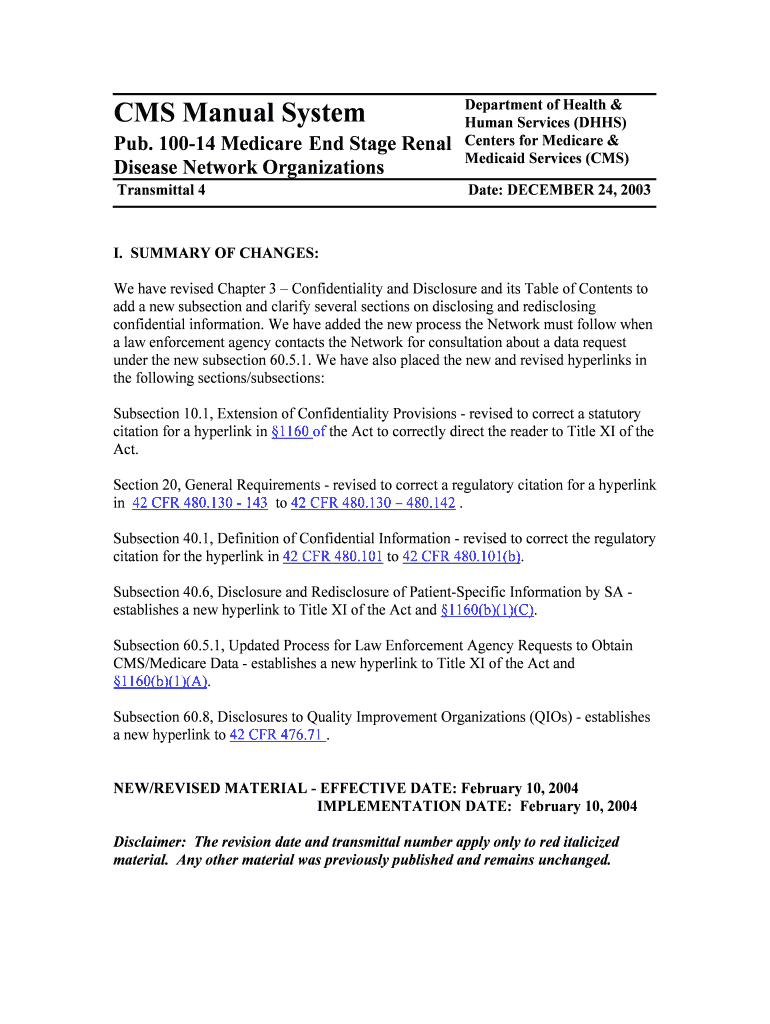
The "100-14 Medicare End Stage Renal - cms" document, known formally as a revision of the CMS (Centers for Medicare & Medicaid Services) Manual System, serves as a critical resource for Medicare End Stage Renal Disease Network Organizations. It encompasses directives for managing confidentiality and disclosure of information, particularly when dealing with data requests from law enforcement agencies. Its primary focus is to ensure that the responsibilities of these networks in safeguarding confidential information are clear and aligned with statutory requirements.
- Confidentiality and Disclosure: This section elaborates on the guidelines regarding the protection and distribution of sensitive patient data.
- Law Enforcement Requests: It outlines the process for handling data requests from law enforcement, a critical aspect for maintaining compliance with legal standards.
How to Use the 100-14 Medicare End Stage Renal - CMS
To effectively utilize the "100-14 Medicare End Stage Renal - cms" document, one must become familiar with the procedures and policies contained within. These documents are essential for establishing compliance protocols and ensuring that personal health information is managed appropriately.
- Review Confidentiality Procedures: Understand the mechanisms in place for protecting patient data.
- Follow Disclosure Protocols: Adhere to federal requirements concerning the release of information under certain conditions.
Who Typically Uses the 100-14 Medicare End Stage Renal - CMS
The primary users of the "100-14 Medicare End Stage Renal - cms" document include Medicare End Stage Renal Disease (ESRD) Network Organizations, healthcare administrators, and legal compliance officers within the United States healthcare system.
- Network Organizations: These entities primarily use the document to ensure they are operating within federal guidelines.
- Healthcare Administrators: They reference this manual to train staff and implement policies regarding data handling.
- Compliance Officers: They utilize the guide to audit procedures and ensure alignment with legal standards.


Key Elements of the 100-14 Medicare End Stage Renal - CMS
Several critical components make up the CMS Manual revisions within this document:
- Statutory References: Revised hyperlinks and citations offer clear paths to relevant laws and regulations.
- Responsibilities: Definitions of the network's role in maintaining data confidentiality.
- Patient Data Guidelines: Instructions for disclosing patient-specific information in legally permissible situations.
Required Documents
To comply with the processes outlined within the "100-14 Medicare End Stage Renal - cms," particular documentation is necessary:
- Patient Records: Including medical histories and treatment regimens.
- Authorization Forms: Specific consents for information release when applicable.
- Law Enforcement Requests Documentation: Any written requests from law enforcement agencies seeking access to patient data.
Legal Use of the 100-14 Medicare End Stage Renal - CMS
The document provides legal backing for secure data handling practices, aligning with the U.S. laws governing medical information confidentiality.
- Compliance with ESIGN Act: Ensures that electronic records and signatures are valid.
- HIPAA Guidelines: Reinforces adherence to Health Insurance Portability and Accountability Act standards.
Steps to Complete the 100-14 Medicare End Stage Renal - CMS
Navigating the processes within this document requires an understanding of form completion specifics:
- Assess Data Needs: Identify what data should be disclosed or kept confidential.
- Gather Appropriate Consents: Ensure proper consents are signed by patients for any data release.
- Implement Security Protocols: Enforce steps that uphold the document's guidelines to secure sensitive data.
Penalties for Non-Compliance
The consequences for failing to comply with the directives in the "100-14 Medicare End Stage Renal - cms" can be significant, including:
- Fines and Sanctions: Legal and financial repercussions for breaching confidentiality protocols.
- Loss of Accreditation: Potential withdrawal of legal standing for Medicare participation.
Software Compatibility
While the "100-14 Medicare End Stage Renal - cms" does not directly interface with software, understanding the technological aspects and ensuring compatibility with tools such as document management systems is crucial.
- Secure File Storage: Use compatible systems that support secure data encryption and management.
- Integration with Healthcare Systems: Ensure alignment with existing health records software for seamless data flow.
State-Specific Rules for the 100-14 Medicare End Stage Renal - CMS
Though the CMS guidelines offer a federal framework, states may have specific adaptations or additional requirements for Medicare compliance under this document:
- State Privacy Laws: Certain states have unique privacy laws that could influence how these CMS guidelines are implemented.
- Additional Approvals: In some states, specific state-level approvals may be necessary alongside CMS directives.




