







Definition & Meaning
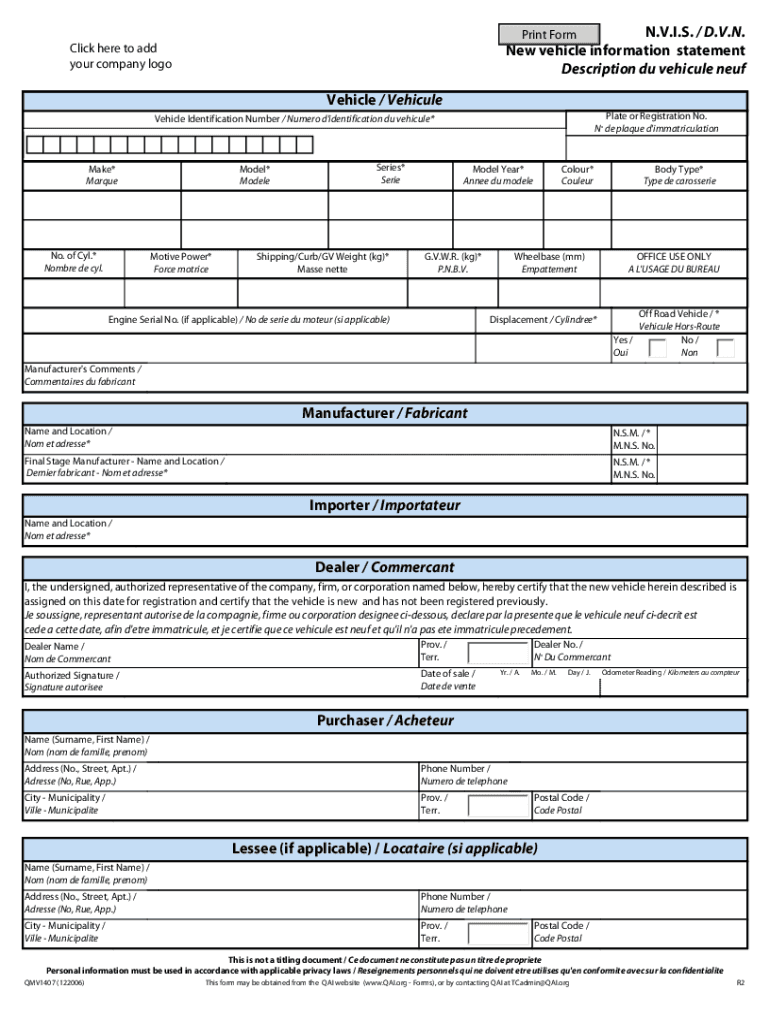
The New Vehicle Information Statement (N.V.I.S. / D.V.N.) is a vital document used primarily for registering new vehicles within the United States. It acts as a certification that a vehicle is brand new and has not previously been registered. Essential for both dealerships and new car owners, this statement is also critical in safeguarding compliance with privacy laws. The document includes comprehensive sections detailing the vehicle's key identifiers, such as make, model, vehicle identification number (VIN), weight, and color. Additionally, it provides fields for dealer and purchaser information, ensuring a thorough record-keeping process that is crucial for both regulatory compliance and future reference.
Key Elements of the New Vehicle Information Statement Template
The template for the New Vehicle Information Statement includes several critical components that ensure all necessary information is captured accurately. Key sections of the form include:
-
Vehicle Details: This section encompasses the make, model, VIN, weight, and color of the vehicle, providing essential details required for registration.
-
Dealer Information: Includes fields for the dealer's name, address, and contact details, ensuring that the vehicle's source is documented.
-
Purchaser Information: Captures the name, address, and signature of the purchaser, confirming the transfer of vehicle ownership.
-
Certification Statement: A critical legal section where the dealer certifies that the vehicle is new and unregistered, often aligned with federal and state regulations.
Steps to Complete the New Vehicle Information Statement
Filling out the New Vehicle Information Statement requires attention to detail to ensure accuracy and compliance. The process can be broken down into several sequential steps:
-
Gather Required Information: Collect all necessary details about the vehicle, including VIN, make, model, and weight.
-
Complete Sections: Begin filling out the form, starting with the vehicle and dealer information. Ensure each section is thoroughly completed to avoid processing delays.
-
Verify Purchaser Information: Accurately enter the purchaser's details, confirming their identity and contact information.
-
Review for Accuracy: Double-check all entries for correctness, ensuring the VIN and other identifiers are correct.
-
Sign and Date: Sign and date the document where required for both the dealer and the purchaser.
-
Submit Form for Registration: Finalize the process by submitting the completed statement to the appropriate regulatory body for vehicle registration.
Legal Use of the New Vehicle Information Statement
In the United States, the legal use of the New Vehicle Information Statement is dictated by state and federal regulations ensuring the authenticity and compliance of vehicle registration. This document's main legal function is to verify that the vehicle is newly manufactured and lacks previous registration. Moreover, it serves as proof in DMV processes that the sale and ownership transfer comply with legal requirements, including privacy laws. Failure to provide this statement can lead to delayed registration or legal complications, making its accuracy and submission crucial in the vehicle registration process.
Applications & Scenarios
The New Vehicle Information Statement is used widely across various scenarios, primarily associated with the sale and registration of new vehicles. Noteworthy applications include:
-
Dealership Sales: Dealerships utilize this document to maintain compliance and manage the transfer of ownership.
-
Finance Companies: In scenarios involving vehicle financing, it verifies the vehicle's condition and eligibility for financing.
-
Private Sales: Although mainly used by dealers, this form can also be applicable in certain private sales where a new vehicle is being resold.
Examples of Using the New Vehicle Information Statement Template
Practical examples illustrate how the template is utilized in real-world settings:
-
Dealership Workflow Efficiency: A dealership in California sold 500 vehicles in a month, using the N.V.I.S. template to streamline the registration of all new vehicles.
-
Compliance Checking: A state department of motor vehicles audits the compliance of vehicle registration applications, where the N.V.I.S. acts as a key document.
-
Record Keeping: A purchaser was required to provide proof of registration in a legal dispute—here, the completed N.V.I.S. confirmed the vehicle's status and ownership.
State-Specific Rules for the New Vehicle Information Statement
Several states may have unique regulations pertaining to the submission and contents of the New Vehicle Information Statement. Important considerations include:
-
California: Mandates specific environmental information on the statement.
-
Texas: May require additional identification checks for the purchaser.
-
New York: Has unique privacy regulations affecting how dealer information is displayed.
Researching state-specific requirements is essential to ensure these documents are correctly adhered to statutory requirements.
Digital vs. Paper Version
Transitioning from paper to digital formats of the New Vehicle Information Statement presents multiple benefits and considerations:
-
Digital Version Advantages: Offers streamlined submission, easier updates, and reduced paperwork handling.
-
Paper Version: Provides a tangible reference, preferred in some traditional or less digitally-inclined workflows.
Selecting between digital and paper formats will depend on the desired convenience, the processes already established, and regulatory acceptance by local authorities.




