




01. Edit your iowa code online
Type text, add images, blackout confidential details, add comments, highlights and more.

Type text, add images, blackout confidential details, add comments, highlights and more.

Draw your signature, type it, upload its image, or use your mobile device as a signature pad.

Send bill of sale for a vehicle in iowa via email, link, or fax. You can also download it, export it or print it out.
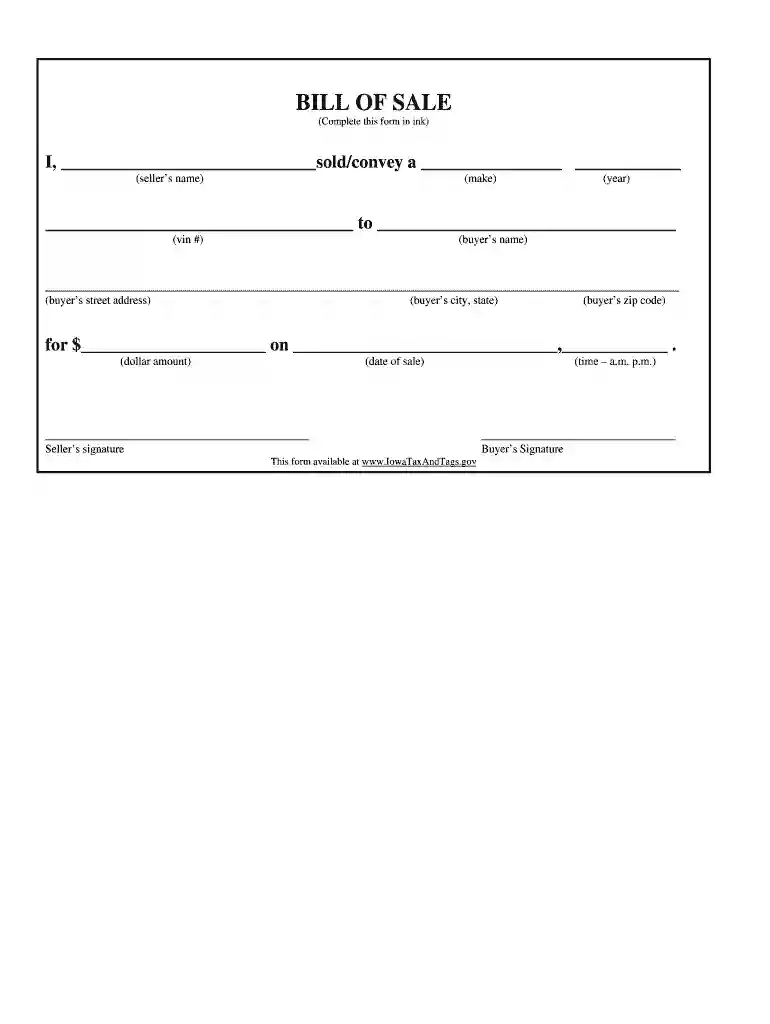
The Polk Bill Sale is a vital document utilized for the transfer of ownership of a vehicle in Polk County, Iowa. This legally binding agreement outlines essential details of the transaction, ensuring that both the seller and the buyer are protected under Iowa law. Generally, a Bill of Sale for a vehicle includes pertinent information about the seller and buyer, details about the vehicle, the sale price, and signatures from both parties, affirming agreement to the terms.
Seller and Buyer Information: Full names, addresses, and contact details of both parties should be listed clearly on the bill. This section establishes the identities of the transaction participants.
Vehicle Details: Essential information regarding the vehicle includes the make, model, year, Vehicle Identification Number (VIN), and odometer readings. This data specifies the exact item being sold and aids in avoiding any disputes.
Sale Price: The agreed-upon price for the vehicle must be explicitly mentioned. This section provides clarity on the transaction's economic terms, which can be important for taxation and ownership verification purposes.
Signatures: The document must include signatures from both the seller and the buyer, demonstrating mutual consent to the sale conditions. Electronic signatures may be permissible under Iowa law, facilitating a seamless transaction process, especially for remote dealings.
In accordance with Iowa state law, a Bill of Sale serves as a crucial instrument for legal vehicle ownership transfer. Below are important legal aspects to keep in mind:
State Requirements: In Iowa, certain vehicles may require additional documentation or adherence to specific regulations during the sale process. It's crucial to be familiar with Iowa Code regulations, which can dictate the necessary details for a valid Bill of Sale.
Proof of Sale: While a Bill of Sale is not always required for registration, it acts as evidence of the transfer of ownership. This can play a significant role in resolving potential disputes regarding the vehicle’s ownership in the future.
Tax Implications: Sellers and buyers must be aware of potential tax liabilities associated with vehicle sales in Iowa. This includes any applicable state sales tax and the need to report the transaction to the Iowa Department of Revenue.
To create a comprehensive Polk Bill Sale, follow these steps to ensure all required elements are included:
Gather Information: Collect all necessary information about the seller, buyer, and vehicle. Ensure you have accurate VIN, purchase price, and the date of the sale.
Use a Template: Utilize a printable Bill of Sale template that complies with Iowa law. Many organizations provide free, downloadable PDF forms.
Complete the Form: Fill out the template carefully, ensuring all fields are accurately completed. Pay special attention to the accuracy of vehicle details and identification information.
Review for Accuracy: Once completed, review the document for clarity and correctness. Both parties should agree on the contents before signing.
Sign and Date: The seller and buyer must sign and date the document, completing the transaction formally.
Several scenarios necessitate the use of a Polk Bill Sale, including:
Private Sales: Individuals selling their personal vehicle to another person often need this document to validate the sale and transfer liability.
Gift Transfers: If a vehicle is being transferred as a gift, a Bill of Sale can still be used to document the transaction, showing no money exchanged hands.
Inheritance: In cases where a vehicle is passed down, a Bill of Sale helps establish the new owner's rights.
Keep Copies: Both parties should keep signed copies of the Bill of Sale in case disputes arise in the future.
Check Vehicle Titles: Ensure that the vehicle title is also signed over to the buyer upon sale; the Bill of Sale is merely a record of the transaction.
Notify the DMV: After completing the sale, either party should notify the Iowa Department of Transportation regarding the transaction, particularly to assist in the new owner’s title registration.
Understanding the Polk Bill Sale ensures a smooth transition of vehicle ownership while complying with local laws and regulations. Familiarity with its components and legal implications aids both sellers and buyers in navigating their responsibilities during the transaction process.
At DocHub, your data security is our priority. We follow HIPAA, SOC2, GDPR, and other standards, so you can work on your documents with confidence.
I,. /convey a. . (sellers name). (make). (year). to. (vin #). (buyers name). (buyers street address). (buyers city, state). (buyers zip code).Read more
Other business papers of William Polk include slave bills of sale, two letters about slave purchases, and a letter from Kenneth Rayner in Memphis aboutRead more
Apr 30, 2021 Its activities primarily include generation, purchase, transmission, distribution, and sale of electric energy. The company provides retailRead more


