

Worksheet domains ranges form 2026

Get Form
domain and range from a graph worksheet Preview on Page 1

Here's how it works

01. Edit your domain and range from a graph worksheet online
Type text, add images, blackout confidential details, add comments, highlights and more.
02. Sign it in a few clicks
Draw your signature, type it, upload its image, or use your mobile device as a signature pad.
03. Share your form with others
Send domain and range worksheet via email, link, or fax. You can also download it, export it or print it out.

How to use or fill out worksheet domains ranges form with our platform

Form edit decoration
9.5
Ease of Setup
DocHub User Ratings on G2
9.0
Ease of Use
DocHub User Ratings on G2
  1. Click ‘Get Form’ to open the worksheet domains ranges form in the editor.
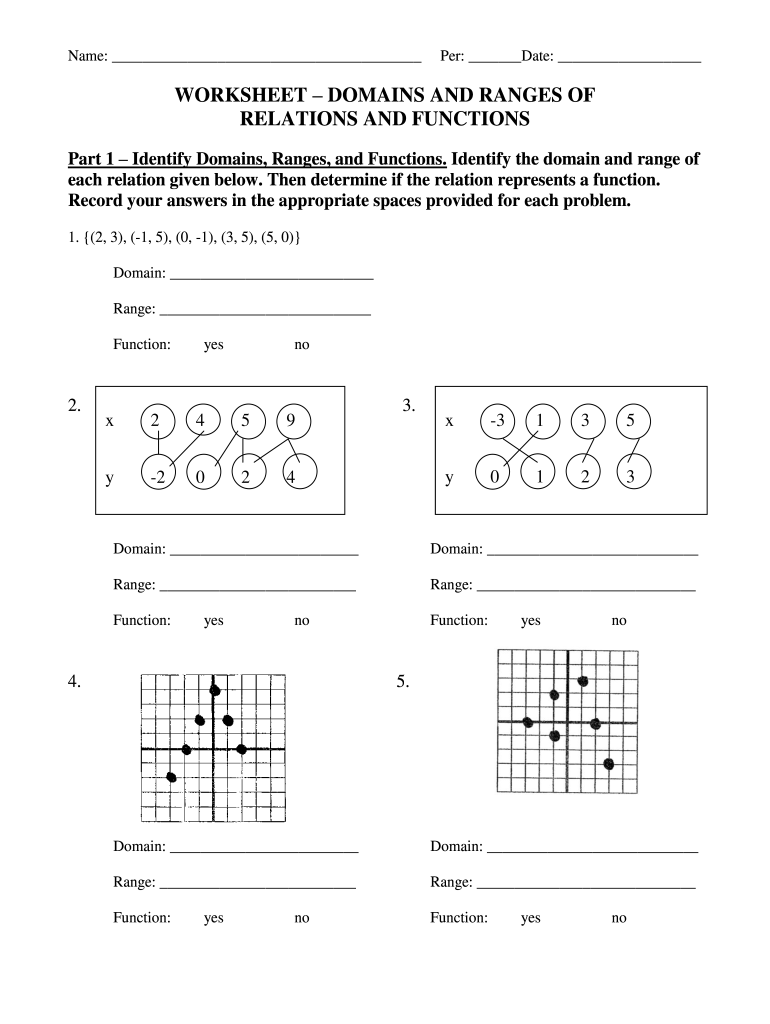
  2. Begin with Part 1. For each relation provided, identify the domain and range. Enter your answers in the designated spaces for each problem.
  3. Determine if each relation represents a function by selecting 'yes' or 'no' in the corresponding field.
  4. Move to Part 2. Carefully read each problem and perform the indicated tasks, such as rewriting relations as ordered pairs or graphing on a coordinate plane.
  5. For each task, again assess whether the relation is a function and record your answer accordingly.
  6. Once all sections are completed, review your entries for accuracy before saving or sharing your form.

Start using our platform today to effortlessly complete your worksheet domains ranges form online for free!

be ready to get more

Complete this form in 5 minutes or less

Get form

Got questions?

We have answers to the most popular questions from our customers. If you can't find an answer to your question, please contact us.
Contact us

With DocHub, you can easily approve your domain and range worksheet pdf or any other document on iOS, even without setting up extra programs. You can access your DocHub account from any internet-connected browser and complete and sign your document in any way you like with just a few clicks.

If you edit your domain and range worksheet pdf with answers with DocHub, you only require a steady internet connection and virtually any browser installed on your device. No need to install any third-party applications or study guides. Simply open a tab with DocHub, drag and drop your file, and modify it on the spot.

Example: a simple function like f(x) = x2 can have the domain (what goes in) of just the counting numbers {1,2,3,...}, and the range will then be the set {1,4,9,...} And another function g(x) = x2 can have the domain of integers {...,-3,-2,-1,0,1,2,3,...}, in which case the range is the set {0,1,4,9,...}
The "|" means "such that," the symbol \u2208 means "element of," and "\u211d" means "all real numbers." Putting it all together, this statement can be read as "the domain is the set of all x such that x is an element of all real numbers." The range of f(x) = x2 in set notation is: R: {y | y \u2265 0}
To find the domain and range, we simply solve the equation y = f(x) to determine the values of the independent variable x and obtain the domain. To calculate the range of the function, we simply express x as x=g(y) and then find the domain of g(y).

Security and compliance

At DocHub, your data security is our priority. We follow HIPAA, SOC2, GDPR, and other standards, so you can work on your documents with confidence.

Learn more
ccpa2
pci-dss
gdpr-compliance
hipaa
soc-compliance

People also ask

The domain of a function is the set of values that we are allowed to plug into our function. This set is the x values in a function such as f(x). The range of a function is the set of values that the function assumes. This set is the values that the function shoots out after we plug an x value in.
We start from the bottom and write the intervals that y is defined on. Use brackets, [], when the endpoints are included and parentheses, (), when the endpoints are excluded. Using the graph above, the range would be: R:(\u22121,2] Because \u22121 is not included we use a parentheses. 2 is included so we use a bracket.
The domain of a function is the set of all possible inputs for the function. For example, the domain of f(x)=x² is all real numbers, and the domain of g(x)=1/x is all real numbers except for x=0. We can also define special functions whose domains are more limited.
Another way to identify the domain and range of functions is by using graphs. Because the domain refers to the set of possible input values, the domain of a graph consists of all the input values shown on the x -axis. The range is the set of possible output values, which are shown on the y -axis.
It's the unique name that appears after the @ sign in email addresses, and after www. in web addresses. For instance, the domain name example.com might translate to the physical address 198.102. 434.8. Other examples of domain names are google.com and wikipedia.org.

domain and range worksheet with answers