Second Judicial District - The North Carolina Court System 2026

Get Form
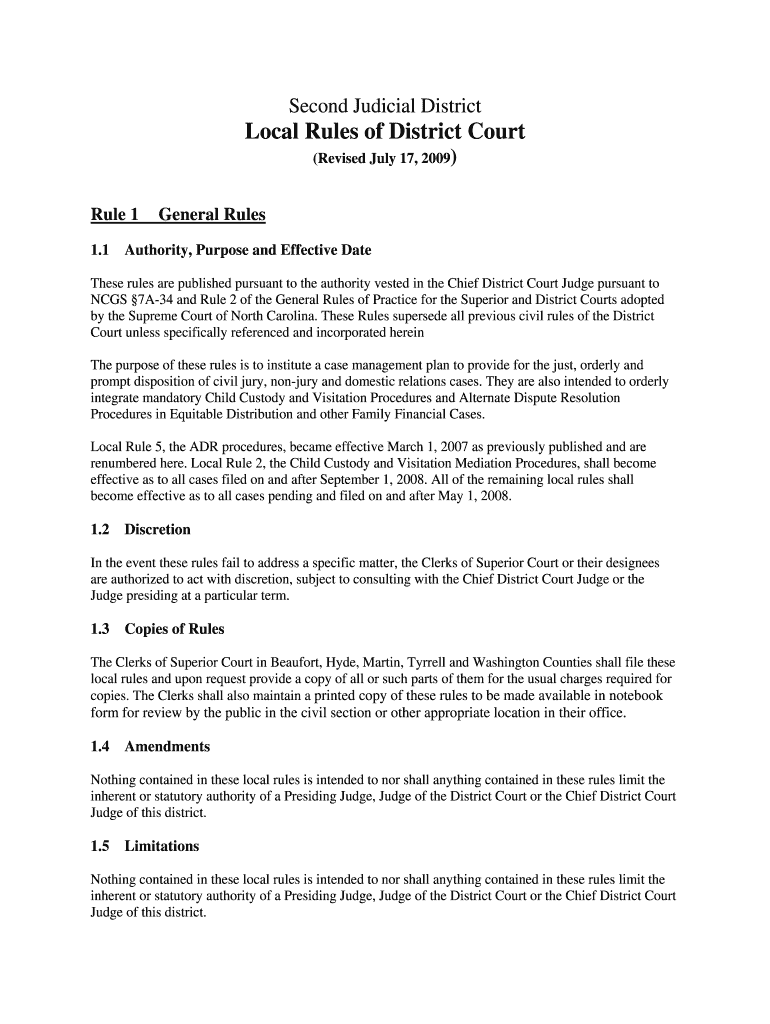
Second Judicial District - The North Carolina Court System Preview on Page 1

Here's how it works

01. Edit your form online
Type text, add images, blackout confidential details, add comments, highlights and more.
02. Sign it in a few clicks
Draw your signature, type it, upload its image, or use your mobile device as a signature pad.
03. Share your form with others
Send it via email, link, or fax. You can also download it, export it or print it out.

How to use or fill out Second Judicial District - The North Carolina Court System with our platform

Form edit decoration
9.5
Ease of Setup
DocHub User Ratings on G2
9.0
Ease of Use
DocHub User Ratings on G2
  1. Click ‘Get Form’ to open the Second Judicial District document in the editor.
  2. Begin by reviewing the General Rules section. Familiarize yourself with the authority and purpose of these rules, as they set the foundation for your form completion.
  3. Navigate to Rule 2, which outlines Mandatory Mediation Procedures. Fill out any required fields regarding custody and visitation claims, ensuring you provide accurate information about both parties involved.
  4. Complete the Financial Needs Affidavit if applicable. This is crucial for non-IVD child support cases and must detail financial conditions clearly.
  5. Review all sections thoroughly before submitting. Ensure that all necessary documents are attached and that you have followed the guidelines for submission outlined in Rule 7.

Start using our platform today to streamline your document editing and form completion process for free!

be ready to get more

Complete this form in 5 minutes or less

Get form

Got questions?

We have answers to the most popular questions from our customers. If you can't find an answer to your question, please contact us.
Contact us
They form a hierarchy of importance, in line with the order of courts in which they sit, with the Supreme Court of India at the top, followed by High Courts of respective states with District Judges sitting in District Courts and Magistrates of Second Class and Civil Judge (Junior Division) at the bottom.
Trials in District Court are always held before a judge, while trials in Superior Court are usually held before a jury, though this right can be waived. Misdemeanors and infractions, as well as juvenile matters, are typically prosecuted in District Court, while felonies are typically prosecuted in Superior Court.
How much does a District Court Judge make in Durham, North Carolina? As of Sep 11, 2025, the average annual pay for a District Court Judge in Durham is $103,961 a year. Just in case you need a simple salary calculator, that works out to be approximately $49.98 an hour.
The court system is separated into three divisions: Appellate Division. Superior Court Division. District Court Division.
The North Carolina Constitution provides for three branches of government: the Legislative Branch, the Executive Branch, and the Judicial Branch. The judiciary is the court system, which is separated into three divisions: the Appellate Division, the Superior Court Division, and the District Court Division.

Security and compliance

At DocHub, your data security is our priority. We follow HIPAA, SOC2, GDPR, and other standards, so you can work on your documents with confidence.

Learn more
ccpa2
pci-dss
gdpr-compliance
hipaa
soc-compliance

People also ask

North Carolinas court system, called the General Court of Justice, is a unified statewide, state-operated system comprised of three divisionsthe Appellate Division (made up of the court of appeals and the state supreme court), the Superior Court Division, and the District Court Division.
In North Carolina, there are three federal district courts, a state supreme court, a state court of appeals, and trial courts with both general and subject matter jurisdiction.
Information about criminal cases in the North Carolina court system can be accessed by visiting a public, self-service terminal located at a clerk of courts office in any county. You can use the terminal to search for cases by defendant name, case number, or victim or witness name.

Related links