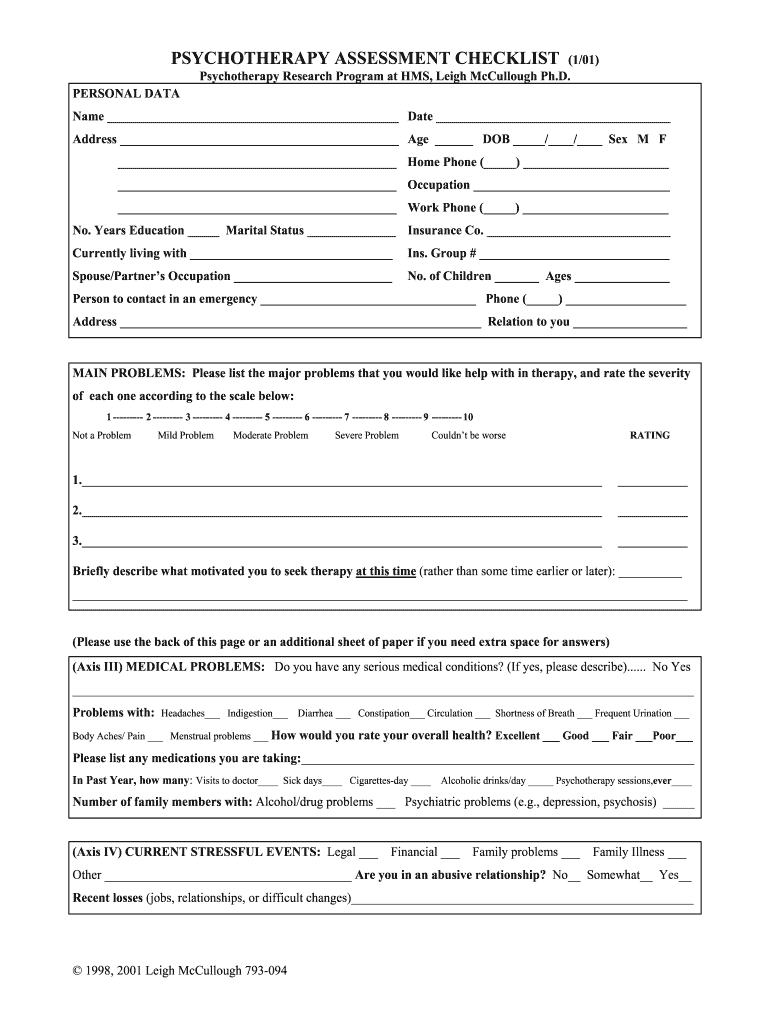
Psychotherapy assessment checklist 2026

Get Form
psychotherapy assessment checklist Preview on Page 1

Here's how it works

01. Edit your psychotherapy assessment checklist online
Type text, add images, blackout confidential details, add comments, highlights and more.
02. Sign it in a few clicks
Draw your signature, type it, upload its image, or use your mobile device as a signature pad.
03. Share your form with others
Send form of psychotherapy via email, link, or fax. You can also download it, export it or print it out.

How to use or fill out psychotherapy assessment checklist with our platform

Form edit decoration
9.5
Ease of Setup
DocHub User Ratings on G2
9.0
Ease of Use
DocHub User Ratings on G2
  1. Click ‘Get Form’ to open the psychotherapy assessment checklist in the editor.
  2. Begin by filling out the 'Personal Data' section. Enter your name, date, address, age, and other relevant personal information. This helps establish your identity and context for therapy.
  3. In the 'Main Problems' section, list the major issues you wish to address in therapy. Use the provided scale to rate their severity from 1 (not a problem) to 10 (couldn't be worse). This will guide your therapist in understanding your priorities.
  4. Proceed to the 'Medical Problems' section. Indicate any serious medical conditions and medications you are currently taking. This information is crucial for your therapist's awareness of any health factors that may affect your treatment.
  5. Continue through sections on current stressful events and daily functioning. Provide honest responses as they contribute significantly to your overall assessment.
  6. Finally, review all entries for accuracy before saving or sharing the completed form with your therapist directly through our platform.

Start using our platform today for free to complete your psychotherapy assessment checklist effortlessly!

be ready to get more

Complete this form in 5 minutes or less

Get form

Got questions?

We have answers to the most popular questions from our customers. If you can't find an answer to your question, please contact us.
Contact us
Traditionally, risk assessment involves asking a person about suicidal thoughts, their frequency and intensity, and the intent, plan, and access to means to act on these thoughts [21].
The five major goals of the counseling process include facilitating behavioral change, enhancing the ability to form and maintain relationships, improving coping skills, promoting decision-making and personal potential, and supporting personal development.
PAC usually precedes the delivery of anesthesia for surgical and nonsurgical procedures. [1] The primary purpose of this endeavor is to assess known and diagnose unknown co-morbidities which directly or indirectly affect the perioperative management of the patients.
This wellbeing assessment uses the Warwick-Edinburgh Mental Well-being Scale (WEMWBS) to measure wellbeing. Good mental wellbeing is about feeling good and functioning well. You may find that your mood goes both up and down so use this tool to monitor it over time.
A clinical assessment conducted by a psychotherapist is a comprehensive process designed to gather information about an individuals psychological, emotional, and mental health.

Security and compliance

At DocHub, your data security is our priority. We follow HIPAA, SOC2, GDPR, and other standards, so you can work on your documents with confidence.

Learn more
ccpa2
pci-dss
gdpr-compliance
hipaa
soc-compliance

People also ask

DRCs PAIMI Advisory Council (PAC) advises our board and staff about issues in the mental health community.
Focus: A psychiatric evaluation focuses more on the medical aspects of mental health, such as diagnosing and treating psychiatric disorders with medication. On the other hand, a psychological evaluation focuses on understanding your thoughts, emotions, and behaviors, often without medication.
The Psychopathology in Autism Checklist (PAC) contains 30 items representing symptoms previously evaluated as specific to one of four major psychiatric disorders (psychosis, depression, anxiety and OCD) and not related to autism. Twelve items evaluated as indicators of general adjustment problems are also included.

psychotherapy assessment