Cladogram practice 2026

Get Form
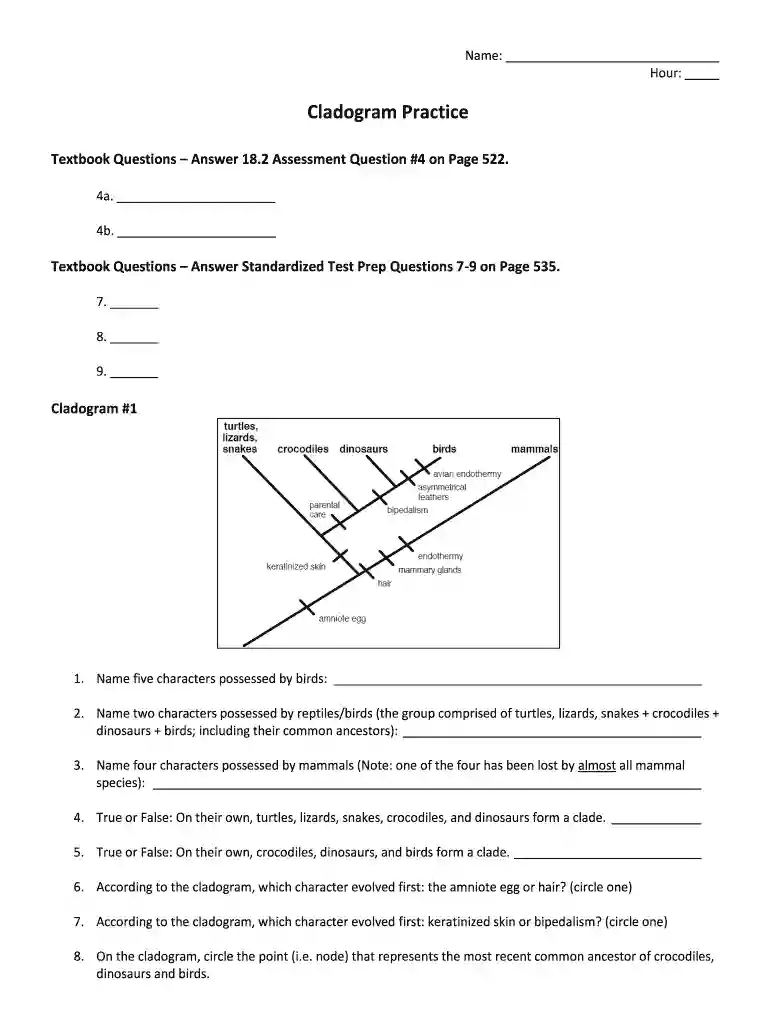
cladogram practice Preview on Page 1

Here's how it works

01. Edit your cladogram practice online
Type text, add images, blackout confidential details, add comments, highlights and more.

02. Sign it in a few clicks
Draw your signature, type it, upload its image, or use your mobile device as a signature pad.

03. Share your form with others
Send cladogram practice problems with answers via email, link, or fax. You can also download it, export it or print it out.

How to use or fill out cladogram practice with our platform

Form edit decoration
9.5
Ease of Setup
DocHub User Ratings on G2
9.0
Ease of Use
DocHub User Ratings on G2
  1. Click ‘Get Form’ to open the cladogram practice document in the editor.
  2. Begin by entering your name and hour at the top of the form. This personalizes your submission and helps in tracking responses.
  3. For the textbook questions, refer to the specified pages and answer each question (4a, 4b, 7-9) directly in the provided spaces. Ensure clarity in your answers for better understanding.
  4. Move on to Cladogram #1. Answer questions about characters possessed by birds, reptiles/birds, and mammals. Pay attention to details as they are crucial for understanding evolutionary relationships.
  5. For true/false questions, circle your answers clearly. This will help in quick assessments later.
  6. In Cladogram #2 and #3, list organisms as prompted and circle nodes where indicated. This visual representation is key to grasping clade relationships.

Start using our platform today for free to enhance your learning experience with interactive forms!

be ready to get more

Complete this form in 5 minutes or less

Get form

Got questions?

We have answers to the most popular questions from our customers. If you can't find an answer to your question, please contact us.
Contact us

Microsoft Word doesn’t have signing tools to generate legitimate electronic signatures and enforceable documents. Fortunately, DocHub is an online eSignature-compliant editor that works with different file formats, including .doc files. Log in to your account and add the Word version of your cladogram practice pdf from your device and cloud, or URL - our editor will automatically convert it into an editable PDF. Make all necessary adjustments in your document and click Sign to generate your own legally-binding eSignature. You will find four signing options from which to choose.

Document editing with DocHub is equally convenient on desktop and mobile devices. You only need an internet browser to modify your cladogram practice online on Android. Open our website and sign in to access the tools you require. Add your file and introduce your intended changes. After that, you can keep your form in your file storage or send it out immediately.

A cladogram is a diagram that shows relationships between species. These relationships are based on observable physical characteristics. Cladograms show the relationships in a graphic that looks like a tree, with branches connected to a common ancestry.
Cladograms do not represent the evolutionary relationships between different groups of the organism and thus is not an evolutionary tree. A phylogenetic tree is an evolutionary tree that shows the evolutionary relationships between different groups of animals.
A cladogram is not, however, an evolutionary tree because it does not show how ancestors are related to descendants, nor does it show how much they have changed, so many differing evolutionary trees can be consistent with the same cladogram.

Security and compliance

At DocHub, your data security is our priority. We follow HIPAA, SOC2, GDPR, and other standards, so you can work on your documents with confidence.

Learn more
ccpa2
pci-dss
gdpr-compliance
hipaa
soc-compliance

People also ask

Cladograms do not describe the process of evolution, and they dont reflect the amount of difference between groups. Cladograms may be based on physical traits, genetic data such as DNA sequencing or, more often, a combination of both. A phylogenetic tree can also be created using genetics and physical characteristics.
Key aspects of a cladogram are the root, clades, and nodes. The root is initial ancestor that is common to all groups branching off from it. The clades are the branches that indicate related groups and their common ancestors. Nodes are the points that indicate the hypothetical ancestors.
A cladogram is a branching tree diagram that shows ancestral relationships among organisms. These diagrams show evolutionary relationships between different branches referred to as clades. Organisms are arranged in such a way that each clade shares common traits or characteristics not shared with other clades.
This AP Biology resource is a cladogram activity. It leads students to create a phylogenetic tree based on a cladistics. Students will use their textbooks or Internet research to determine if a group of vertebrates have lungs, vertebra, placenta, hair, and endothermy.
Limitations of cladogram: Cladograms are limited because they do not show how ancestors are related to living species, only that there is a relationship between the various species. Cladograms also do not show the ways in which species have evolved over time.

Related links