
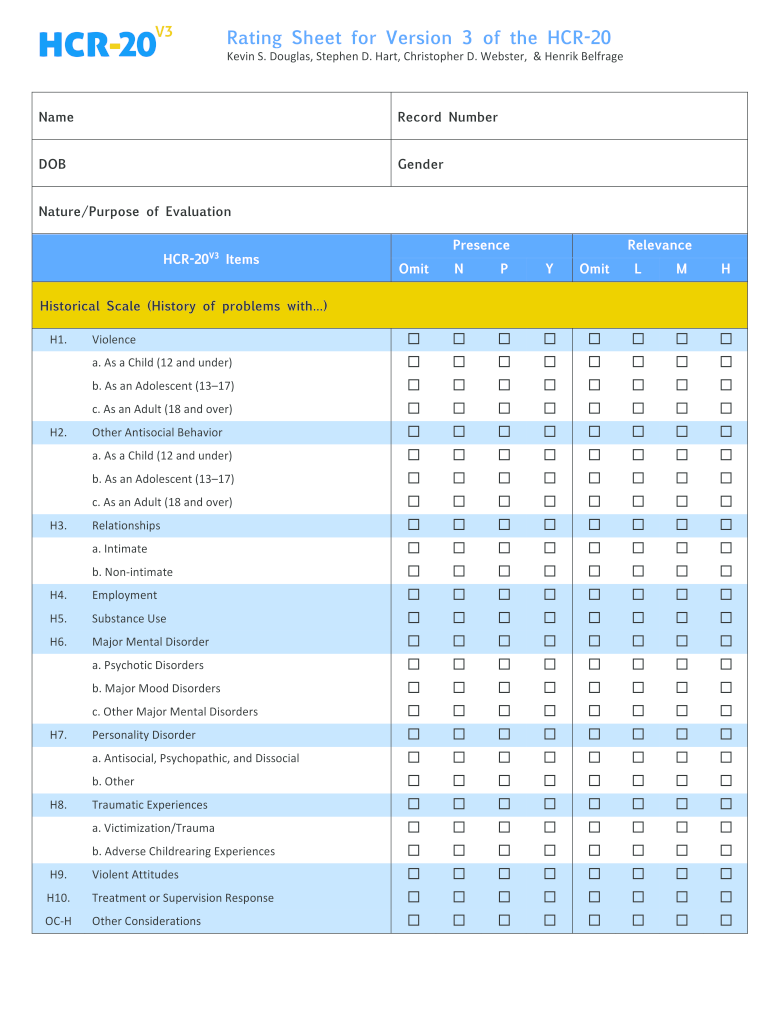







Definition and Meaning of HCR-20
The HCR-20 is a structured risk assessment tool developed for evaluating the risk of violence in individuals, particularly those with a history of mental disorders or antisocial behavior. This instrument is widely utilized in forensic settings and mental health assessments to systematically assess various risk factors that can inform treatment plans and management strategies.
Components of the HCR-20
The HCR-20 consists of two primary sections:
- Historical Factors: These include past violent behavior, demographic information, and history of mental health issues.
- Clinical Factors: This section evaluates current mental health symptoms, risk factors, and treatment responses.
- Risk Management Factors: It assesses the individual’s environment and readiness for change, providing a comprehensive overview of the elements influencing potential violent behavior.
Understanding these components is crucial for evaluators to make informed predictions and help create effective management strategies for individuals under assessment.
How to Use the HCR-20 Assessment Tool
Using the HCR-20 involves several systematic steps to ensure accurate risk assessment and evaluation.
- Gather Relevant Information: Collect historical data on the individual, including previous convictions, psychiatric history, and any incidents of violence.
- Complete the Assessment: Utilize the HCR-20 rating sheet to evaluate each of the 20 items. Each item has specific criteria that must be assessed, focusing on the individual’s past and current behaviors.
- Score Interpretation: Once the assessment is completed, scoring can be carried out. Scores can assist in categorizing individuals into varying levels of risk to inform management plans.
- Review and Document: Compile findings and document the assessment process, providing a clear rationale for the scores assigned.
Evaluators should approach this process with objectivity and thoroughness to ensure the reliability of the results.
Key Elements of the HCR-20 Assessment
An understanding of the elements assessed by the HCR-20 is critical for accurate and effective application.
- Historical Data: Includes prior instances of violence, serious violations of law, and the individual’s socio-economic background.
- Clinical Insights: Involves recent mental health evaluations, substance use issues, and current psychological distress.
- Risk Management Strategies: Evaluates the individual’s current environment, previous compliance with treatment plans, and commitment to rehabilitation.
These elements combine to create a comprehensive view of the individual’s risk profile, assisting evaluators in making informed management and intervention decisions.
Examples of HCR-20 Use Cases
Several scenarios illustrate the practical application of the HCR-20 in various contexts.
- Forensic Assessments: Courts may require HCR-20 assessments for individuals charged with violent crimes to inform sentencing and rehabilitation measures.
- Mental Health Evaluations: Clinicians may employ the HCR-20 to evaluate individuals in psychiatric facilities, providing a structured method to assess the risk of self-harm or harm to others.
- Pre-Release Evaluations: Parole boards might use the HCR-20 to assess the risk of recidivism for incarcerated individuals about to be released, ensuring public safety.
These examples underscore the versatility and importance of the HCR-20 in different settings, highlighting its role in promoting safety while supporting individuals’ rehabilitation.
The Role of HCR-20 in Risk Management
The HCR-20 plays a pivotal role in developing risk management strategies tailored to individual needs and circumstances.
Risk Management Planning
- Tailored Strategies: Based on the assessment, individualized management strategies can be designed, addressing specific factors contributing to risk.
- Strengthening Support Systems: Heightened focus can be placed on enhancing support systems, including family, friends, and treatment resources.
- Monitoring and Evaluation: Setting up a framework for ongoing risk monitoring allows for timely interventions if risk factors escalate, ensuring adaptability to changing circumstances.
Implementing these strategies based on HCR-20 findings can significantly enhance individual outcomes and community safety.
Important Terms Related to HCR-20
Familiarity with key terms associated with the HCR-20 enriches understanding of its application and relevance.
- Risk Assessment: The systematic evaluation of an individual's potential for harmful behavior.
- Violence Risk Factors: Specific characteristics or patterns that have been statistically linked to an increased risk of violent behavior.
- Evidence-Based Practice: Treatment and management decisions based on the best available scientific evidence, enhancing the likelihood of positive outcomes.
These terms form the foundational language of the HCR-20, facilitating clearer communication among professionals using the tool.
Digital vs. Paper Versions of HCR-20
The HCR-20 is available in both digital and paper formats, each with distinct advantages.
Digital Version
- Accessibility and Ease of Use: Allows for easier navigation and integration with other electronic health records.
- Real-Time Updates: Facilitates immediate updates to assessments and scores, ensuring accuracy in documentation.
Paper Version
- Simplicity: Some evaluators prefer paper for ease of use in settings without electronic capabilities.
- Physical Records: Paper assessments can be simpler to file and archive in traditional record-keeping systems.
Evaluators should choose the format that aligns best with their working environment and personal preference to ensure accurate and efficient assessments.
Conclusion
The HCR-20 risk assessment tool is essential for evaluating and managing individuals who may pose a risk of violence. Through a structured approach, clear application guidelines, key definitions, and real-world examples, professionals can effectively utilize the HCR-20 to enhance public safety and support individual rehabilitation.




