Responses plaintiff 2026

Get Form
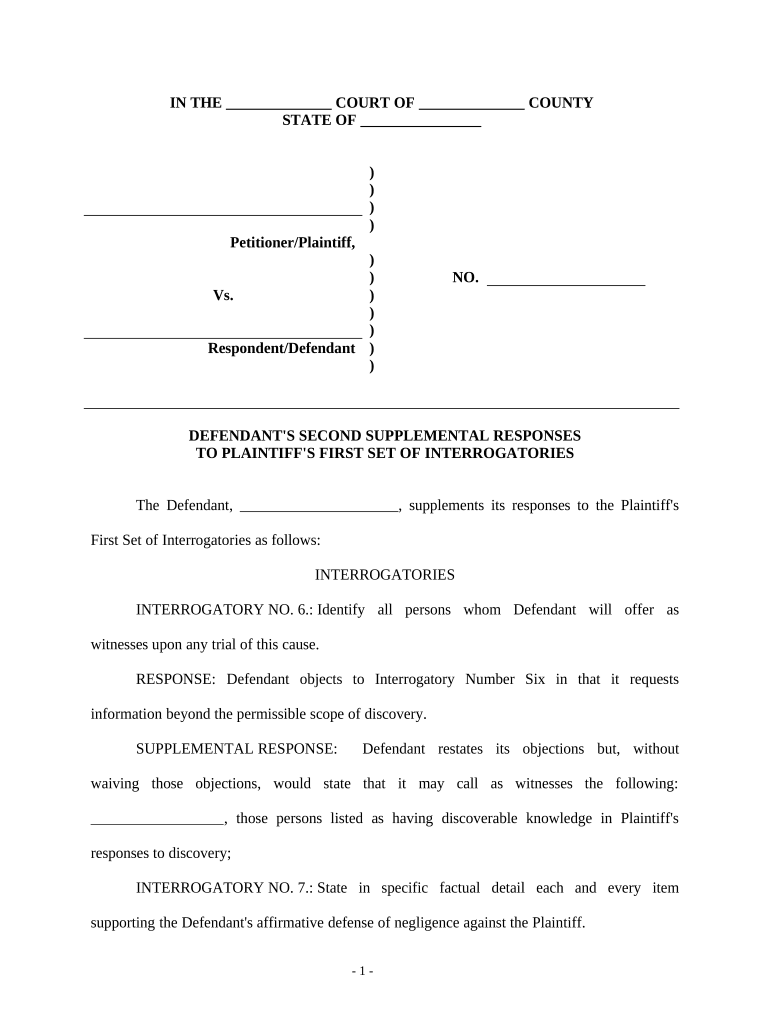
responses plaintiff Preview on Page 1

Here's how it works

01. Edit your form online
Type text, add images, blackout confidential details, add comments, highlights and more.
02. Sign it in a few clicks
Draw your signature, type it, upload its image, or use your mobile device as a signature pad.
03. Share your form with others
Send it via email, link, or fax. You can also download it, export it or print it out.

How to use or fill out responses plaintiff with our platform

Form edit decoration
9.5
Ease of Setup
DocHub User Ratings on G2
9.0
Ease of Use
DocHub User Ratings on G2
  1. Click ‘Get Form’ to open the responses plaintiff document in the editor.
  2. Begin by filling in the court name and county at the top of the form. This sets the context for your document.
  3. In the section labeled 'INTERROGATORIES', carefully read each interrogatory. For example, under INTERROGATORY NO. 6, identify potential witnesses by entering their names in the provided space.
  4. For INTERROGATORY NO. 7, detail any evidence supporting your affirmative defense. Use clear and specific language to describe each item.
  5. Continue through each interrogatory, ensuring that you provide thorough and accurate responses based on your knowledge and available documents.
  6. Once all sections are completed, review your entries for accuracy before saving or exporting your document.

Start using our platform today to streamline your document editing and ensure a smooth completion process!

be ready to get more

Complete this form in 5 minutes or less

Get form

Got questions?

We have answers to the most popular questions from our customers. If you can't find an answer to your question, please contact us.
Contact us
In a civil case, the plaintiff is the party who initiates a lawsuit by filing a complaint against the defendant or respondent (depending on the type of civil case). The plaintiff seeks a legal remedy, such as damages or injunctive relief, and bears the burden of proof to establish the claims made in the action.
To successfully defeat a motion to dismiss, a pro se plaintiff must rebut the following potential assertions: The plaintiffs allegations dont fit the facts of the case. There is a missing element of the claim. There are no factual allegations in the complaint, only conclusions.
(b) The answer to the statement of claim may include any counterclaims against the claimant, cross claims against other respondents, or third party claims, specifying all relevant facts and remedies requested, as well as any additional documents supporting such claim.
Answering the Claims for Relief On a separate page or pages, write a short and plain statement of the answer to the allegations in the complaint. Number the paragraphs. The answer should correspond to each paragraph in the complaint, with paragraph 1 of the answer corresponding to paragraph 1 of the complaint, etc.
Be brief. Answer the allegations in the complaint with one or two sentences. Again remember that the statements you make in your answer can be used as admissions against you. Your response to the allegations in the complaint may admit part of the statement in the specific paragraph and deny part.

Security and compliance

At DocHub, your data security is our priority. We follow HIPAA, SOC2, GDPR, and other standards, so you can work on your documents with confidence.

Learn more
ccpa2
pci-dss
gdpr-compliance
hipaa
soc-compliance

People also ask

How to Write a Complaint Response Email to a Customer Step 1: Validate the Customers Experience. Step 2: Explain how/why the problem happened. Step 3: Offer Some Form of ``Im Sorry. Step 4: Explain how you will resolve the issue (or tell the customer what youve already done).
What is a Plaintiffs Reply? After a plaintiff initiates a lawsuit by filing a statement of claim, the defendant has an opportunity to respond through a Statement of Defence. If the defence introduces new facts or allegations, the plaintiff may need to file a reply.
It emphasises the need for a comprehensive review of the claims made, enlisting pertinent facts, and providing a clear stance on liability. A well-constructed response ought to include an enumeration of the legal grounds upon which the response is predicated, supported by relevant statutory and case law references.

Related links