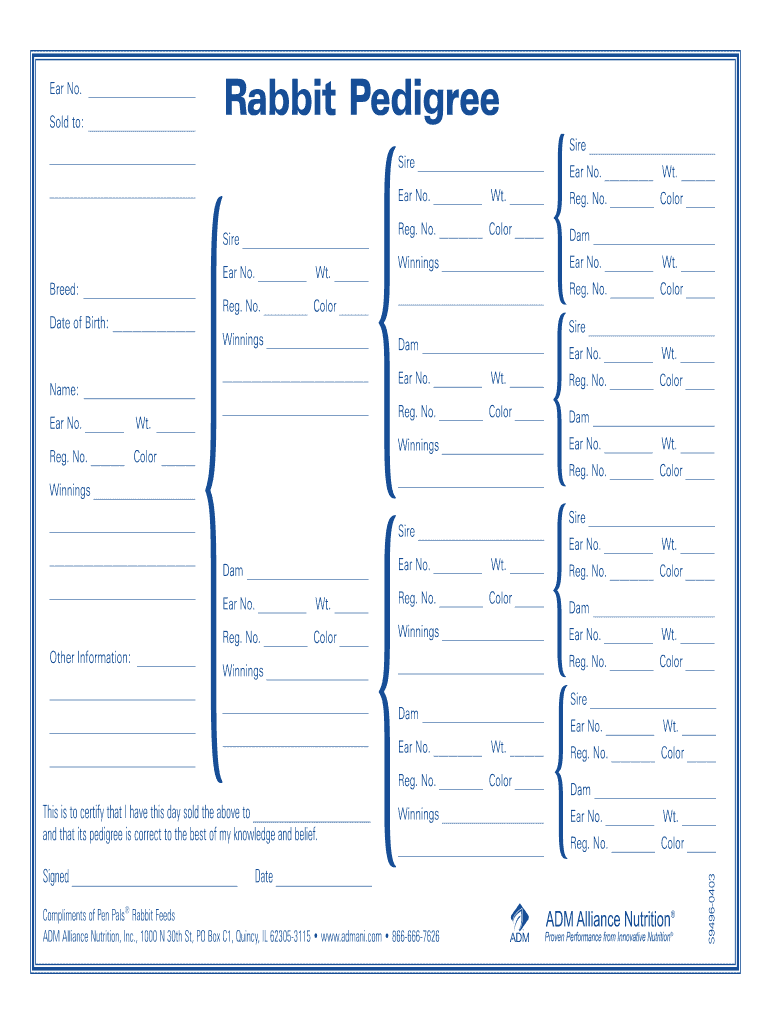





Rabbit pedigree form 2026

Get Form
free rabbit pedigree template Preview on Page 1

Here's how it works

01. Edit your free rabbit pedigree template online
Type text, add images, blackout confidential details, add comments, highlights and more.
02. Sign it in a few clicks
Draw your signature, type it, upload its image, or use your mobile device as a signature pad.
03. Share your form with others
Send rabbit pedigree template via email, link, or fax. You can also download it, export it or print it out.

Definition and Meaning of the Rabbit Pedigree Form

The rabbit pedigree form is a vital document that details the lineage and ancestry of a rabbit. This form may contain specific sections that outline information about the sire (father) and dam (mother), including their registration numbers, weights, coat colors, and any relevant wins in competitions. By establishing the genetic background of a rabbit, this form aids in maintaining breed standards and ensures the animal’s lineage is well-documented for breeding purposes.

Utilizing a rabbit pedigree form is essential for breeders, as it facilitates informed breeding decisions. Breeding rabbits with known pedigrees can minimize hereditary issues, promote desired traits in offspring, and improve the overall health and stability of the breed. The pedigree acts as a historical record, making it easier to track and validate the lineage of future generations.

Key Elements of the Rabbit Pedigree Form

When completing a rabbit pedigree form, it is critical to include specific information to ensure it serves its purpose effectively. Here are the key elements typically outlined in such a form:

  • Sire and Dam Information:

    • Full names and registration numbers
    • Breeder details, including any awards or recognitions
  • Ancestral Background:

    • Complete lineage tracing back several generations
    • Information on any notable achievements or traits
  • Physical Attributes:

    • Weight, color, and any breed-specific characteristics
    • Health history and notable behaviors
  • Registration Information:

    • Official registration details and any relevant registration organization
    • Date of registration to establish lineage authenticity

These elements help not only in breeding decisions but also in guaranteeing breed integrity, making this form crucial for serious breeders.

Steps to Complete the Rabbit Pedigree Form

Filling out a rabbit pedigree form involves several organized steps. Understanding these can simplify the process:

  1. Gather Information:

    • Collect details about the rabbit's lineage, registration, and traits.
    • Reach out to previous owners or breeders for accurate lineage history if needed.
  2. Fill In Sire and Dam Details:

    • List both parents' names and registration numbers.
    • Include any titles, championships, or notable achievements.
  3. Document Ancestry:

    • Create a family tree format that details several generations of lineage.
    • For each ancestor, provide relevant information such as weight and color.
  4. Include Physical Traits:

    • Record the physical characteristics of each rabbit, particularly those of the offspring.
    • Mention any unique behavioral traits that may influence breeding decisions.
  5. Final Verification:

    • Double-check all information for accuracy.
    • Ensure the document is neatly formatted and all sections are completed.

This structured approach ensures that the pedigree form is comprehensive and accurate, benefiting both current and future breeding efforts.

How to Use the Rabbit Pedigree Form

The rabbit pedigree form is utilized in various contexts by breeders, buyers, and registries. The following details how these groups typically employ the form:

  • For Breeders:

    • To structure breeding programs.
    • To select breeding pairs that can yield desirable traits based on lineage.
  • For Buyers:

    • To verify the background and lineage of rabbits before purchasing.
    • To ensure that the rabbit comes from a healthy genetic line.
  • For Clubs and Registries:

    • To maintain accurate records of rabbit breeds and their lineage for competitions.
    • To facilitate the verification process when new registrations are submitted.

Using this form effectively can preserve breed history, support ethical breeding practices, and ensure the health and wellbeing of rabbits within breeding programs.

Examples of Using the Rabbit Pedigree Form

Practical scenarios can provide insight into the utility of the rabbit pedigree form in various contexts:

  1. Breeder Records:

    • A breeder keeping detailed pedigrees for each rabbit ensures they can track genetic traits and make informed decisions about future breedings. This helps maintain breed qualities over time.
  2. Competing Animals:

    • In a rabbit show, a pedigree form may be presented to judges to prove the ancestry of a rabbit, offering its provenance and possibly demonstrating its qualifications for specific categories within competitions.
  3. Health Considerations:

    • If a rabbit develops a hereditary health issue, the pedigree form helps veterinarians trace back the lineage to determine potential genetic factors, thus informing better breeding practices to avoid similar issues in future generations.

These examples highlight not only how common the pedigree form is in the industry but also its importance in fostering healthy breeding practices and preserving breed integrity over time.

be ready to get more

Complete this form in 5 minutes or less

Get form

Got questions?

We have answers to the most popular questions from our customers. If you can't find an answer to your question, please contact us.
Contact us
The 3-3-3 rule for rabbits (and other pets) is a guideline for adjusting to a new home: 3 days for the rabbit to decompress and feel overwhelmed, 3 weeks to learn routines and start showing personality, and 3 months to feel truly secure, bonded, and at home. This rule emphasizes patience, consistency, and providing a safe space for the rabbit to adjust to new sights, sounds, and smells. The phases of adjustment First 3 Days (Decompression): Expect your rabbit to be scared, skittish, or hide. They might not eat much or interact, and may leave territorial droppings. Provide a quiet space, a hidey-box, food, water, and a litter box, and let them decompress on their own terms. Next 3 Weeks (Learning Routine): Your rabbit will start learning the daily schedule (feeding, playtime) and begin to show their true personality. This is a good time to start training and building trust through gentle interactions. First 3 Months (Feeling Secure): Your rabbit should start feeling secure, confident, and bonded with you. They will feel truly at home and display more relaxed, happy behaviors. This video explains the 3-3-3 rule for animal rescue: 1mAmber Melanie SmithYouTube Apr 22, 2025Key takeaways for owners Patience is crucial: Dont rush interactions; let the rabbit set the pace. Consistency is key: Stick to a routine for feeding, playtime, and litter box breaks. Provide a safe haven: A hideaway box is essential for them to feel secure. AI can make mistakes, so double-check responsesSetting Expectations House Rabbit SocietyHouse Rabbit SocietyNew Jersey House Rabbit Society - FacebookNov 7, 2024 The new sights, smells and sounds can be overwhelming and somewhat frightening. Imagine, if you will, being dropped offFacebook
To figure out your rabbits breed, look at its size, ear shape (upright or lop), fur type, and distinct color patterns, as most pet rabbits are mixes, but purebred traits help narrow it down. Check for specific markings like a Dutch saddle, body type (compact, commercial, arch), or fur length (short, woolly) to compare with breeds recognized by organizations like the American Rabbit Breeders Association (ARBA). If unsure, a vet or experienced breeder can offer expert advice, though many pet rabbits are lovable mutts. Key Features to Observe Ears: Are they short and upright (like a Netherland Dwarf), or do they hang down (Lop breeds like Holland Lop, American Fuzzy Lop)?. Body Type: Does it have a compact body, a longer semi-arch (like a Flemish Giant), a full commercial shape (like a Californian), or a unique cylindrical shape (Himalayan)?. Fur: Is it short and dense, or long and woolly (Angora)?. Color Markings: Look for unique patterns like the Dutchs white blaze or saddle, or Himalayans dark points on a white body, as many breeds have specific markings. Size Weight: Small (e.g., Netherland Dwarf), Medium (e.g., Belgian Hare), or Large (e.g., Flemish Giant)?. This video provides a guide on how to identify your rabbits breed: 1mLennon The BunnyYouTube Jun 23, 2018Next Steps Use Visual Guides: Search online for rabbit breed chart or visit sites like Lafeber or The Bunny Lady for photos and descriptions. Consult Experts: A local rabbit rescue, breeder, or rabbit-savvy vet can help identify mixes or purebreds. Watch this video for a more in-depth identification process: 1mThe Rabbit ShowYouTube Oct 11, 2024Remember Many pet rabbits are mixed breeds, so you might not find a perfect match, but you can identify dominant traits. Personality and care needs vary more by individual than by breed, so focus on general rabbit care, say Reddit users and Lafeber Co.. AI can make mistakes, so double-check responsesWhat breed is my rabbit? - RedditJun 30, 2025 Please keep in mind that pet rabbits are usually mixes of indeterminate breeds, and we may not always be able to proviRReddit r/RabbitsWhat Breed Is My Rabbit? Lafeber Co. Small MammalsTake a look at your rabbits profile when he or she is sitting and relaxed. The American Rabbit Breeders Association breaks breedsLafeber
A happy rabbit shows contentment through playful binkies (twisty jumps) and zoomies (fast runs), relaxed body language like flopping onto their side, a healthy appetite, gentle teeth chattering (purring), and affectionate behaviors such as grooming you or nudging for attention, indicating they feel safe and bonded. Body Language Movement Binkies Zoomies: Hopping, twisting, and jumping in the air (binky) or running fast in circles (zoomies) shows joy. Relaxed Flopping: Flops onto their side or back, appearing dead, means they feel completely safe. Curious Exploring: Hopping around and investigating their environment shows comfort. Loafing: Sitting with paws tucked under them, or stretching out fully, indicates relaxation. Nose Twitching: A constant twitching nose shows alertness and happiness. This video shows a rabbit performing a happy binky: 57sThe Bunny LadyYouTube Sep 15, 2020Sounds Affection Teeth Chattering (Purring): A soft, quiet grinding or chattering of teeth when petted or relaxed means contentment. Honking: A faint honking or oinking sound can signal excitement, often around food. Grooming/Licking: Licking you shows affection and that they consider you family. Nudging/Chinning: Rubbing their chin or nudging you claims you as their own and asks for attention. Circling Feet: Running circles around your feet often shows excitement or affection. Watch this video to see and hear a rabbits happy purring: 54sCaptain Jasper Rabbit YouTube Sep 6, 2025Other Signs Healthy Appetite: Eating and drinking well indicates overall health and happiness. Playing with Toys: Tossing toys shows engagement and enjoyment. Seeking Company: Lying near you or wanting to be petted shows they enjoy your presence. If you notice sudden changes or a lack of these behaviors, consult a vet to rule out health issues. AI can make mistakes, so double-check responsesHow do i know my rabbit is happy or not? : r/RabbitsApr 16, 2022RReddit r/Rabbits10 signs your bunny is happy - YouTubeJan 16, 2023 this is nothing to worry about theyre just showing you how excited and happy they are about their. food. they are genYouTube Honeys Bunnies
Rabbits have many predators, with no single biggest, but foxes, coyotes, birds of prey (hawks, owls), and weasels/stoats are consistently cited as major threats in the wild, alongside domestic dogs and cats in suburban areas, all seeing rabbits as a vital food source due to their abundance and vulnerability. Larger predators like wolves and bears may also prey on them, while smaller ones like snakes and raccoons target young or weak rabbits. Key Predators by Type: Mammals: Foxes, coyotes, wolves, lynx, stoats, weasels, raccoons, badgers, feral cats, and dogs. Birds: Hawks, owls, eagles, and crows (especially for young). Reptiles: Snakes (particularly larger ones). Why Theyre Hunted So Often: Prey Animals: Rabbits are a crucial part of the food chain, supporting many carnivores. Easy Targets: Their speed and burrowing instincts help, but they are vulnerable to stealthy hunters and often caught early morning or late night. Opportunistic Hunters: Predators exploit their presence in gardens, fields, and urban spaces. This video shows how a stoat hunts a rabbit: 57sBBCYouTube Nov 17, 2009 In summary, while a coyote might take down a rabbit in the wild and a hawk in the air, there isnt one universal biggest predator; rather, a wide range of animals depend on them for survival, making rabbits prey for nearly any local hunter. AI can make mistakes, so double-check responsesPet rabbit welfare guidance - gov.scot - The Scottish GovernmentApr 6, 2018 Rabbits are prey animals whose predators include foxes, dogs, cats, birds of prey and stoats. This affects how and whatThe Scottish GovernmentWhat are the rabbits predators? - QuoraAug 13, 2015 Mammalian Predators: Common mammalian predators of rabbits include foxes, wolves, lynxes, stoats, weasels, raccoons, cQuora
To fill out a rabbit pedigree template, include the rabbits name, registration number, date of birth, and detailed information about its ancestors, including names and registration numbers of parents and grandparents.

Security and compliance

At DocHub, your data security is our priority. We follow HIPAA, SOC2, GDPR, and other standards, so you can work on your documents with confidence.

Learn more
ccpa2
pci-dss
gdpr-compliance
hipaa
soc-compliance

People also ask

Rabbits apologize through body language, often by lowering their head, nudging, or grooming as a sign of submission and a desire to reconcile after a conflict, with the gesture of touching heads being a common, gentle way to say sorry and ask for grooming to restore bonding, though they dont truly understand complex human remorse. A rabbit might also approach cautiously, lick, or circle your feet, indicating they want peace and connection after a scolding or misunderstanding. Signs of apology between rabbits: Head Touching/Rubbing: A common gesture where one rabbit gently touches or rubs its head against the others, seeking to re-establish peace. Grooming: After a tense moment, licking or grooming the other rabbits head or ears is a strong sign of affection and forgiveness, restoring trust. Lowered Head: A rabbit might lie down with its head flat on the ground as a gesture of deference, showing they know they upset the other and want to be accepted. This video shows how rabbits use head-touching to apologize to each other: 30sLennon The BunnyYouTube Nov 5, 2022Signs of apology to humans: Nudging Licking: A soft nose nudge or a gentle lick can be a way to get attention and signal affection after an incident. Circling Feet: Running in circles around your feet, sometimes called love-bunnies, is a sign of affection and a request for attention or forgiveness. Relaxed Body Language: Approaching slowly with relaxed ears and a general calm demeanor indicates a desire for reconciliation and to rebuild trust. What to do if your rabbit apologizes: Accept the gesture: Gently pet them or stroke their head to show you accept their peace offering. Mirror the behavior: Offer a gentle head touch or a stroke to reinforce the bond. Understand their limits: If the apology isnt accepted (e.g., they run away), give them space and try again later. AI can make mistakes, so double-check responsesHOW DO RABBITS APOLOGIZE TO HUMANS?Jun 18, 2025 you thats an invitation. its not rude its trust in rabbit terms its offering the vulnerable side of their body a gYouTube Hop NotchDid you know that bunnies apologise to each other by touching Nov 5, 2025 Did you know that bunnies apologise to each other by touching heads? Similar to when they ask to be groomed by their paFacebook
Rabbits need unlimited access to grass and hay, so they shouldnt ever be left without food. However, if its an emergency and theres no other choice, then they can go up to 12 hours without eating.Aug 2, 2024

free rabbit pedigree pdf