




01. Edit your nikah nama pdf online
Type text, add images, blackout confidential details, add comments, highlights and more.

Type text, add images, blackout confidential details, add comments, highlights and more.

Draw your signature, type it, upload its image, or use your mobile device as a signature pad.

Send nikah nama form via email, link, or fax. You can also download it, export it or print it out.
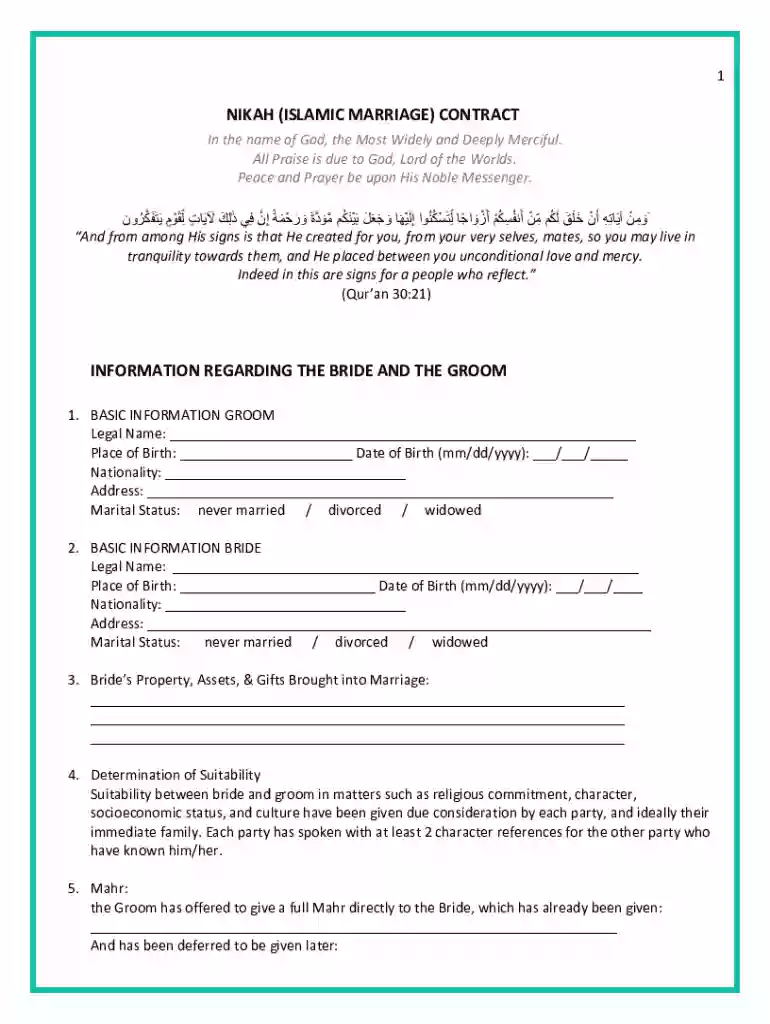
The Nikah Nama, or marriage contract, serves as a vital document for Muslim marriages, especially within various cultural contexts. The English version of this form provides clarity for those who may not be fluent in Urdu or other native languages. It contains essential information regarding the marriage details, rights, and obligations of both parties. The form ensures that all necessary components of the marriage are documented securely, fulfilling legal and cultural requirements.
Several critical elements are incorporated into the Nikah Nama form in English. Each section carefully captures essential information to validate the marriage contract.
Including these key elements supports legal validity and social acknowledgment of the marriage.
Accessing the Nikah Nama form is straightforward, making it accessible for those preparing for marriage.
These methods allow individuals to choose the path that best suits their needs and circumstances.
Completing the Nikah Nama form necessitates careful attention to detail to ensure accuracy.
This structured approach ensures that the form is filled correctly and legally binding.
The Nikah Nama serves as a critical legal document within the context of Islamic marriages. It provides evidence of marriage for various legal purposes, including:
Understanding its legal implications is vital to ensuring the rights of both parties are upheld in the event of disputes.
A comprehensive grasp of specific terminology enhances understanding and application of the Nikah Nama.
Familiarity with these terms aids in navigating the marriage process and understanding the document's implications.
The Nikah Nama form is predominantly used by:
Recognizing these users facilitates a better comprehension of the document's purpose and significance in various scenarios.


Practical scenarios showcase the Nikah Nama's application and importance.
Such examples illustrate the multipurpose nature of the Nikah Nama, emphasizing its role as a foundational document in marital agreements.
At DocHub, your data security is our priority. We follow HIPAA, SOC2, GDPR, and other standards, so you can work on your documents with confidence.
An Islamic marriage certificate, often referred to as a Nikah Nama or Nikah Certificate, is a formal document that verifies a marriage conducted
Fill Out the Application Form: Obtain the official NADRA Marriage Registration Certificate Form from the center or download it from the NADRA website.


