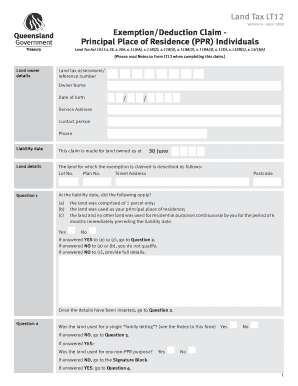
Hazard tree assessment 2026

Get Form
tree risk assessment report example Preview on Page 1

Here's how it works

01. Edit your tree risk assessment report example online
Type text, add images, blackout confidential details, add comments, highlights and more.
02. Sign it in a few clicks
Draw your signature, type it, upload its image, or use your mobile device as a signature pad.
03. Share your form with others
Send basic tree risk assessment form fillable via email, link, or fax. You can also download it, export it or print it out.

How to use or fill out hazard tree assessment with our platform

Form edit decoration
9.5
Ease of Setup
DocHub User Ratings on G2
9.0
Ease of Use
DocHub User Ratings on G2
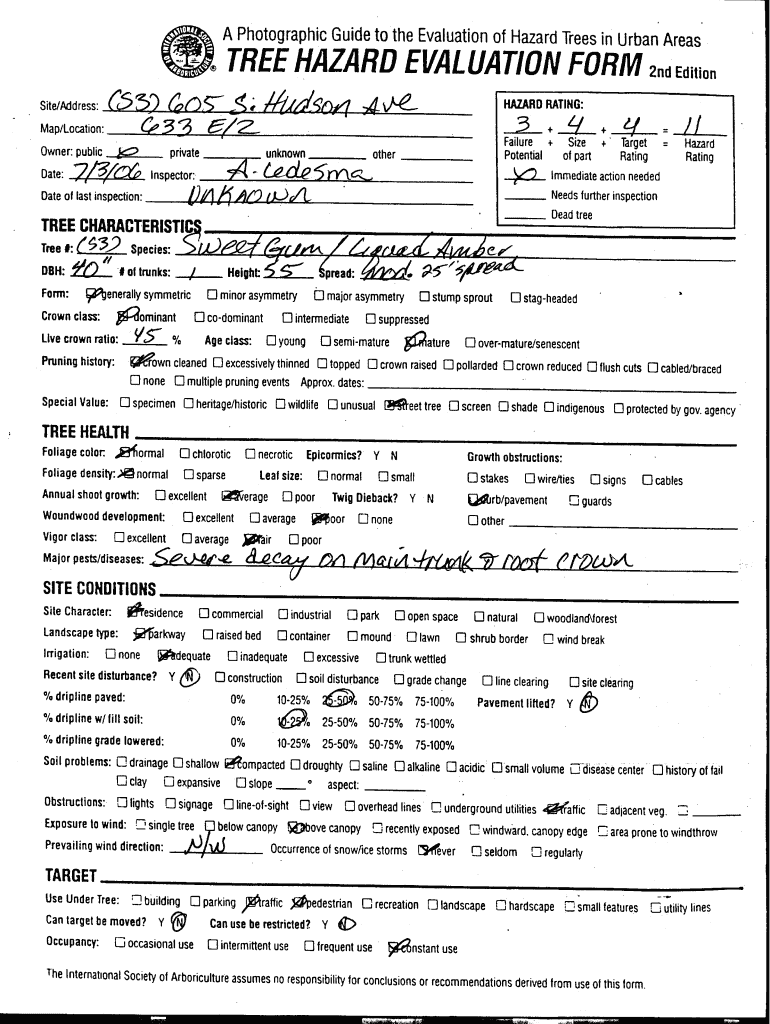
  1. Click ‘Get Form’ to open the hazard tree assessment in the editor.
  2. Begin by entering the site address and map location in the designated fields. This information is crucial for identifying the specific area being assessed.
  3. Fill in the owner details, selecting whether it is public or private property. This helps in determining responsibility for any necessary actions.
  4. Assess and record the hazard rating by evaluating potential failure points of the tree. Use the provided scale to indicate immediate action needed or if further inspection is required.
  5. Complete sections on tree characteristics, health, and defects. Pay attention to foliage color, density, and any visible pests or diseases that may affect tree stability.
  6. Evaluate site conditions including soil problems and obstructions that could impact tree health. Document any recent disturbances that may have affected the area.
  7. Finally, review your entries for accuracy before saving or sharing your completed assessment using our platform’s export features.

Start your hazard tree assessment today for free and ensure safety in your environment!

be ready to get more

Complete this form in 5 minutes or less

Get form

Got questions?

We have answers to the most popular questions from our customers. If you can't find an answer to your question, please contact us.
Contact us
The air risk staff generally follows a basic four step risk assessment process, including hazard identification, exposure assessment, dose-response assessment, and risk characterization, as described below.
There are many types of hazards - chemical, ergonomic, physical, and psychosocial, to name a few - which can cause harm or adverse effects in the workplace.
A professional tree risk assessment involves several key steps: Visual Inspection: Arborists perform detailed observations to identify visible signs of damage or disease. Advanced Diagnostics: Tools like resistance drilling and drone inspections are used to uncover hidden issues within the tree and its root system.
Tree risk assessments rely on identifying and assessing structural condition to assess failure potential. Defect is the term we commonly use to identify a condition or characteristic that is structurally weak or contributes to a structural weakness.
A hazard tree is a tree that has a structural defect that makes it likely to fail in whole or in part. Falling trees are an ever-present hazard when traveling or camping in the forest, yet too often we are unaware of the risks associated with defective trees.

Security and compliance

At DocHub, your data security is our priority. We follow HIPAA, SOC2, GDPR, and other standards, so you can work on your documents with confidence.

Learn more

People also ask

Hazards are broken down into four main categories: physical, chemical, biological, and psychosocial (also known as psychological). Each category has multiple hazards.
Create awareness of hazards and risks. Identify who may be at risk (e.g., workers, cleaners, visitors, contractors, the public, etc.). Determine whether a control program is required for a particular hazard. Determine if existing control measures are adequate or if more should be done.
There are four main types of risk assessments that organisations commonly utilize: qualitative, quantitative, subjective, and objective. In this article, we will explore each type of risk assessment in-depth, discussing their importance, processes, benefits, and limitations.

tree assessment form