


Create your Utility Easement Legal Document from scratch

Start Building Now
Title decoration

Here's how it works

01. Start with a blank Utility Easement Legal Document
Open the blank document in the editor, set the document view, and add extra pages if applicable.
02. Add and configure fillable fields
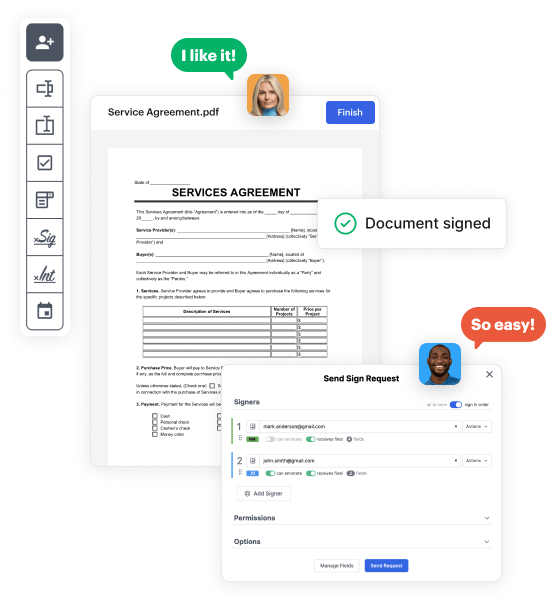
Use the top toolbar to insert fields like text and signature boxes, radio buttons, checkboxes, and more. Assign users to fields.
03. Distribute your form
Share your Utility Easement Legal Document in seconds via email or a link. You can also download it, export it, or print it out.

A simple tutorial on how to set up a professional-looking Utility Easement Legal Document

Form edit decoration

Step 1: Sign in to DocHub to begin creating your Utility Easement Legal Document.

First, log in to your DocHub account. If you don't have one, you can easily sign up for free.

Step 2: Navigate to the dashboard.

Once logged in, head to your dashboard. This is your primary hub for all document-focused processes.

Step 3: Kick off new document creation.

In your dashboard, choose New Document in the upper left corner. Select Create Blank Document to build the Utility Easement Legal Document from a blank slate.

Step 4: Incorporate template fillable areas.

Add numerous elements like text boxes, photos, signature fields, and other fields to your template and designate these fields to particular users as necessary.

Step 5: Personalize your form.

Personalize your template by including guidelines or any other crucial information utilizing the text feature.

Step 6: Go over and modify the form.

Thoroughly review your created Utility Easement Legal Document for any inaccuracies or needed adjustments. Make use of DocHub's editing features to perfect your form.

Step 7: Share or export the form.

After completing, save your file. You can choose to retain it within DocHub, transfer it to various storage options, or forward it via a link or email.


be ready to get more

Build your Utility Easement Legal Document in minutes

Start creating now

Got questions?

We have answers to the most popular questions from our customers. If you can't find an answer to your question, please contact us.
Contact us
Execution: The Easement must be executed on behalf of both the Grantor and the Grantee, and all signatures must be acknowledged by a Notary Public. Recording: The Easement must be recorded in the Office of the County Recorder of the county in which the Land is located.
When termed as a utility easement, it means a utility companys right to access and control the portion of another persons land that is located near utility facilities and structures (i.e. utility poles, transformers, overhead or underground electrical lines).
Right-of-way maintenance responsibilities may be specified in the express creation of an easement. When not specified, the responsibility is generally upon the easement holder and the owner of the servient estate has no obligations.
The easements shall be at least 15 feet in width and may be coincident with utility easements. Where a subdivision is traversed by a legal drain, the easement for the drain shall be in ance with the Indiana Code requirements for legal drains.
An easement holder is deemed to have all rights necessarily incident to the enjoyment of the easement and its servitude, and the owner of the servient estate may not obstruct, interfere, or otherwise encroach upon the easement holders use and enjoyment.
be ready to get more

Build your Utility Easement Legal Document in minutes

Start creating now

Related Q&A to Utility Easement Legal Document

Utility easements are used to construct and maintain utilities. Drainage easements are used to construct and maintain storm water utilities, surface water flow and detention.
The agreements that create these easements are generally included in the deed of the property. Most of these easements already exist and simply need to be tolerated by the property owners. Tennessee utility easement laws dont open the utility companies to use the property in any way they like.
Private road easements shall be at least sixty feet (60) in width. Common driveway easements shall be at least forty feet (40) in width. Cut and fill slopes and stormwater systems adjacent to roads and driveways must either be shown as easements or rights of way in favor of the maintenance entity.

Additional resources on building your forms