Handle Mechanics Forms effortlessly online

Document management can stress you when you can’t locate all of the documents you need. Fortunately, with DocHub's considerable form collection, you can find everything you need and swiftly take care of it without switching among software. Get our Mechanics Forms and begin working with them.

Using our Mechanics Forms using these basic steps:

  1. Check Mechanics Forms and select the form you need.
  2. Preview the template and click on Get Form.
  3. Wait for it to upload in the online editor.
  4. Modify your form: include new information and pictures, and fillable fields or blackout certain parts if necessary.
  5. Complete your form, preserve modifications, and prepare it for delivering.
  6. When all set, download your form or share it with other contributors.

Try out DocHub and browse our Mechanics Forms category with ease. Get your free account today!

Commonly Asked Questions about Mechanics Forms

There are two main types of mechanics: classical mechanics and quantum mechanics.
What are examples of mechanics? Examples of classical mechanics include one-dimensional kinematics, projectile motion, gravitation, momentum, torque, dynamic equilibrium, conservation of energy, and statics. Examples of quantum mechanics include the photoelectric effect, quantum computing, and atomic clocks.
From the Basics: A Guide to Basic Tools for Mechanics Pliers, such as needle-nose, slip joint, or groove joint pliers, provide versatility for gripping and turning tasks. A mechanics tool set is a fundamental addition, offering a range of tools like combination wrenches, ratchets, and sockets.
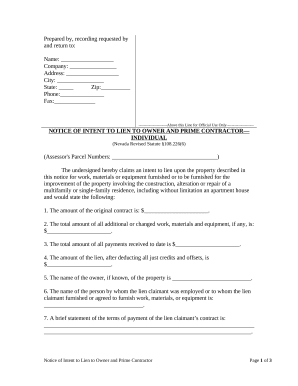
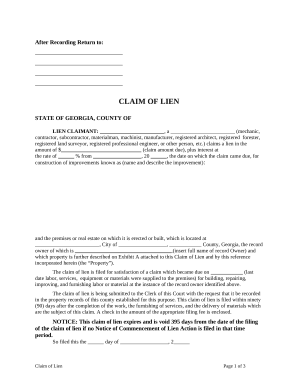
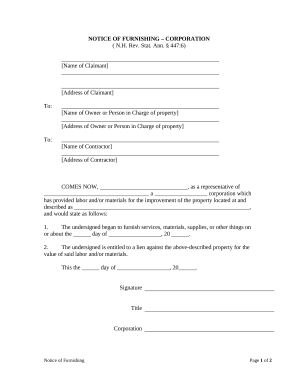
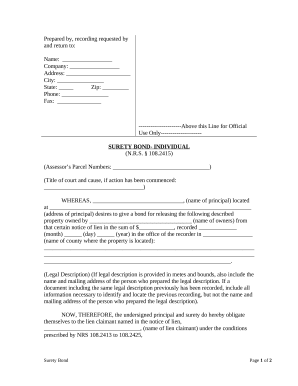
If contractors and suppliers dont get paid on a construction project in New York, they can file a mechanics lien to secure payment. A mechanics lien is a legal tool that provides the unpaid party with a security interest in the property.
Mechanics may be divided into three branches: statics, which deals with forces acting on and in a body at rest; kinematics, which describes the possible motions of a body or system of bodies; and kinetics, which attempts to explain or predict the motion that will occur in a given situation.
Mechanics is the physical science that deals with the effects of forces on the state of motion or rest of solid, liquid, or gaseous bodies. The field may be divided into the mechanics of rigid bodies, the mechanics of deformable bodies, and the mechanics of fluids.
There are three types of mechanics: Classical Mechanics. Classical mechanics is an actual hypothesis portraying the movement of perceptible articles, from machine parts to projectiles, and galactic items. Quantum Mechanics. Quantum mechanics is a basic hypothesis in material science. Relativistic Mechanics.
There are many branches of classical mechanics, such as: statics, dynamics, kinematics, continuum mechanics (which includes fluid mechanics), statistical mechanics, etc. Mechanics: A branch of physics in which we study the object and properties of an object in form of a motion under the action of the force.