
Employee Guidelines
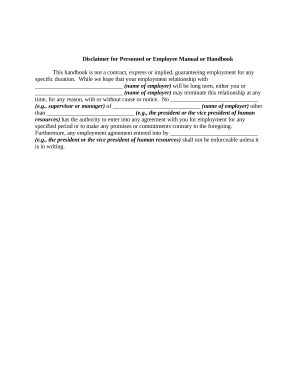
Get and manage Employee Guidelines online
Improve your file managing using our Employee Guidelines collection with ready-made form templates that suit your requirements. Get the document template, modify it, fill it, and share it with your contributors without breaking a sweat. Start working more effectively with your forms.
How to use our Employee Guidelines:
- Open our Employee Guidelines and find the form you want.
- Preview your document to ensure it’s what you want, and click Get Form to begin working on it.
- Change, include new text, or point out important information with DocHub tools.
- Fill out your form and preserve the modifications.
- Download or share your form template with other recipients.
Examine all the possibilities for your online file administration with our Employee Guidelines. Get your free free DocHub account right now!
Video Guide on Employee Guidelines management

Commonly Asked Questions about Employee Guidelines
How enforceable is an employee handbook?
Generally speaking, an employee handbook is not a legally binding contract unless it explicitly states that it is. However, certain statements in the handbook can be interpreted as contractual promises if they are specific enough and imply mutual obligations between employer and employee.
What are the guidelines for the employee handbook?
The employee handbook policy should include: Workplace policies: Descriptions of the workplace environment, including confidentiality, harassment prevention, and workplace safety. Code of conduct: Guidelines on employee behavior, including dress code, cyber security, conflict of interest, and workplace relationships.
What are rules for employees called?
As a small business owner, you need to inform your employees about your policies, procedures, and expectations . Your employees should also know their rights and protections under state and federal law. This information should be consolidated into a written document, called an employee handbook.
Do small companies need an employee handbook?
Benefits of a Well-Written Handbook An employee handbook makes a valuable tool for small businesses. It provides clear guidelines on company policies and procedures, as well as the expectations of employees. This helps to ensure that everyone is on the same page and working towards the same goals.
Does a small business need an employee handbook?
No matter what size your business, an employee handbook is essential. Employee handbooks define company policies and list procedures for addressing employee questions and issues. Defining your policies and procedures up front will help your business run more smoothly and prevent conflicts down the line.
Does every company have a handbook?
While companies arent required to create a handbook, employers are required to notify their employees of certain rights. Most employers choose to do this in state-specific employee handbooks. Heres an example for a California employee handbook requirements.
How do you write employee guidelines?
Key Sections of an Employee Handbook Introduction Welcome. Welcome new employees and write briefly about how the company began and whos in charge. Workplace Commitments. Company Policies and Procedures. Employment Classification. Attendance Policies. Leave Policies. Work Performance. Discipline Policy.
Included What does an employee handbook contain?
Welcome letter and introduction to the company, such as its history, mission, values, and culture. Equal Employment Opportunity Commission (EEOC) statement. Workplace policies and procedures, including when it comes to hiring, attendance, payroll, breaks, paid time off, cybersecurity, privacy, and anti-discrimination. 7 Employee Handbook Examples You Should Use - TriNet trinet.com insights employee-handbook- trinet.com insights employee-handbook-
Is not having an employee handbook illegal?
What Happens If My Company Doesnt Have an Employee Handbook? The law does not require employers to develop an employee handbook. (One exception: California law requires all employers to adopt a written policy prohibiting sexual harassment.)