




01. Edit your 2023 form 940 fillable online
Type text, add images, blackout confidential details, add comments, highlights and more.

Type text, add images, blackout confidential details, add comments, highlights and more.

Draw your signature, type it, upload its image, or use your mobile device as a signature pad.

Send 2023 form 940 via email, link, or fax. You can also download it, export it or print it out.
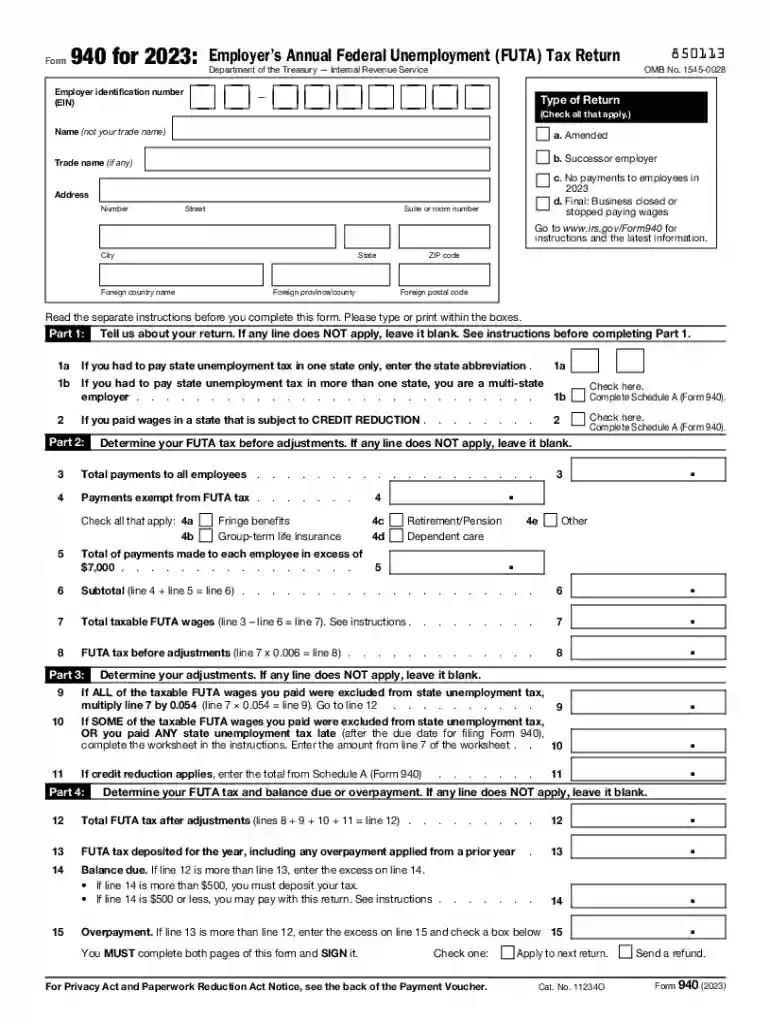
The "Annual IRS Unemployment Tax Forms Confirm FUTA" primarily refers to the IRS Form 940, which is essential for employers to report their annual Federal Unemployment Tax Act (FUTA) obligations. FUTA is a federal tax that employers must pay to fund state workforce agencies. The tax is used to administer unemployment programs, providing temporary financial assistance to workers who have lost their jobs.
Employers report their FUTA tax liability annually, which includes details such as total payments made to employees and necessary adjustments for calculating the correct tax owed. This form is comprehensive and serves as a crucial element for maintaining compliance with federal unemployment tax regulations.
Gather Required Information:
Follow Form Instructions:
Fill Out Employer Information:
Report Employee Wages:
Calculate Taxable FUTA Wages:
Compute Total FUTA Tax:
Check for Overpayments:
Business owners and employers across the United States are required to file Form 940 if they pay wages subject to FUTA tax. This includes most businesses with employees, irrespective of their size or type, including corporations, partnerships, and sole proprietorships. Understanding how to file this form assists in staying compliant with federal regulations and avoiding penalties.
The annual deadline for filing Form 940 is January 31 following the tax year. For employers who have deposited all tax due on time, the deadline is extended to February 10. It is vital to adhere strictly to these deadlines to avoid penalties.
Form 940 can be filed both electronically and through the traditional mail system:
Failure to file Form 940 or provide accurate information can result in substantial penalties. Non-compliance with deadlines or underpayment of taxes owed leads to fees and interest. Employers should diligently adhere to IRS regulations and consult tax professionals if uncertainties arise.
Understanding the breadth and function of Form 940 is essential for employers to fulfill their legal obligations under the FUTA regulations, ensuring their workforce protection, and maintaining proper compliance with federal laws. By following structured guidance and seeking expert advice when needed, businesses can navigate the complexities associated with this important annual filing.
We've got more versions of the 2023 form 940 fillable form. Select the right 2023 form 940 fillable version from the list and start editing it straight away!
| Versions | Form popularity | Fillable & printable |
|---|---|---|
| 2025 | 4.6 Satisfied (51 Votes) | |
| 2024 | 4.5 Satisfied (59 Votes) | |
| 2023 | 4.1 Satisfied (47 Votes) | |
| 2022 | 4.5 Satisfied (23 Votes) | |
| 2021 | 4.8 Satisfied (91 Votes) | |
| 2020 | 4.4 Satisfied (177 Votes) | |
| 2019 | 4.4 Satisfied (191 Votes) | |
| 2018 | 4.2 Satisfied (140 Votes) | |
| 2017 | 4.4 Satisfied (124 Votes) | |
| 2016 | 4.4 Satisfied (645 Votes) | |
| 2015 | 4 Satisfied (33 Votes) | |
| 2014 | 4 Satisfied (22 Votes) | |
| 2014 | 4.5 Satisfied (29 Votes) | |
| 2013 | 4.4 Satisfied (52 Votes) | |
| 2012 | 4.4 Satisfied (45 Votes) |
At DocHub, your data security is our priority. We follow HIPAA, SOC2, GDPR, and other standards, so you can work on your documents with confidence.
Use Form 940 to report your annual Federal Unemployment Tax Act (FUTA) tax. Only employers pay FUTA tax. Do not collect or deduct FUTA tax from your employees
If you deposited your total FUTA tax when due, check Yes if you paid all state unemployment contributions by February 12, 2001.
Although the IRS eliminated the Forms 1040EZ and 1040A beginning for 2018 returns, Forms 1040A and 1040EZ were discontinued beginning in 2018. New tax rates


