




01. Edit your form 940 2021 online
Type text, add images, blackout confidential details, add comments, highlights and more.

Type text, add images, blackout confidential details, add comments, highlights and more.

Draw your signature, type it, upload its image, or use your mobile device as a signature pad.

Send 940 form 2021 via email, link, or fax. You can also download it, export it or print it out.
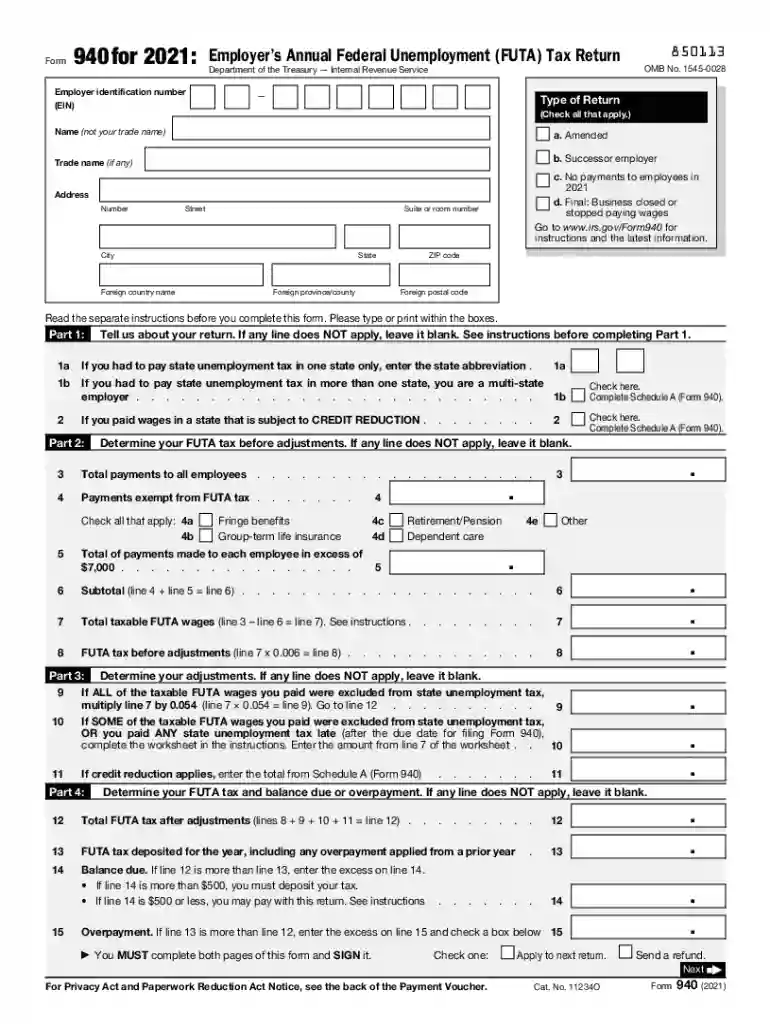
Form 940 for 2021, officially titled the Employer's Annual Federal Unemployment (FUTA) Tax Return, serves a critical role for employers in the United States. This form ensures compliance with Federal Unemployment Tax Act requirements by reporting an employer's annual FUTA tax liability. Employers who pay significant amounts in wages must complete this form to detail various financial data points, including total payments to employees and state unemployment taxes paid. As a result, Form 940 facilitates the accurate calculation and reporting of unemployment taxes, contributing to the consistent funding of unemployment benefits for workers across the nation.
Employers utilize Form 940 for 2021 to accurately report their FUTA tax obligations. The form requires comprehensive data, such as the total wages paid to employees, adjustments, and any unemployment taxes already paid to states. To ensure accurate reporting, employers should:
By following these steps, employers can ensure compliance and avoid errors that could result in penalties or additional taxes.
Completing Form 940 requires meticulous attention to detail. Below is a step-by-step guide tailored to support employers in accurately finishing the form:
Employers must observe these steps meticulously to prevent errors and ensure the smooth filing of their tax return.
Understanding the key components of Form 940 ensures precise completion. Major sections include:
Employers should familiarize themselves with these elements to accurately report and calculate FUTA tax obligations.
Legal compliance is a pivotal reason for using Form 940. Employers must file this form to legally satisfy federal regulations under the FUTA. Properly filing Form 940:
Remaining informed about their legal obligations helps employers maintain regulatory compliance and secure business operations.
Timely submission of Form 940 is critical. The standard deadline for filing is January 31 following the end of the tax year. If all FUTA tax payments have been submitted on time and in full throughout the year, employers may qualify for a 10-day extension, moving the deadline to February 10. Employers should maintain records of all submission deadlines to ensure timely filing and avoid penalties.
Failing to file Form 940 can result in significant complications and financial penalties for employers. Penalties may include:
To avoid these penalties, employers should ensure that all form information is complete, accurate, and submitted by the specified deadlines.
Employers can file Form 940 both digitally and in paper format. Each method has advantages:
Digital Filing:
Paper Filing:
Select the method that best supports your business operation, considering access to resources and preference for technology use.
Form 940 is pertinent to various business types across industries. Those most likely to file include:
Understanding how Form 940 applies to these business kinds helps companies manage tax liability efficiently.


We've got more versions of the form 940 2021 form. Select the right form 940 2021 version from the list and start editing it straight away!
| Versions | Form popularity | Fillable & printable |
|---|---|---|
| 2025 | 4.6 Satisfied (51 Votes) | |
| 2024 | 4.5 Satisfied (59 Votes) | |
| 2023 | 4.1 Satisfied (47 Votes) | |
| 2022 | 4.5 Satisfied (23 Votes) | |
| 2021 | 4.8 Satisfied (91 Votes) | |
| 2020 | 4.4 Satisfied (177 Votes) | |
| 2019 | 4.4 Satisfied (191 Votes) | |
| 2018 | 4.2 Satisfied (140 Votes) | |
| 2017 | 4.4 Satisfied (124 Votes) | |
| 2016 | 4.4 Satisfied (645 Votes) | |
| 2015 | 4 Satisfied (33 Votes) | |
| 2014 | 4 Satisfied (22 Votes) | |
| 2014 | 4.5 Satisfied (29 Votes) | |
| 2013 | 4.4 Satisfied (52 Votes) | |
| 2012 | 4.4 Satisfied (45 Votes) |
At DocHub, your data security is our priority. We follow HIPAA, SOC2, GDPR, and other standards, so you can work on your documents with confidence.
Jan 11, 2022 Form 940 Due Date. Form 940 is due by January 31. If an employer made deposits on time and in full, they may file Form 940 by February 10.Read more
To avoid a penalty, make your payment with your 2021. Form 940 only if your FUTA tax for the fourth quarter. (plus any undeposited amounts from earlier quarters)Read more
Feb 28, 2026 Indicate by check mark if the registrant is a well-known seasoned issuer, as defined in Rule 405 of the Securities Act. ☒ Yes ☐ No.Read more


