




01. Edit your form 940 2013 online
Type text, add images, blackout confidential details, add comments, highlights and more.

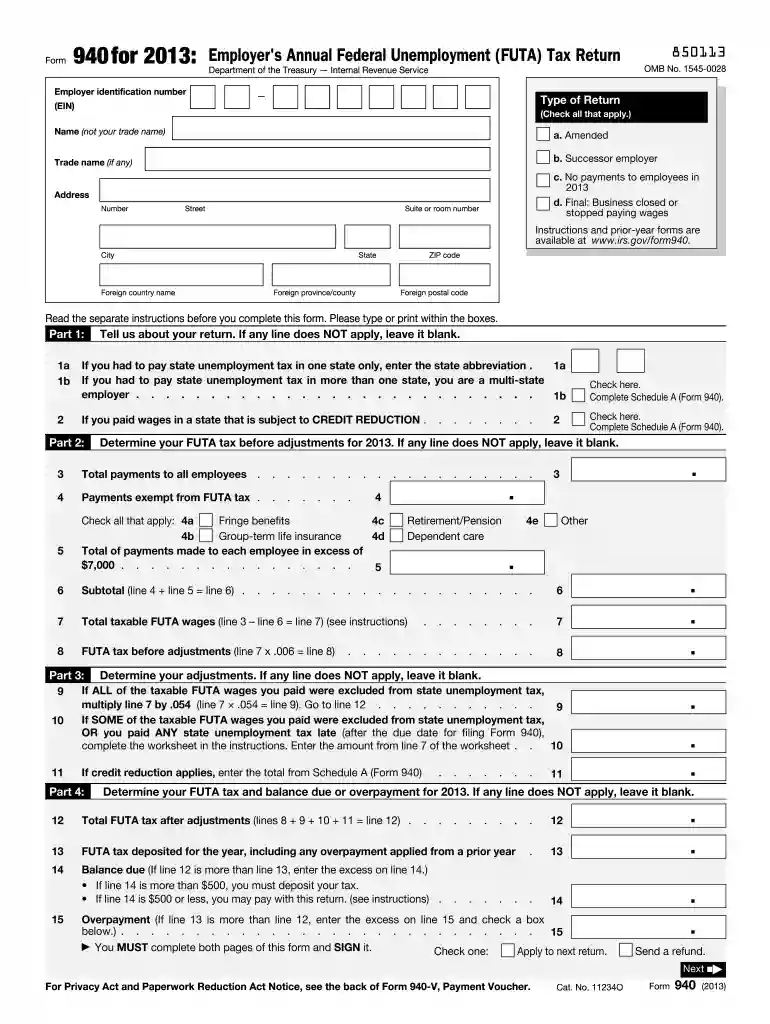
Type text, add images, blackout confidential details, add comments, highlights and more.

Draw your signature, type it, upload its image, or use your mobile device as a signature pad.

Send form 940 for 2022 via email, link, or fax. You can also download it, export it or print it out.
Form 940 for the year 2013, commonly referred to as the "Employer's Annual Federal Unemployment (FUTA) Tax Return," is a crucial document required by the IRS. It is used by employers to report their federal unemployment tax liability. The form plays a significant role in the unemployment compensation system, as it helps finance programs for unemployed workers.
Completing Form 2013 Federal involves several steps, each requiring careful attention to detail. Here’s a step-by-step guide:
Gather Required Information:
Complete Each Section:
Review Instructions:
Understanding essential terminology aids in accurate form completion. Here are key terms associated with Form 2013 Federal:
The IRS provides comprehensive guidelines for completing Form 2013 Federal. These guidelines clarify compliance requirements and ensure accurate filing:
Filing by the designated deadline is mandatory to avoid penalties:
Submitting Form 2013 Federal necessitates gathering the right documentation to streamline the filing process:
Multiple submission avenues are available, allowing employers to choose the most convenient method:
Failure to accurately file Form 2013 Federal on time comes with implications:
Form 2013 Federal is essential for specific entities:
Understanding the function and requirements of Form 2013 Federal ensures compliance and a smooth filing experience.


We've got more versions of the form 940 2013 form. Select the right form 940 2013 version from the list and start editing it straight away!
| Versions | Form popularity | Fillable & printable |
|---|---|---|
| 2025 | 4.6 Satisfied (51 Votes) | |
| 2024 | 4.5 Satisfied (59 Votes) | |
| 2023 | 4.1 Satisfied (47 Votes) | |
| 2022 | 4.5 Satisfied (23 Votes) | |
| 2021 | 4.8 Satisfied (91 Votes) | |
| 2020 | 4.4 Satisfied (177 Votes) | |
| 2019 | 4.4 Satisfied (191 Votes) | |
| 2018 | 4.2 Satisfied (140 Votes) | |
| 2017 | 4.4 Satisfied (124 Votes) | |
| 2016 | 4.4 Satisfied (645 Votes) | |
| 2015 | 4 Satisfied (33 Votes) | |
| 2014 | 4 Satisfied (22 Votes) | |
| 2014 | 4.5 Satisfied (29 Votes) | |
| 2013 | 4.4 Satisfied (52 Votes) | |
| 2012 | 4.4 Satisfied (45 Votes) |
At DocHub, your data security is our priority. We follow HIPAA, SOC2, GDPR, and other standards, so you can work on your documents with confidence.





by W Form Cited by 1 Purpose. Complete Form W-4 so that your employer can withhold the correct federal income tax from your pay. Consider completing a new Form.Read more
As with all State and Federal tax matters, please consult with your tax advisor. Deduct up to $2,500 for each account/beneficiary you hold in each plan.Read more


