






Definition and Purpose of IRS Form 940 for 2017
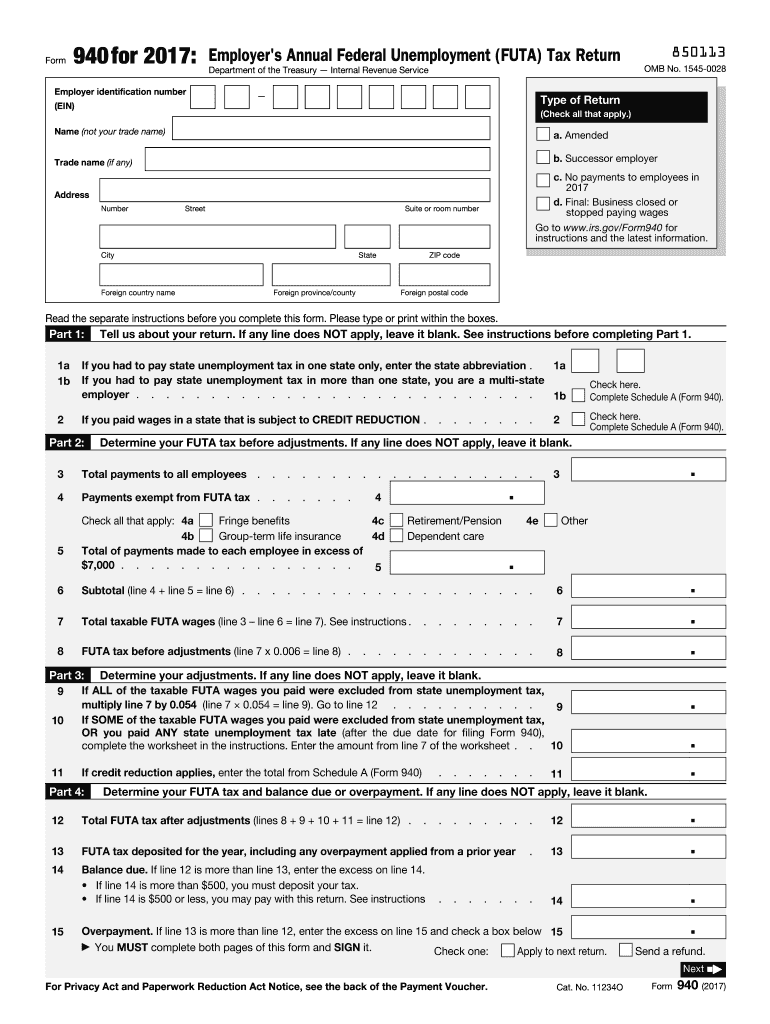
Form 940 for 2017 is the Employer's Annual Federal Unemployment (FUTA) Tax Return, required by the Internal Revenue Service (IRS). It is specifically designed to assist employers in reporting their FUTA tax liability. The primary objective of the FUTA tax is to fund unemployment programs administered by each state. The form contains several sections allowing employers to report their identification data, calculate their tax based on wages paid to employees, and claim allowable adjustments related to state unemployment contributions.
Key Sections of Form 940
- Employer Identification Information: Includes critical data such as the employer's name, address, and Employer Identification Number (EIN).
- Tax Calculation: Instructions for computing the annual FUTA tax liability, which is generally 6% of the first $7,000 paid to each employee.
- State Unemployment Tax Adjustments: A section to record any reductions in FUTA tax due to state unemployment tax credits.
- Payment Details: Provides guidelines on reporting payments made throughout the taxable year, including any carried forward or applied credits.
Steps to Complete IRS Form 940 for 2017
-
Assemble Required Information: Gather details such as EIN, total wages paid, state unemployment tax rates, and any previous FUTA overpayments or credits.
-
Fill Out Identification Details: Enter the employer's name, address, and EIN in the designated section.
-
Calculate Taxable Wages: Determine the amount of wages subject to FUTA tax, typically the first $7,000 paid to each employee.
-
Compute the FUTA Tax Liability: Use the wages subject to FUTA, multiplied by the applicable tax rate, to find the total tax due.
-
Adjust for State Taxes: Record any applicable credits for contributions to state unemployment funds to reduce the FUTA liability.
-
Finalize Payment Section: Summarize total taxes due, any credits or payments made, and determine if additional taxes are owed or if a refund is due.
Who Typically Uses IRS Form 940 for 2017
Applicable Entities
- Corporations: Large businesses that are often required to file due to the number of employees.
- Partnerships and LLCs: Both types of businesses, especially if they have employees, must assess whether they meet the criteria for FUTA tax annual reporting.
- Non-Profit Organizations: Even organizations exempt from income tax may be liable for FUTA tax if they have paid employees.
Individual Scenarios
- Small Business Owners: Sole proprietors with employees need to file if they paid wages subject to the FUTA tax.
- Independent Contractors: While they usually do not qualify for unemployment benefits, those who hire employees need to comply with FUTA requirements.
Filing Deadlines and Important Dates for IRS Form 940
- Annual Deadline: The form is due to the IRS by January 31 following the end of the tax year.
- Quarterly Deposits: If the FUTA tax liability surpasses $500, it is mandatory for employers to make quarterly deposits.
- Extended Due Dates: Employers making timely deposits may be eligible to file by February 10, offering a short grace period.
Penalties for Non-Compliance with Form 940
Consequences of Non-Filing
-
Failure to File Penalties: A significant fine can be imposed if the form is not submitted by the deadline.
-
Interests on Unpaid Taxes: Accumulation of interest on any outstanding FUTA tax liability begins accruing immediately post-deadline.
Additional Compliance Considerations
- Correcting Mistakes: Unintentional errors should be corrected promptly to avoid penalties.
- Advice and Guidance: Consider consulting with a tax professional to ensure compliance and accurate reporting.
State-Specific Rules Affecting IRS Form 940
Variability Across States
-
Credit Reductions: States with outstanding federal loans may see reduced credits, altering FUTA tax liabilities.
-
State Unemployment Contributions: Different states have varying rates, which impact overall credits and therefore influence the federal tax liability.
Practical Example
- California: With historical credit reduction issues, employers may need to adjust the final tax liability upwards, effectively increasing the FUTA tax payment.
How to Obtain IRS Form 940 for 2017
-
Download from IRS Website: The form is readily available as a PDF through the official IRS website for employers.
-
Tax Software Integration: Utilizing systems like DocHub or TurboTax streamlines the form preparation process by automatically completing sections using imported data.
-
Order by Mail: Physical copies can be ordered directly from the IRS for those preferring traditional paper filing.
Important Terms Related to IRS Form 940
-
Federal Unemployment Tax Act (FUTA): Legislation mandating employer-paid unemployment taxes to fund state-administered unemployment programs.
-
Employer Identification Number (EIN): A unique identifier assigned to businesses for tax reporting purposes.
-
Credit Reduction States: States with federal loan balances affecting employer tax credits and increasing liability.