




01. Edit your 940 mailing address online
Type text, add images, blackout confidential details, add comments, highlights and more.

Type text, add images, blackout confidential details, add comments, highlights and more.

Draw your signature, type it, upload its image, or use your mobile device as a signature pad.

Send it via email, link, or fax. You can also download it, export it or print it out.
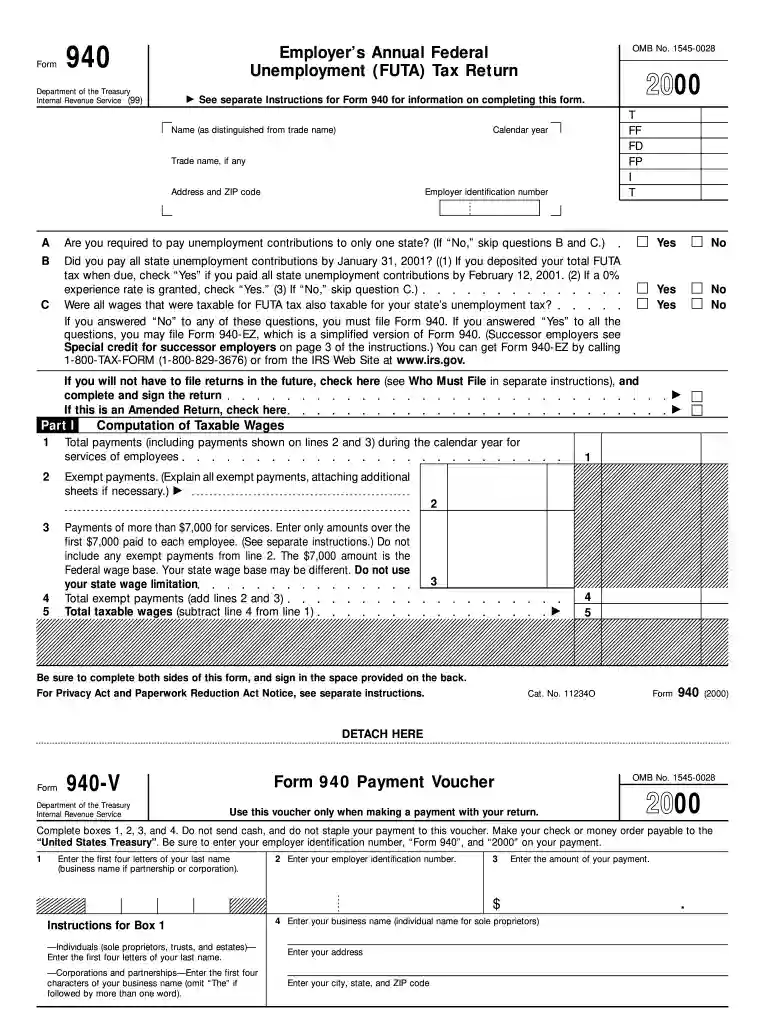
Form 940, the Employer’s Annual Federal Unemployment (FUTA) Tax Return, is used by employers to report their federal unemployment taxes. This document is crucial for ensuring compliance with federal tax obligations related to unemployment benefits provided to workers. For the year 2000, the 940 form's structure and requirements remained consistent with its purpose of calculating and reporting the annual FUTA tax, which helps fund the unemployment account that supports unemployed workers.
Employers must calculate their total FUTA tax liability for the year using the 2000 940 form. The process involves reporting wages paid to employees and subtracting exemptions such as state unemployment contributions. The form also allows for determining the amount of tax owed or refund due. Employers need to understand their total wages and calculate the taxable amount correctly to file the form accurately. It's essential to follow the instructions embedded in the form to avoid underpayments or overpayments.
Employers can obtain the 2000 940 form from the IRS website, office supply stores, or through a tax professional. Many payroll software programs also come with built-in templates for past and current forms. Ensuring you have the correct version for the year is essential, as tax forms can undergo periodic changes that impact their validity and utility.
Several crucial sections appear on Form 940, including:
Knowing these elements ensures that businesses provide comprehensive information that leads to an accurate calculation of the FUTA tax liability.
The IRS provides guidelines to ensure that employers accurately complete and file Form 940. It emphasizes the need for accuracy in the reporting of wages and proper adjustments for exemptions. Employers must also align their filing with established IRS deadlines to avoid penalties. The IRS offers resources like publications and help lines to assist with complex questions or specific scenarios that may arise.
Employers must file the 940 form annually, with a due date typically on January 31 following the reporting year. If all FUTA taxes are paid on time, the due date extends to February 10. Staying aware of these deadlines is crucial to maintain compliance and avoid late filing penalties.
Failure to file Form 940 on time or submit correct payments can result in penalties. The IRS may impose fines for late submissions, incorrect calculations, or failure to pay the necessary tax amounts. It's imperative for employers to understand these consequences and ensure timely and accurate filings to minimize or avoid penalties.
Employers have the option to file the 940 form electronically or on paper. Digital filing offers advantages such as online record-keeping, faster processing, and immediate confirmation from the IRS. However, some businesses may prefer paper filings for records or administrative reasons. Understanding the pros and cons of each option can help employers choose the best method for their needs.
These aspects provide great convenience and reliability, essential for businesses that prioritize streamlined operations.
Programs like TurboTax and QuickBooks offer compatibility with various IRS forms, including Form 940. These platforms provide step-by-step assistance for completing the form, calculating the tax liability, and filing it directly. This compatibility is particularly beneficial for businesses without dedicated tax professionals, allowing them to ensure compliance with ease.
We've got more versions of the 940 mailing address form. Select the right 940 mailing address version from the list and start editing it straight away!
| Versions | Form popularity | Fillable & printable |
|---|---|---|
| 2025 | 4.6 Satisfied (51 Votes) | |
| 2024 | 4.5 Satisfied (59 Votes) | |
| 2023 | 4.1 Satisfied (47 Votes) | |
| 2022 | 4.5 Satisfied (23 Votes) | |
| 2021 | 4.8 Satisfied (91 Votes) | |
| 2020 | 4.4 Satisfied (177 Votes) | |
| 2019 | 4.4 Satisfied (191 Votes) | |
| 2018 | 4.2 Satisfied (140 Votes) | |
| 2017 | 4.4 Satisfied (124 Votes) | |
| 2016 | 4.4 Satisfied (645 Votes) | |
| 2015 | 4 Satisfied (33 Votes) | |
| 2014 | 4 Satisfied (22 Votes) | |
| 2014 | 4.5 Satisfied (29 Votes) | |
| 2013 | 4.4 Satisfied (52 Votes) | |
| 2012 | 4.4 Satisfied (45 Votes) |
At DocHub, your data security is our priority. We follow HIPAA, SOC2, GDPR, and other standards, so you can work on your documents with confidence.
Oct 30, 2025 940.TWU.2000 (940.898.2000). Institute of Health Sciences-Houston Center 6700 Fannin St Houston, TX 77030 (Houston Center Google Map) 713.794.Read more
2. Payments of more than $7,000 for services. Enter only amounts over the first $7,000 paid to each employee. (See separate instructions.) Do not.Read more
Jun 1, 2000 BIOCHLOR DATABASE. June, 2000. I. BIOCHLOR CHLORINATED SOLVENT PLUME DATABASE. TABLE OF CONTENTS. Page No. EXECUTIVE SUMMARY.Read more


