


Create your Civil Law Form from scratch

Start Building Now
Title decoration

Here's how it works

01. Start with a blank Civil Law Form
Open the blank document in the editor, set the document view, and add extra pages if applicable.
02. Add and configure fillable fields
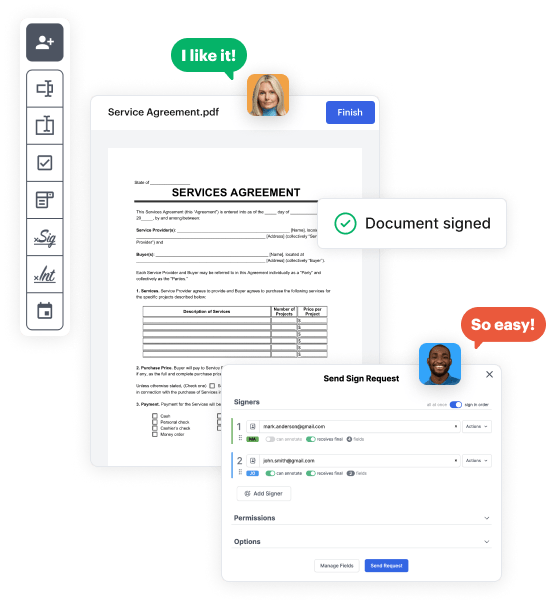
Use the top toolbar to insert fields like text and signature boxes, radio buttons, checkboxes, and more. Assign users to fields.
03. Distribute your form
Share your Civil Law Form in seconds via email or a link. You can also download it, export it, or print it out.

Design your Civil Law Form in a matter of minutes

Form edit decoration

Step 1: Access DocHub to set up your Civil Law Form.

Begin by accessing your DocHub account. Utilize the advanced DocHub functionality at no cost for 30 days.

Step 2: Navigate to the dashboard.

Once logged in, go to the DocHub dashboard. This is where you'll create your forms and manage your document workflow.

Step 3: Design the Civil Law Form.

Hit New Document and select Create Blank Document to be taken to the form builder.

Step 4: Design the form layout.

Use the DocHub tools to add and configure form fields like text areas, signature boxes, images, and others to your form.

Step 5: Insert text and titles.

Include needed text, such as questions or instructions, using the text tool to lead the users in your form.

Step 6: Customize field properties.

Adjust the properties of each field, such as making them required or formatting them according to the data you plan to collect. Assign recipients if applicable.

Step 7: Review and save.

After you’ve managed to design the Civil Law Form, make a final review of your form. Then, save the form within DocHub, send it to your selected location, or share it via a link or email.


be ready to get more

Build your Civil Law Form in minutes

Start creating now

Got questions?

We have answers to the most popular questions from our customers. If you can't find an answer to your question, please contact us.
Contact us
The complaint is the document that sets out the Plaintiffs charges against the Defendant.
A civil action begins when a party to a dispute files a complaint, and pays a filing fee required by statute. A plaintiff who is unable to pay the fee may file a request to proceed in forma pauperis.
Commencing an Action. A suit is commenced by the purchase of an index number in the City Court Clerks Office. Once an index number has been purchased, the litigant has 120 days to serve the summons and complaint.
The first step in a civil action is the filing of the complaint with the clerk or judge. Service of process upon the defendant is not essential to commencement of the action, but Rule 4(h) does require service of the summons and complaint within 120 days after the filing of the complaint.
Complete the Civil complaint form fully and neatly. Be sure to provide enough information so the person you are suing knows why he or she is being sued. Once the complaint is completed, you must file it at the correct Magisterial District Court office. Be prepared to pay the filing fees.
be ready to get more

Build your Civil Law Form in minutes

Start creating now

Related Q&A to Civil Law Form

You will also be required to pay a filing fee ($15 for claims of $1,000 or less; $20 for claims more than $1,000 to $5,000). You must pay the fee by cash, certified check, money order or bank check made out to the Clerk of the Civil Court. The court does not accept personal checks.
To begin a civil lawsuit in federal court, the plaintiff files a complaint with the court and serves a copy of the complaint on the defendant.
Commencing an Action A suit is commenced by the purchase of an index number in the City Court Clerks Office. Once an index number has been purchased, the litigant has 120 days to serve the summons and complaint.

Additional resources on building your forms