Create your Dress code policy Canada Form from scratch

Start Building Now
Title decoration

Here's how it works

01. Start with a blank Dress code policy Canada Form
Open the blank document in the editor, set the document view, and add extra pages if applicable.
02. Add and configure fillable fields
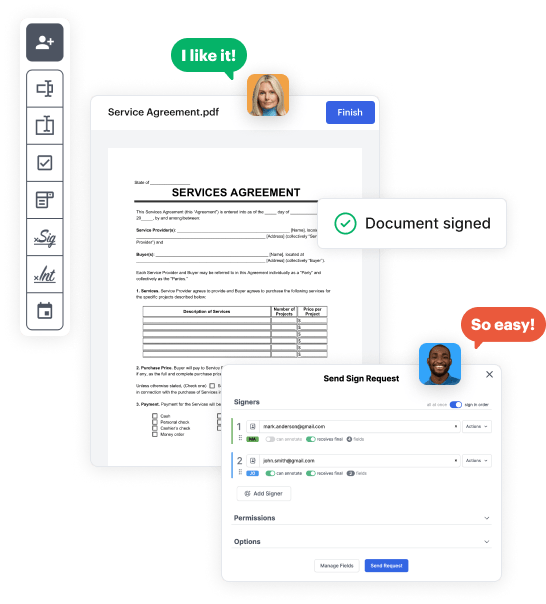
Use the top toolbar to insert fields like text and signature boxes, radio buttons, checkboxes, and more. Assign users to fields.
03. Distribute your form
Share your Dress code policy Canada Form in seconds via email or a link. You can also download it, export it, or print it out.

A detailed walkthrough of how to design your Dress code policy Canada Form online
Form edit decoration

Step 1: Start with DocHub's free trial.

Go to the DocHub website and register for the free trial. This provides access to every feature you’ll require to create your Dress code policy Canada Form without any upfront cost.

Step 2: Navigate to your dashboard.

Log in to your DocHub account and navigate to the dashboard.

Step 3: Initiate a new document.

Hit New Document in your dashboard, and select Create Blank Document to design your Dress code policy Canada Form from the ground up.

Step 4: Utilize editing tools.

Add various fields such as text boxes, radio buttons, icons, signatures, etc. Arrange these fields to match the layout of your form and assign them to recipients if needed.

Step 5: Organize the form layout.

Rearrange your form in seconds by adding, moving, removing, or combining pages with just a few clicks.

Step 6: Create the Dress code policy Canada Form template.

Turn your freshly crafted form into a template if you need to send multiple copies of the same document multiple times.

Step 7: Save, export, or share the form.

Send the form via email, share a public link, or even post it online if you want to collect responses from more recipients.

be ready to get more

Build your Dress code policy Canada Form in minutes

Start creating now

Got questions?

We have answers to the most popular questions from our customers. If you can't find an answer to your question, please contact us.
Contact us
10 Tips For Revamping Your Companys Dress Code Demonstrate Fair And Respectful Policies. Balance Personal Expression With Brand Representation. Establish A Baseline Of Inclusivity, Diversity And Autonomy. Explain The Why Of The Company Dress Code. Provide A Short List Of Banned Items.
Provide Basic Guidelines. Provide basic guidelines such as business casual, but less hard fast rules. Match The Culture. Communicate The Why Keep It Simple. Model The Dress Code. Reflect The Organization. Set Expectations And Gather Input. Aim To Empower Your People.
Describing the expected level of formality in attire (e.g., business professional, business casual). Provide examples of acceptable clothing items (suits, blouses, ties, skirts, etc.). If applicable, outline guidelines for casual or business casual attire on designated days.
To Create and Enforce a Workable Dress Code for Your Team: Simplify the Rules. Many dress codes become unenforceable because theyre bogged down by minutiae. Keep it Gender-Neutral. Include Clear Consequences. Enforce the Dress Code Consistently.
For example, we may require employees to wear semi-formal attire for an event. Then, both male and female employees should wear suits, ties, white shirts and appropriate shoes. Our company may also introduce [dress-down Friday] when employees can wear more casual clothing like jeans, simple blouses and boots.
be ready to get more

Build your Dress code policy Canada Form in minutes

Start creating now

Related Q&A to Dress code policy Canada Form

A dress code policy is a document that outlines the appropriate dress code for a companys employees. Dress codes vary from company to company and are dependent on a companys culture and industry type.
Dress codes should set out what is and what isnt acceptable, and should cover not only outfits but individual garments, accessories and footwear. Policies should be as all-encompassing as possible to avoid any potentially embarrassing situations. Dress codes should be easily interpretable and written in plain English.
Explain why the policy exists and how it benefits both employees and the company. Provide resources to help employees find appropriate clothing and attire for the workplace. Set expectations for all employees so they know whats expected of them when dressing for work.

Additional resources on building your forms