




01. Edit your form online
Type text, add images, blackout confidential details, add comments, highlights and more.

Type text, add images, blackout confidential details, add comments, highlights and more.

Draw your signature, type it, upload its image, or use your mobile device as a signature pad.

Send it via email, link, or fax. You can also download it, export it or print it out.
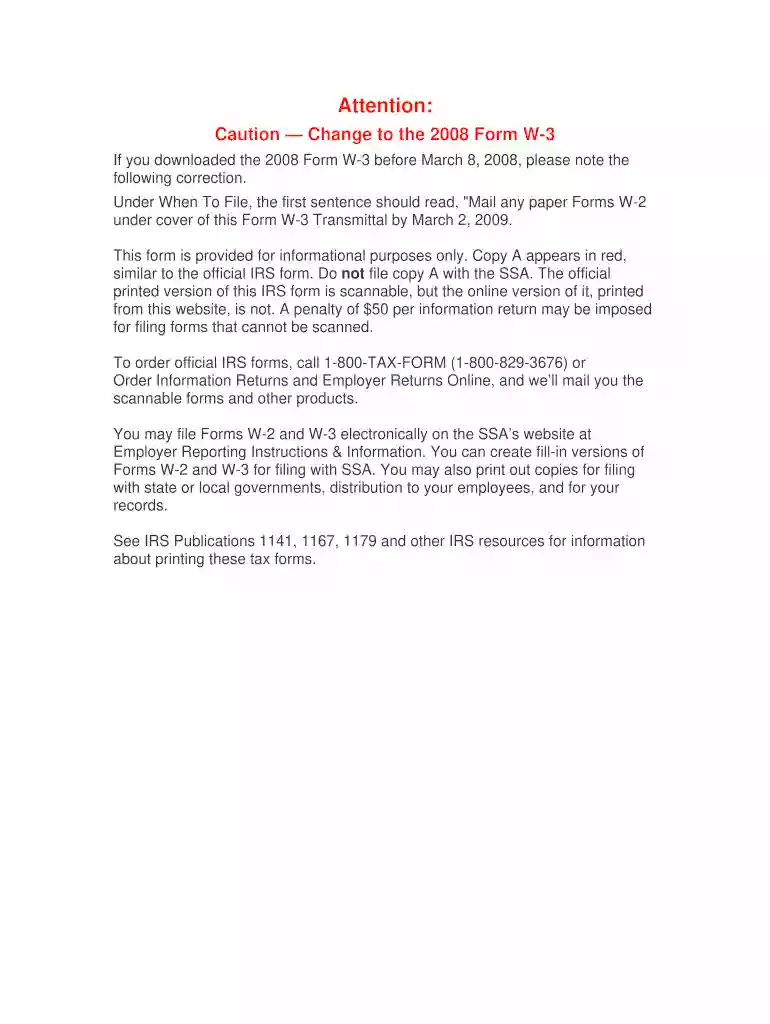
The 2008 Form W-3, also known as the Transmittal of Wage and Tax Statements, serves as a summary document for the IRS and the Social Security Administration (SSA) to accompany Form W-2 submissions. It consolidates the information from multiple W-2 forms and is essential for employers to report wages, tips, and other compensation paid to employees. It includes total amounts for taxable wages, Social Security wages, Medicare wages, withheld federal income tax, Social Security tax, and Medicare tax.
Gather Necessary Information: Collect all copies of the employee W-2 forms and ensure all information is accurate. Necessary details include employer identification number (EIN), total wages, Social Security amounts, and Medicare figures.
Complete Employer Information: Enter the employer's name, address, and EIN accurately. Check for any changes from previous years to avoid discrepancies.
Fill in Totals for All W-2s: Aggregate the totals from all W-2 forms for each category, such as taxable wages, Social Security wages, and Medicare wages. Ensure no category is left uncalculated.
Calculate Federal Taxes: Add up all federal income, Social Security, and Medicare taxes withheld across all employee W-2 forms, ensuring accuracy to match with detailed employee data.
Include Contact Person: Provide details of a key contact at the company, including their name and phone number, should there be any queries from the SSA or IRS.
Sign and Date the Form: An authorized company representative must sign and date the form to certify its accuracy before submission.
Order from the IRS Website: Access the IRS's official website to request official, machine-readable versions of the form for accurate processing.
Download from the SSA: Use the Social Security Administration's resources to obtain a downloadable copy of the form. Ensure it's formatted for electronic filing if this is the chosen method for submission.
Request from Tax Professionals: Tax preparation professionals and services can also provide the form. Engaging with a certified public accountant (CPA) may streamline the acquisition and filing process.
Deadline for Submission: The deadline to submit the 2008 W-3 form, alongside all associated W-2 forms, is February 28, 2009, if filing by paper, or March 31, 2009, if filing electronically. Late submissions can result in penalties.
Correction Deadlines: If corrections to a submitted Form W-3 are necessary, they should be made promptly, acknowledging any additional dates specified by the IRS for amendments and corrections.
Electronic Filing: Employers are encouraged to file electronically through the SSA's Business Services Online (BSO) platform. This method is efficient and reduces the likelihood of processing errors.
Paper Filing: Employers choosing to submit by mail must ensure that all forms are machine-readable, as per IRS guidelines, to avoid processing issues.
Failure to file the 2008 W-3 form accurately and on time can lead to penalties from the IRS. These penalties can escalate based on the size of the business and the severity of the oversight. Ensuring that all information is complete and correct upon initial submission helps mitigate these risks.
The 2008 Form W-3 is primarily used by employers, ranging from small businesses to large corporations, that must report the annual wages and taxes withheld from their employees. It is essential for businesses of all sizes who have issued W-2 forms to employees within the year 2008.


Adherence to IRS-provided guidelines is crucial when completing and submitting Form W-3. The IRS mandates the format in which information should be submitted, especially when using electronic filing options. Following these guidelines ensures compliance and timely processing.
While the federal requirements for the W-3 form are standardized across the U.S., some states may have additional reporting obligations. Employers should check for any state-specific guidelines or additional data submission requirements to ensure full compliance at both state and federal levels.
We've got more versions of the 2008 w 3 form form. Select the right 2008 w 3 form version from the list and start editing it straight away!
| Versions | Form popularity | Fillable & printable |
|---|---|---|
| 2024 | 4.8 Satisfied (22 Votes) | |
| 2023 | 4.2 Satisfied (48 Votes) | |
| 2022 | 4.9 Satisfied (31 Votes) | |
| 2021 | 4.8 Satisfied (161 Votes) | |
| 2020 | 4.4 Satisfied (217 Votes) | |
| 2019 | 4.4 Satisfied (274 Votes) | |
| 2018 | 4.4 Satisfied (268 Votes) | |
| 2017 | 4.4 Satisfied (830 Votes) | |
| 2016 | 4.3 Satisfied (48 Votes) | |
| 2015 | 4 Satisfied (43 Votes) | |
| 2014 | 4.1 Satisfied (48 Votes) | |
| 2013 | 4 Satisfied (54 Votes) | |
| 2012 | 4 Satisfied (27 Votes) | |
| 2011 | 4.2 Satisfied (71 Votes) | |
| 2010 | 4.2 Satisfied (30 Votes) |
Yes, a typed name is accepted as a legitimate electronic signature when you add it to your form using a compliant solution like DocHub. Simply import your 2008 w 3 form to our editor, click Sign in the top tool pane → Create your signature → Type your name in the proper tab, and select how it will appear on your document.
If you use Chrome, there are two simple ways to edit your 2008 w 3 form online. First, go to the DocHub website, add your document, and edit it using our toolbar. You can also set up our Chrome extension and edit any document by dragging and dropping it in your web browser window.
At DocHub, your data security is our priority. We follow HIPAA, SOC2, GDPR, and other standards, so you can work on your documents with confidence.
A Form W-3 Transmittal is completed only when paper Copy A of. Form(s) W-2, Wage and Tax Statement, are being filed. Do not file. Form W-3 alone. Do not fileRead more
We ask for the information on Form W-3PR to carry out the Internal Instead, see Where to file, on page 3. PR), verify that your EIN is correct in box cRead more
Dec 20, 2016 This Conservation Management Plan (Plan) delineates reasonable actions we, the U.S. Fish and Wildlife. (USFWS), believe will contribute toRead more


