



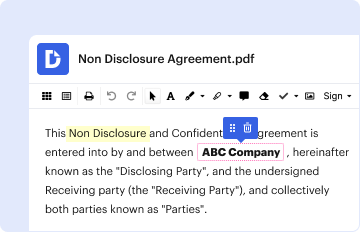
01. Edit your 2015 w3 form online
Type text, add images, blackout confidential details, add comments, highlights and more.

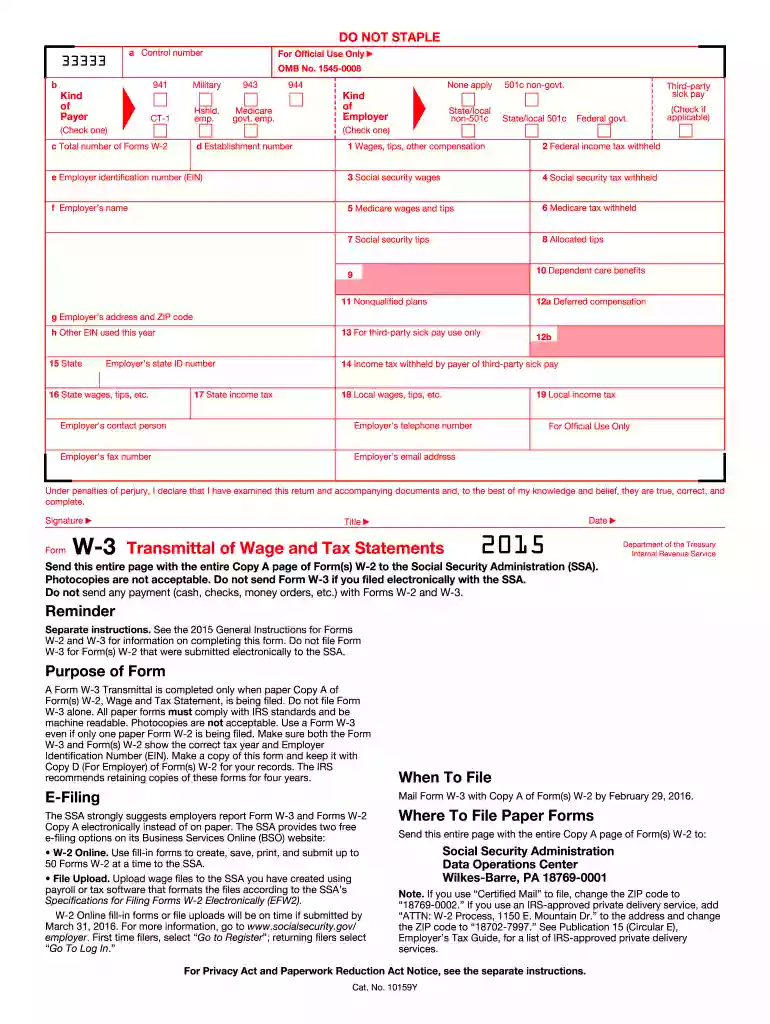
Type text, add images, blackout confidential details, add comments, highlights and more.
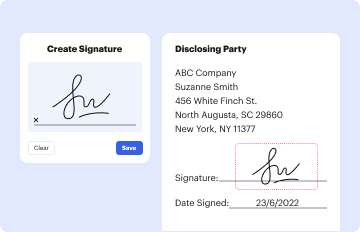
Draw your signature, type it, upload its image, or use your mobile device as a signature pad.

Send 2015 w 3 via email, link, or fax. You can also download it, export it or print it out.
The 2015 W-3 form, also known as the Transmittal of Wage and Tax Statements, is a summary document used by employers to transmit copies of employees' W-2 forms to the Social Security Administration (SSA). The W-3 form details the total wages paid and taxes withheld across an organization for the tax year, serving as a summary of all the individual wage and tax statements issued by the employer. This form is crucial for maintaining accurate records with the federal government and ensuring compliance with tax laws.
Employers must fill out the W-3 form when submitting the W-2 forms to the SSA. It’s essential to ensure that all information aligns precisely between the W-2s and the W-3 to avoid discrepancies. Employers can choose to file the form electronically, which is recommended by the SSA, especially if they are filing 250 or more forms, as it simplifies the process and reduces errors.
The filing deadline for the 2015 W-3 form was January 31, 2016. Employers need to ensure timely submission to avoid penalties. The SSA advises filing as soon as possible within January to mitigate the risk of last-minute issues. If filing electronically, the deadline remains the same.
Failing to file the W-3 form correctly or missing the deadline can result in significant penalties. Employers may incur costs for late filing, incorrect information, or failure to keep copies for their records. For 2015, penalties ranged based on the lateness and the size of the company, emphasizing the importance of accuracy and timeliness.
The legal implications of the W-3 form center around its role in verifying wage and tax reporting. Employers must ensure compliance with both IRS and SSA regulations to prevent legal challenges, which can arise from misinformation or non-compliance. Accurate filing supports an employer's legal responsibility to honestly report employee earnings and tax withholdings.
The IRS provides comprehensive guidelines concerning the completion and submission of both W-2 and W-3 forms. Following these guidelines can help employers understand the specific requirements, such as which numbers must match and how corrections should be handled. The guidelines also cover the electronic filing process and necessary software compatibility to ease the filing process for large businesses.
Employers often use software programs like TurboTax or QuickBooks to facilitate the filing of W-2s and the W-3 form. These programs can streamline the data collection process, handle calculations, and electronically submit the forms to the SSA, reducing the potential for human error. Compatibility with these tools ensures more efficient management of tax documents for the employer.
We've got more versions of the 2015 w3 form form. Select the right 2015 w3 form version from the list and start editing it straight away!
| Versions | Form popularity | Fillable & printable |
|---|---|---|
| 2024 | 4.8 Satisfied (22 Votes) | |
| 2023 | 4.2 Satisfied (48 Votes) | |
| 2022 | 4.9 Satisfied (31 Votes) | |
| 2021 | 4.8 Satisfied (161 Votes) | |
| 2020 | 4.4 Satisfied (217 Votes) | |
| 2019 | 4.4 Satisfied (274 Votes) | |
| 2018 | 4.4 Satisfied (268 Votes) | |
| 2017 | 4.4 Satisfied (830 Votes) | |
| 2016 | 4.3 Satisfied (48 Votes) | |
| 2015 | 4 Satisfied (43 Votes) | |
| 2014 | 4.1 Satisfied (48 Votes) | |
| 2013 | 4 Satisfied (54 Votes) | |
| 2012 | 4 Satisfied (27 Votes) | |
| 2011 | 4.2 Satisfied (71 Votes) | |
| 2010 | 4.2 Satisfied (30 Votes) |
Upload your w3 form 2015 to DocHub (once you’ve set up an account for this). If you need to fill out fields in it, use appropriate tools from the top pane. For instance, add Signature Fields, assign each to specific person, and click on Sign → Request signatures from others. Change your message for your recipients and click Send Request. You can also send your form by fax or as a Signing link instead of using email (you’ll find these options by navigating to the Menu → Send)
You can easily edit and complete your w 3 2015 on any iOS device. Open an internet browser of your choice, go to the DocHub website, authorize or create a new account, add your file for editing, and make your desired alterations. Our service is mobile-friendly, so using its features on your phone will be a no-brainer, even on the first try.
At DocHub, your data security is our priority. We follow HIPAA, SOC2, GDPR, and other standards, so you can work on your documents with confidence.


A Form W-3 Transmittal is completed only when paper Copy A of. Form(s) W-2, Wage and Tax Statement, is being filed. Do not file Form. W-3 alone. All paper formsRead more
Purpose. Complete Form W-4 so that your employer can withhold the correct federal income tax from your pay. Consider completing a new Form W-4 each year.Read more
May 2, 2017 File Copy A of Form W-2 with Form W-3 at the following address. For example, 2015 and GU shows that you are correcting a. 2015 Form W-2GU.Read more


