




01. Edit your w 3 2016 online
Type text, add images, blackout confidential details, add comments, highlights and more.

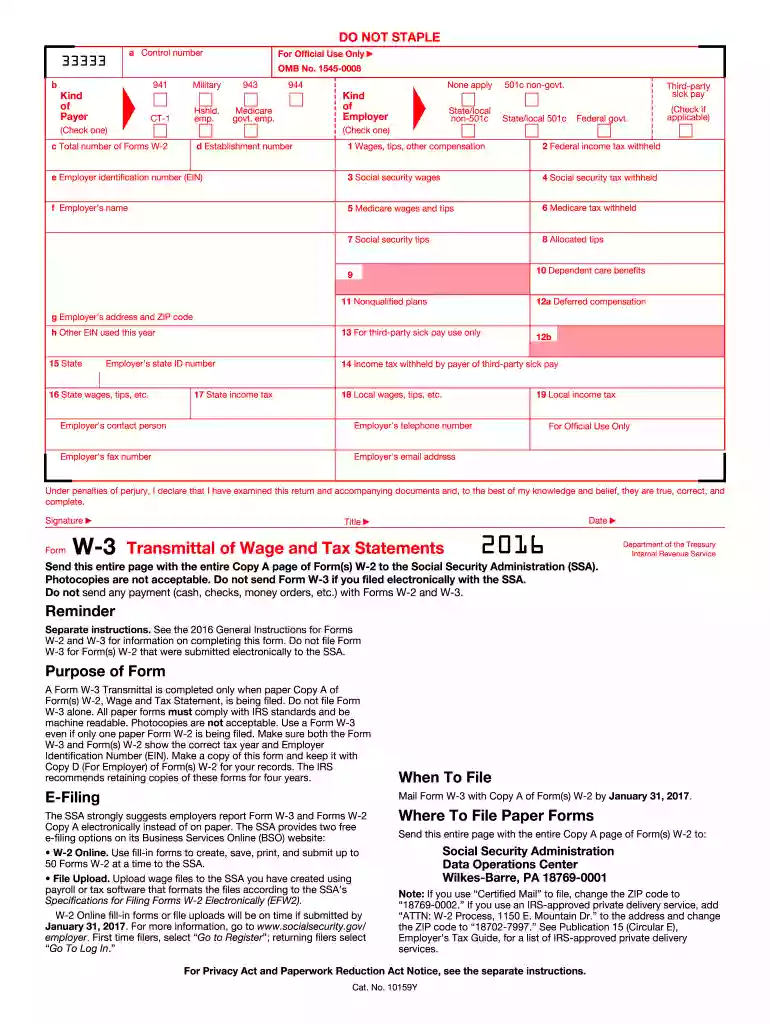
Type text, add images, blackout confidential details, add comments, highlights and more.

Draw your signature, type it, upload its image, or use your mobile device as a signature pad.

Send form w 3 2016 via email, link, or fax. You can also download it, export it or print it out.
Form W-3, officially known as the Transmittal of Wage and Tax Statements, serves as a cover sheet for Forms W-2, summarizing employees' annual wages and taxes withheld. This document is integral to ensuring compliance with federal tax filing requirements, as employers must submit it to the Social Security Administration (SSA). In 2016, the form remained an essential part of the reporting process, facilitating correct recording of employee earnings and withholding data for tax purposes. The information on Form W-3 helps the SSA verify the earnings of employees, contributing to the accurate calculation of future Social Security benefits and other welfare programs.
To use Form W-3, employers should gather all completed W-2 forms for their employees for the tax year 2016. After ensuring that each W-2 contains accurate wage and tax information, the employer must complete Form W-3 by summarizing the total wages paid and taxes withheld for all employees. The form then acts as a transmittal document accompanying the W-2 forms submitted to the SSA. Form W-3 is only required when filing one or more paper W-2 forms with the SSA, serving as a comprehensive cover letter that includes a summary of all collected data.
The deadline for submitting Form W-3 and accompanying W-2 forms to the SSA for the 2016 tax year was January 31, 2017. This deadline applies to both paper and electronic submissions. Employers should ensure timely filing to avoid penalties. Prior to submission, employers should also confirm that all information is accurate, as corrections after the filing deadline can complicate compliance and result in fines.
Non-compliance with Form W-3 filing requirements can result in substantial penalties. If the employer fails to file by the deadline, the penalty starts at $50 per form and can escalate based on how late the submission is and the size of the business. Additionally, providing incorrect information or failing to file can result in further fines. These penalties are designed to encourage timely and accurate submission to prevent disruptions in wage and tax reporting, impacting Social Security records.
Form W-3 is primarily used by employers or business owners in the U.S. who have paid wages to employees throughout the tax year. This includes small businesses, large corporations, and nonprofit organizations. The form ensures that these entities report accurate wage and tax information to the SSA, fulfilling both federal and state requirements and setting the groundwork for employees’ tax returns and Social Security entitlements.
The digital version of Form W-3 offers efficiency, ensuring quick submission and fewer errors due to automated checks through the IRS e-file system. Electronic filing is encouraged for those submitting more than 250 W-2 forms, offering benefits such as confirmation of receipt and processing. In contrast, paper submissions can be slower with a higher risk of errors, requiring careful manual validation before posting. The SSA provides specific guidelines to ensure that paper forms are printed correctly to facilitate scanning and processing.
We've got more versions of the w 3 2016 form. Select the right w 3 2016 version from the list and start editing it straight away!
| Versions | Form popularity | Fillable & printable |
|---|---|---|
| 2024 | 4.8 Satisfied (22 Votes) | |
| 2023 | 4.2 Satisfied (48 Votes) | |
| 2022 | 4.9 Satisfied (31 Votes) | |
| 2021 | 4.8 Satisfied (161 Votes) | |
| 2020 | 4.4 Satisfied (217 Votes) | |
| 2019 | 4.4 Satisfied (274 Votes) | |
| 2018 | 4.4 Satisfied (268 Votes) | |
| 2017 | 4.4 Satisfied (830 Votes) | |
| 2016 | 4.3 Satisfied (48 Votes) | |
| 2015 | 4 Satisfied (43 Votes) | |
| 2014 | 4.1 Satisfied (48 Votes) | |
| 2013 | 4 Satisfied (54 Votes) | |
| 2012 | 4 Satisfied (27 Votes) | |
| 2011 | 4.2 Satisfied (71 Votes) | |
| 2010 | 4.2 Satisfied (30 Votes) |
Sure, you’ll find numerous apps for this on the web. Nonetheless, if you need to eSign your w3 form 2016 without installing extra software, DocHub is the best choice you can make. This robust editor works on mobile devices just like on desktops. Open our editor in your preferred internet browser, register or log in to your account, and start processing your paperwork.
You may complete and sign your w3 2016 online, even on a tight deadline. All you need to access top-notch editing tools on any device is a DocHub profile, that you can sign up in a few moments. When you register, upload your file or find what you are searching for in our catalog, complete it utilizing the editing tools you want, and put your electronic signature on it at the end.
At DocHub, your data security is our priority. We follow HIPAA, SOC2, GDPR, and other standards, so you can work on your documents with confidence.


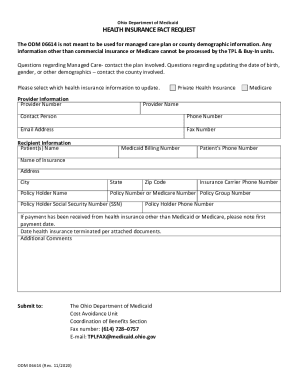


A Form W-3 Transmittal is completed only when paper Copy A of. Form(s) W-2, Wage and Tax Statement, is being filed. Do not file Form. W-3 alone. All paper formsRead more
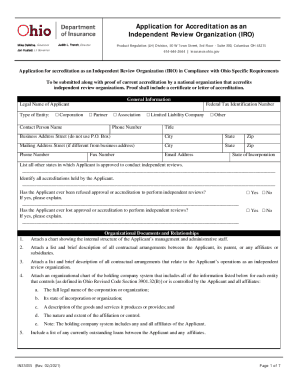
May 2, 2017 The employer may deduct the cash payments as business expenses or charitable contributions. For more information, see Notice. 2016-55, 2016-40Read more
RI W-3 Instructions (2024) Transmittal of Wage and Tax Statements Instructions PDF file, less than 1mbmegabytes RI-W3 (2022) Transmittal of Wage and TaxRead more


