




01. Edit your form online
Type text, add images, blackout confidential details, add comments, highlights and more.

Type text, add images, blackout confidential details, add comments, highlights and more.

Draw your signature, type it, upload its image, or use your mobile device as a signature pad.

Send it via email, link, or fax. You can also download it, export it or print it out.
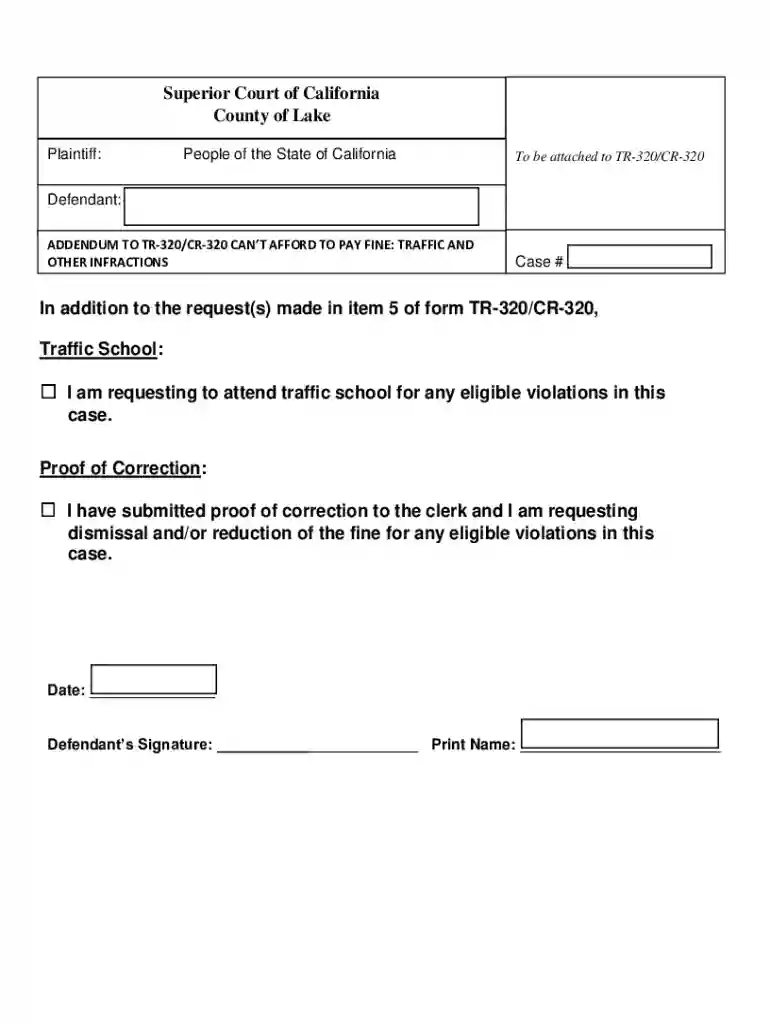
The "Addendum to TR-320/CR-320: Can't Afford to Pay Fine" is a supplementary form used in conjunction with the TR-320/CR-320 in the Superior Court of California, County of Lake. It serves as a formal request for individuals who are unable to pay imposed fines related to traffic violations or other infractions. This addendum facilitates the submission of additional financial information and circumstances to petition the court for an alternative judgment, such as community service, a payment plan, or a reduced fine.
To use the addendum effectively, individuals must attach it to the primary TR-320/CR-320 form. Begin by accurately completing the details on the original form, then fill out the addendum to explain your financial constraints. Clearly detail your income, expenses, and any other factors that influence your ability to pay the fine. It's crucial to provide honest and comprehensive information, as the court will assess your situation based on the details presented in both forms.
Successfully completing the addendum involves a detailed and truthful portrayal of your financial status:
Utilizing the addendum can be advantageous for those facing financial hardships. It provides a structured method to explain your inability to pay fines and proposes alternative solutions the court may consider. By presenting a comprehensive financial statement, you increase your chances of obtaining a modified penalty that aligns with your economic situation.
Typically, individuals who are unable to fulfill financial obligations associated with court fines use this addendum. It is most common among defendants with limited incomes, such as students, retirees, or individuals experiencing unemployment. However, any defendant with a legitimate claim of financial hardship can use this form.


This addendum is legally recognized within the jurisdiction of the California Superior Court. It adheres to procedural correctness by providing a legitimate channel through which defendants can communicate financial difficulties. Use of this form ensures transparency and fosters an equitable treatment process in court adjudications.
Several core components are essential for the effective use of the addendum:
While the form is primarily used in California, specific rules regulate its application:
Consider the following scenarios when the addendum might be effectively employed:
By detailing financial challenges and offering feasible alternatives, these examples illustrate the addendum’s practical application.
At DocHub, your data security is our priority. We follow HIPAA, SOC2, GDPR, and other standards, so you can work on your documents with confidence.





To be attached to TR-320/CR-320. Plaintiff: People of the State of California. Defendant: Case #. ADDENDUM TO TR-320/CR-320 CANT AFFORD TO PAY FINE: TRAFFIC
by BA COLGAN 2020 Cited by 51 See, e.g., JUDICIAL COUNCIL OF CAL., SF LOCAL FORM TR-320/CR-320: SAN. FRANCISCO SUPERIOR COURT: CANT AFFORD TO PAY FINE: TRAFFIC AND OTHER.
can afford to train models at such high cost, further increasing market concentration. Source: Maslej et al., 2024a (730). Access to massive datasets is


