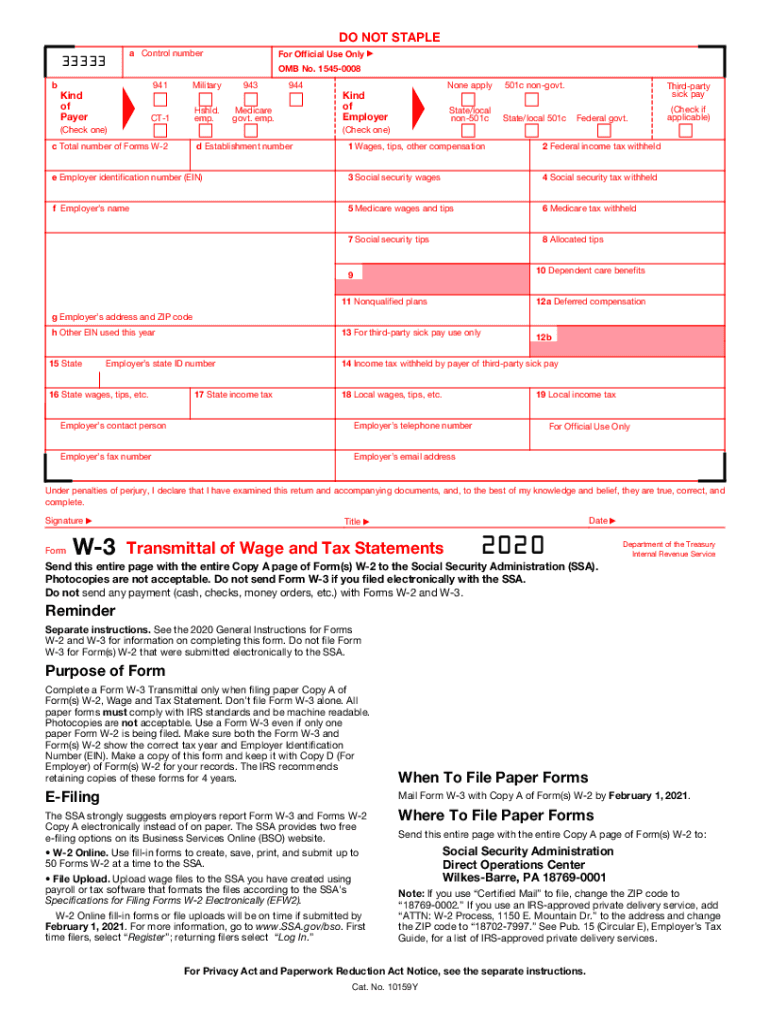







Definition and Meaning of Form W-3
Form W-3, known as the Transmittal of Wage and Tax Statements, is a summary form used by employers to report total wages, tips, and other compensation paid to employees along with the total taxes withheld during a given year. This form acts as a reconciliation tool, ensuring that the total amounts reported on individual Form W-2s match the aggregated totals. The W-3 is submitted to the Social Security Administration (SSA), accompanying the Forms W-2. Employers use this form to verify that W-2 forms have been filed correctly and completely.
How to Use Form W-3
Employers are required to use Form W-3 to accompany and summarize all the W-2 forms they file for their employees. The W-3 form itself does not replace any tax obligations but serves as a cover sheet for the W-2 forms submitted to the SSA. When filling out the form:
- Collect Information: Aggregate data from all W-2s you have issued to employees.
- Fill Out the Form: Enter your business's Employer Identification Number (EIN), the year for which the form is filed, and the total amounts of all reported wages and taxes.
- Attach W-2 Forms: Ensure that each employee's W-2 form aligns with the totals on the W-3.
Steps to Complete Form W-3
Completing Form W-3 involves the following key steps:
- Identify Business Information: Include your business name, address, and EIN on the form.
- Verify Employee Wages: Total the wage, tip, and compensation amounts from all employee W-2 forms.
- Total Taxes Withheld: Sum all federal income, Social Security, and Medicare taxes withheld over the year.
- Manual Filing or E-Filing: Choose between sending physical copies via mail or using the SSA's online Business Services to e-file.
- Certification: Sign and date the form to confirm accuracy.
Filing Deadlines and Important Dates for Form W-3
The filing deadline for Form W-3 and the accompanying W-2 forms is January 31 following the tax year. This deadline applies to both paper and electronic submissions. Timely filing is crucial to avoid penalties and ensure employees have accurate records for their income tax returns.
- January 31: Deadline to file Form W-3 with the SSA.
- January 31: Deadline to provide employees with their W-2s.
- February 28: Possible extended deadline for paper filings if a request is approved.
Required Documents for Form W-3
To accurately complete Form W-3, employers must gather:
- W-2 Forms: All employee W-2s for the tax year.
- Employer Identification Number (EIN): Used to identify the filing entity.
- Business Information: Name, address, and contact details of the business.
- Compiled Wage and Tax Totals: Ensure all figures on W-3 match with the totals of all employees’ W-2s.
Proper documentation ensures the form is filled accurately and helps avoid potential discrepancies with the SSA.
Form Submission Methods: Online vs. Mail
Form W-3 can be filed:
- Online Submission: Preferred for its efficiency and accuracy.
- Use the SSA's Business Services Online (BSO) to submit electronically.
- Instant confirmation of receipt and error checking.
- Mail Submission: Traditional but slower option.
- Ensure forms are sent to the appropriate SSA mailing address.
- Use IRS-provided envelopes and send with return receipt requested for verification.
Penalties for Non-Compliance with Form W-3 Requirements
Non-compliance with W-3 filing requirements can result in significant penalties:
- Late Filing: Penalties based on how late the forms are submitted.
- Incorrect Forms: Fines for errors, especially those that lead to incorrect employee tax reporting.
- Lack of Filing: Severe penalties for not filing a required W-3 with the SSA.
Fines vary based on the date corrections and filings are made, stressing the importance of accuracy and timeliness.
Examples of Using Form W-3
Real-world scenarios emphasize the importance of Form W-3:
- Small Businesses: Ensures all employee income is reported accurately and that taxes withheld are correctly accounted for by the SSA.
- Corporations: Helps reconcile payroll records against reported taxes.
- Partnerships: Simplifies collective reporting for partnerships employing numerous staff by offering a consolidated overview of wages and taxes withheld.
These examples illustrate how Form W-3 serves as an important component in accurate tax reporting and reconciliation.