01. Edit your w 3 2013 online
Type text, add images, blackout confidential details, add comments, highlights and more.

Type text, add images, blackout confidential details, add comments, highlights and more.

Draw your signature, type it, upload its image, or use your mobile device as a signature pad.

Send 2013 w 3 via email, link, or fax. You can also download it, export it or print it out.
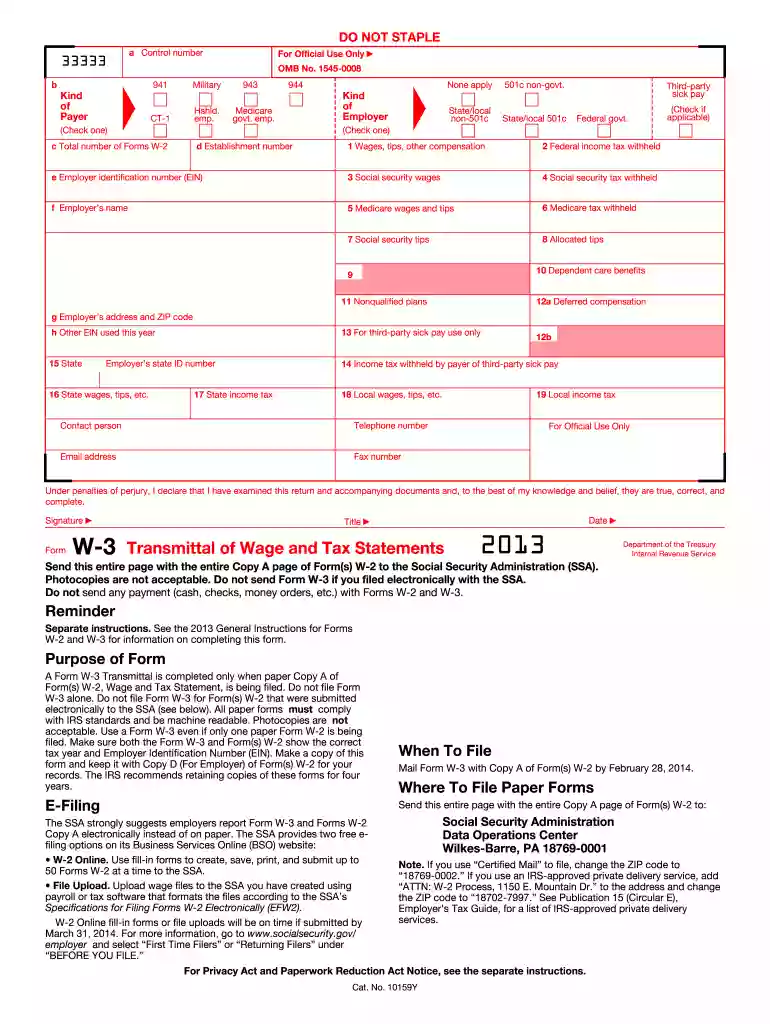
"W 2013 forms" generally relates to annual tax forms used for reporting income and tax information to the Internal Revenue Service (IRS) for the year 2013. These forms are critical documents for individuals and businesses to report earnings, calculate taxes owed, or claim refunds. Common forms include W-2 for wage reporting and W-3 for transmitting W-2 data to the Social Security Administration (SSA).
Using the W 2013 forms involves various steps:
Gather Required Information: Collect personal and financial information pertinent to the tax year, such as Social Security numbers, employer details, and income data.
Complete the Appropriate Sections: Fill in each form's sections accurately. For example, the W-2 form includes wage and withholding details, while the W-3 form summarizes data from multiple W-2 forms.
Review for Accuracy: Double-check entries to ensure all figures and personal details are correctly reported.
Submit Forms: W-2 forms are distributed to employees and filed with the IRS, while W-3 forms are sent to the SSA along with the corresponding W-2 forms.
Completing the W 2013 forms requires meticulous attention:
Identify the Correct Form: Understand the purpose of each form, such as W-2 for employees and W-3 for employers.
Enter Personal Details: Provide accurate personal information, including name, address, and Social Security number.
Report Financial Data: Record wages, tips, and other compensation, as well as tax withholdings.
Verify Calculations: Ensure calculations are correct to avoid discrepancies that could delay processing.
Sign and Date the Form: Finalize the forms with appropriate signatures and dates where needed.
Familiarity with key terminology is essential:
Legal compliance is crucial when handling W 2013 forms:
The IRS provides clear instructions for these forms:
Adhering to deadlines is essential:
Failure to handle the forms properly may lead to:
Understanding the components of each form is vital:
We've got more versions of the w 3 2013 form. Select the right w 3 2013 version from the list and start editing it straight away!
| Versions | Form popularity | Fillable & printable |
|---|---|---|
| 2024 | 4.8 Satisfied (22 Votes) | |
| 2023 | 4.2 Satisfied (48 Votes) | |
| 2022 | 4.9 Satisfied (31 Votes) | |
| 2021 | 4.8 Satisfied (161 Votes) | |
| 2020 | 4.4 Satisfied (217 Votes) | |
| 2019 | 4.4 Satisfied (274 Votes) | |
| 2018 | 4.4 Satisfied (268 Votes) | |
| 2017 | 4.4 Satisfied (830 Votes) | |
| 2016 | 4.3 Satisfied (48 Votes) | |
| 2015 | 4 Satisfied (43 Votes) | |
| 2014 | 4.1 Satisfied (48 Votes) | |
| 2013 | 4 Satisfied (54 Votes) | |
| 2012 | 4 Satisfied (27 Votes) | |
| 2011 | 4.2 Satisfied (71 Votes) | |
| 2010 | 4.2 Satisfied (30 Votes) |
Of course, it is possible with DocHub. This trustworthy and compliant online solution features a phone-based signing option. After you log in to your DocHub account and import your w 2013 forms to our editor, complete all required fields and use the Sign feature on the upper barf. Click on Create your signature and choose Phone from the available choices. Here, you scan a QR code using your smartphone and draw your signature on your phone screen, as you normally do when signing physical papers. If you access DocHub right from your mobile device, you can eSign your document by drawing your electronic signature, adding its picture, or simply with a typed name.
You can get and modify your w 2013 forms online by using DocHub. Its simple yet feature-rich design allows you to begin productive work immediately after you sign up your account. Create your profile and add your file, and then our user interface will guide you through our stress-free form completion experience.
At DocHub, your data security is our priority. We follow HIPAA, SOC2, GDPR, and other standards, so you can work on your documents with confidence.