






Understanding IRS Form W-3SS: Definition & Purpose
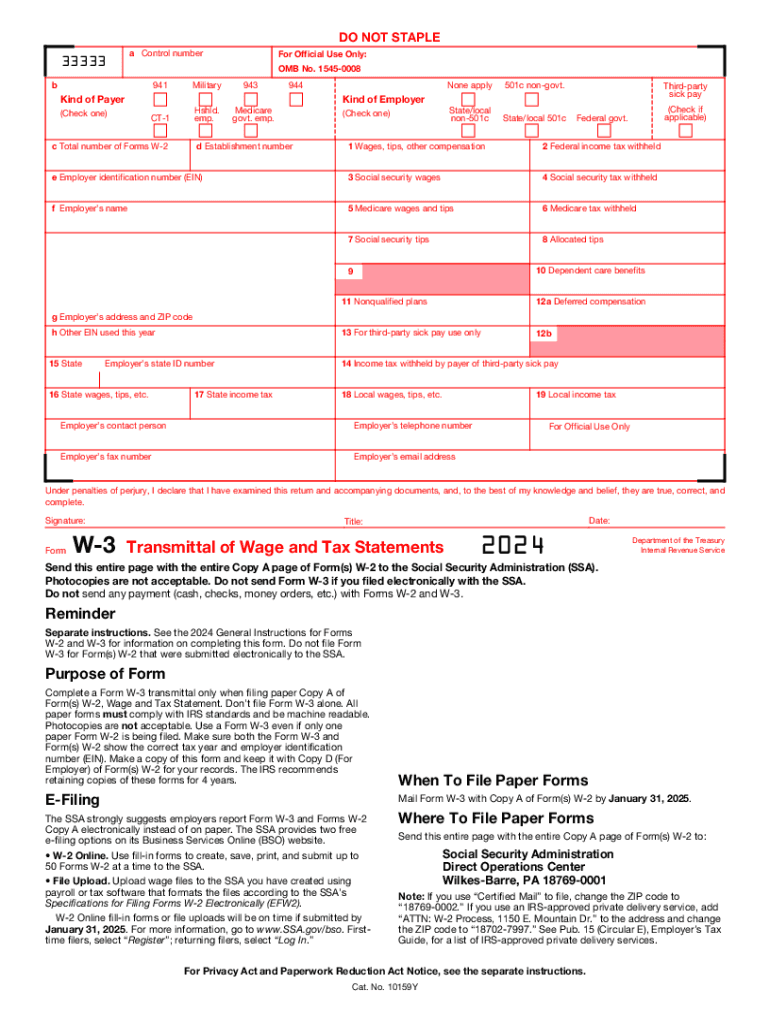
IRS Form W-3SS, officially known as the Transmittal of Wage and Tax Statements, is a form used by employers in U.S. territories to report total earnings, withheld taxes, and related data to the Social Security Administration (SSA). Specifically tailored for use in American Samoa, Guam, the Commonwealth of the Northern Mariana Islands, the U.S. Virgin Islands, and Puerto Rico, this form serves as a transmittal page for Form W-2SS. It's critical for summarizing and transmitting information from multiple W-2SS forms submitted by the employer. The transmittal assists the SSA in maintaining accurate employee earnings records, ensuring that the data matches the W-2SS forms issued to employees.
How to Use the IRS Form W-3SS
Employers must file IRS Form W-3SS along with Form W-2SS to summarize and consolidate information provided on individual W-2SS forms. The W-3SS includes important information such as total earnings, total wages earned by the employees, federal and local taxes withheld, and other benefits. For each W-2SS issued, the corresponding amounts must be accurately reflected in the cumulative report on the W-3SS. To ensure accuracy, employers should reconcile this data before submitting it to the SSA to avoid discrepancies or penalties.
Steps to Complete the IRS Form W-3SS
- Gather Required Information: Collect the information from all W-2SS forms, including wages, tips, withheld taxes, and other compensations.
- Enter Employer Information: Include the employer’s name, address, Employer Identification Number (EIN), and contact person.
- Enter Employee Compensations: Report the total wages, tips, and other compensations of all employees that match the data on the W-2SS forms.
- Detail Withheld Taxes: Fill in the total amounts of federal and local taxes withheld.
- Submit by Deadline: Ensure submission of the W-3SS and W-2SS to the SSA by the specified deadline, typically by the end of February following the tax year.
Filing Deadlines and Important Dates for IRS Form W-3SS
The deadline for filing IRS Form W-3SS is generally by February 28th of the year following the taxable year for paper submissions and by March 31st for electronic filing. Missing these deadlines can lead to penalties and potential discrepancies in employees' social security accounts. Staying on top of these important dates is crucial for compliance and to avoid financial repercussions.
Penalties for Non-Compliance with IRS Form W-3SS
Employers face significant penalties for failing to file the W-3SS or for inaccuracies on the form. These penalties depend on how late the forms are filed and the degree of non-compliance. The IRS applies different penalty tiers based on whether the errors are corrected within 30 days, after August 1st, or not at all. Additionally, deliberate disregard to file the form in a timely manner or filing with incorrect information incurs the highest penalty rates.
How to Obtain IRS Form W-3SS
IRS Form W-3SS can be obtained directly from the IRS website, downloaded as a PDF form. Employers may also get it from tax software packages that provide the form and facilitate its completion. It's crucial to use the latest version of the W-3SS to ensure compliance with current IRS requirements.
Importance of IRS Form W-3SS for Employers
Filing the IRS Form W-3SS is essential for maintaining compliance with federal tax laws specific to U.S. territories. It ensures that employee earnings are accurately reported, allowing the SSA to calculate and record worker benefits correctly. This process helps reinforce trust between employers and employees as accurate filings prevent errors in workers' compensation and social security records.
Variants and Alternatives to IRS Form W-3SS
IRS Form W-3 is a related variant commonly used by employers within the United States to summarize W-2 forms. The W-3SS is specifically designated for U.S. territories, providing a tailored mechanism for employers outside the mainland. While these forms serve similar purposes, regional applicability defines the correct choice. For digital solutions, many employers leverage compatible tax software to streamline preparation and submission of these forms electronically.
Digital vs. Paper Versions
Employers can choose between digital and paper submissions of IRS Form W-3SS. E-filing is preferred due to its convenience, reduction in errors, and extended deadline. Digital submission through IRS-approved channels ensures faster processing and receipt confirmation. However, opting for paper filing continues to be an option, requiring adherence to earlier deadlines and mindful of the mailing time necessary to ensure timely submission.


