
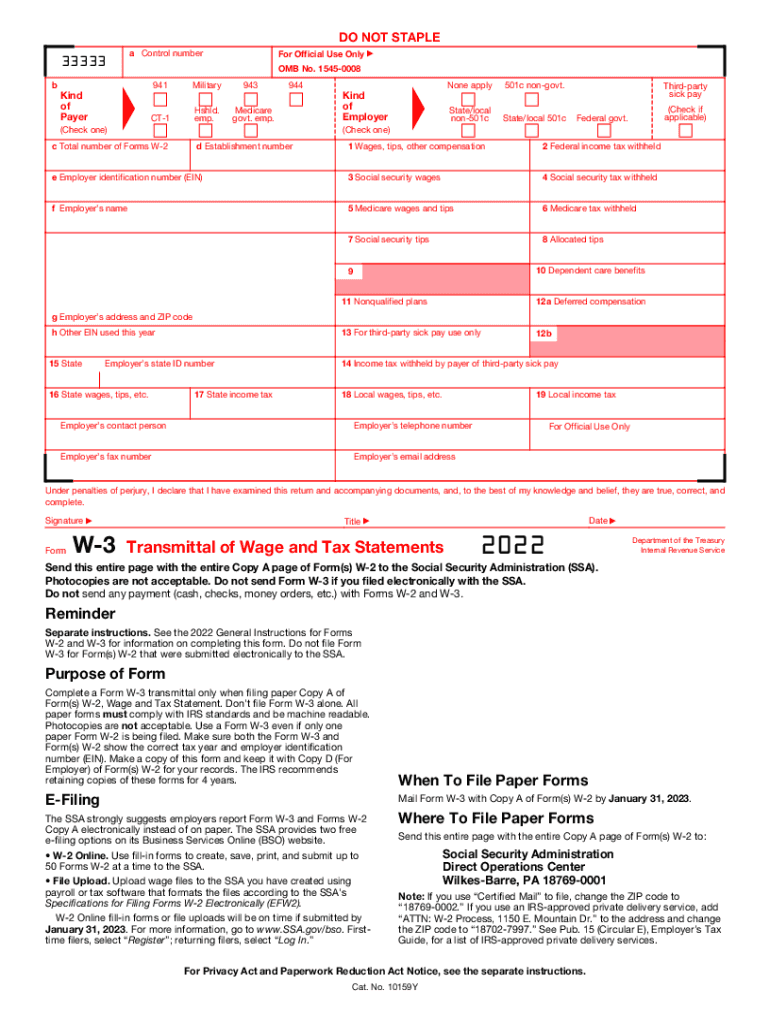







Definition and Purpose of the 2022 Form W-3
The 2022 Form W-3, Transmittal of Wage and Tax Statements, is a summary form that employers use to report total earnings, Social Security wages, Medicare wages, and various other tax-related numbers for their employees to the Social Security Administration (SSA). The W-3 form acts as a cover sheet and must accompany Forms W-2 when submitting them to the SSA. This ensures the agency receives a complete summary of all employees' wage and tax data for a particular year, facilitating the accurate recording and processing of individual earnings and contributions to federal programs.
Importance of the 2022 Form W-3
The W-3 form plays a critical role in ensuring compliance with federal wage reporting requirements. Failure to submit an accurate or timely W-3 can result in penalties for employers. It serves as an official record that allows the SSA to verify that employees' wages have been reported, which is essential for the proper calculation of Social Security benefits. Employers also benefit by maintaining transparency and preventing errors in tax calculations that could result in costly audits or fines.
How to Use the 2022 Form W-3
To use the Form W-3 effectively, employers must gather all relevant data from the W-2 forms they have issued to their employees. The W-3 requires the total amounts from all W-2s in several categories: wages, tips, other compensation, income tax withheld, Social Security and Medicare wages, and more. Once compiled, this information should be entered carefully to prevent discrepancies between the W-3 and the supporting W-2 forms. Employers then submit the completed W-3, alongside the W-2s, to the SSA by the designated deadline.
Obtaining the 2022 Form W-3
Employers can obtain the 2022 Form W-3 in several ways. The form is typically available as a PDF download from the official IRS website. Additionally, employers can request paper copies through the IRS's order forms, ensuring they have physical copies for manual filing. Many payroll software solutions also offer integrated options for generating and submitting W-3 forms electronically, which streamlines the process and minimizes potential for error.
Steps to Complete the 2022 Form W-3
-
Gather Required Information: Collect all employee W-2 forms and verify that the information is accurate and complete.
-
Enter Employer Data: Fill in your business information, including employer identification number (EIN), address, and contact details.
-
Summarize Employee Data: Input total figures for wages, tips, other compensation, and tax withholdings as reported on all W-2s.
-
Review and Confirm: Double-check all entries for accuracy to ensure the W-3 aligns with the sum of submitted W-2 forms.
-
Submission: Send the W-3, along with associated W-2 forms, to the SSA by the February deadline.
Who Typically Uses the 2022 Form W-3
Employers of all sizes and industries in the United States must use Form W-3 if they have issued any W-2 forms. This includes corporations, small businesses, limited liability companies (LLCs), partnerships, and non-profit organizations with payrolls. Self-employed individuals generally do not need a W-3 unless they have employees.


IRS Guidelines for Completing the W-3 Form
The IRS provides comprehensive instructions for preparing the W-3 form, which include guidelines on properly aggregating wage data, withholding information, and ensuring consistency across all forms. It is essential for employers to review these guidelines each year, as changes in tax law or submission standards can affect how the forms should be completed and submitted.
Filing Deadlines for the 2022 Form W-3
The deadline for submitting the 2022 Form W-3, alongside the Forms W-2, is January 31, 2023. This date applies to both paper and electronic filings. Timely submission is crucial to evade penalties and ensure compliance with federal reporting standards. Additionally, deadlines might vary for state filings depending on specific state regulations, so employers should verify any state-specific requirements.
Penalties for Non-Compliance
Failure to file Form W-3 correctly or by the due date can result in penalties from the IRS. The amount of the penalty depends on how late the form is filed, with larger businesses facing potentially higher penalties. Employers must ensure accuracy since any mismatched information between W-3 and W-2 forms can trigger further penalties and audits. Filing accurate returns promptly is the best safeguard against these issues.


