




01. Edit your 2014 w 3 online
Type text, add images, blackout confidential details, add comments, highlights and more.

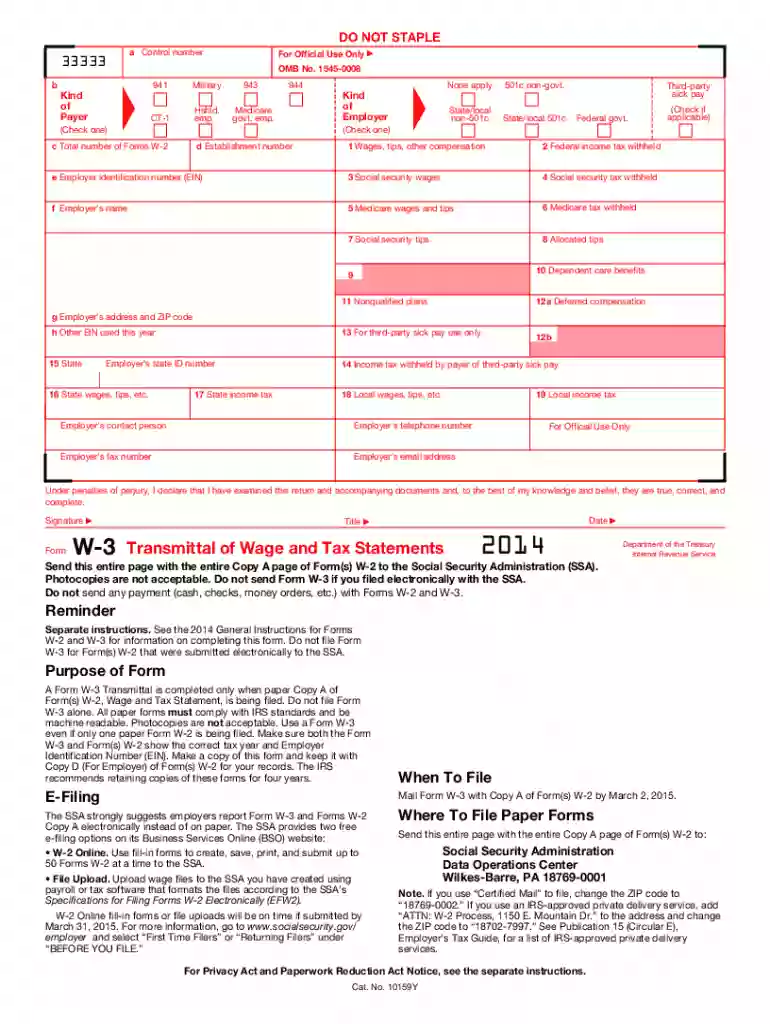
Type text, add images, blackout confidential details, add comments, highlights and more.

Draw your signature, type it, upload its image, or use your mobile device as a signature pad.

Send form w3 2014 via email, link, or fax. You can also download it, export it or print it out.
The 2014 W IRS Form, often referred to in specific contexts, is a document primarily used for tax-related purposes by individuals and businesses. Its primary function is to ensure accurate reporting of income, deductions, and credits to the IRS, which is essential for determining the correct amount of tax owed or refund due. This particular form version reflects the tax regulations and guidelines relevant to the year 2014, encapsulating the economic and legislative changes of that period. It serves as a critical tool for compliance with federal tax requirements.
To use the 2014 W IRS Form effectively, taxpayers must first ensure they have collected all necessary financial documents related to that tax year. These documents typically include income statements, investment records, and receipts for deductible expenses. The form must then be filled out with accurate personal and financial information. It's crucial to follow IRS instructions closely, as inaccuracies can lead to processing delays or audits. Once completed, the form can be submitted through various methods, depending on the taxpayer's preference and eligibility.
Obtaining the 2014 W IRS Form is straightforward. It can be downloaded directly from the IRS website or retrieved through professional tax software that includes historical form versions. Taxpayers can also request a paper version by contacting the IRS directly. It's advisable to ensure that the form is the official version to avoid any discrepancies during submission.
The form consists of several critical sections, each serving a specific function to capture comprehensive financial information. These sections typically include:
Understanding terminology on the 2014 W IRS Form is crucial for accurate completion:
Legal adherence when using the 2014 W IRS Form is imperative. This form must be filed in accordance with IRS guidelines, and any errors or omissions can result in penalties. Proper completion involves thorough record-keeping and honest reporting of all financial activities for the year. Utilizing the form correctly is essential for maintaining compliance and avoiding legal issues.
Submitting the form within stipulated deadlines is critical to avoid late filing penalties. The standard deadline is April 15th of the following year, though extensions may be available. The form can be filed electronically, which is generally faster and allows for direct communication with the IRS, or mailed using the addresses provided in IRS instructions.
The IRS provides extensive resources to assist taxpayers in completing the 2014 W IRS Form. These guidelines include step-by-step instructions available on their website, offering detailed clarifications on each section of the form. Taxpayers can also seek assistance through IRS helplines or consult with tax professionals for personalized support.
We've got more versions of the 2014 w 3 form. Select the right 2014 w 3 version from the list and start editing it straight away!
| Versions | Form popularity | Fillable & printable |
|---|---|---|
| 2024 | 4.8 Satisfied (22 Votes) | |
| 2023 | 4.2 Satisfied (48 Votes) | |
| 2022 | 4.9 Satisfied (31 Votes) | |
| 2021 | 4.8 Satisfied (161 Votes) | |
| 2020 | 4.4 Satisfied (217 Votes) | |
| 2019 | 4.4 Satisfied (274 Votes) | |
| 2018 | 4.4 Satisfied (268 Votes) | |
| 2017 | 4.4 Satisfied (830 Votes) | |
| 2016 | 4.3 Satisfied (48 Votes) | |
| 2015 | 4 Satisfied (43 Votes) | |
| 2014 | 4.1 Satisfied (48 Votes) | |
| 2013 | 4 Satisfied (54 Votes) | |
| 2012 | 4 Satisfied (27 Votes) | |
| 2011 | 4.2 Satisfied (71 Votes) | |
| 2010 | 4.2 Satisfied (30 Votes) |
At DocHub, your data security is our priority. We follow HIPAA, SOC2, GDPR, and other standards, so you can work on your documents with confidence.



Apr 15, 2015 ITIN, see Form W-7, Application for. IRS Individual Taxpayer Identification. Number, and its instructions. Get. Form W-7 online at IRS.gov.Read more
Purpose. Complete Form W-4 so that your employer can withhold the correct federal income tax from your pay. Consider completing a new Form W-4 each year.Read more


