




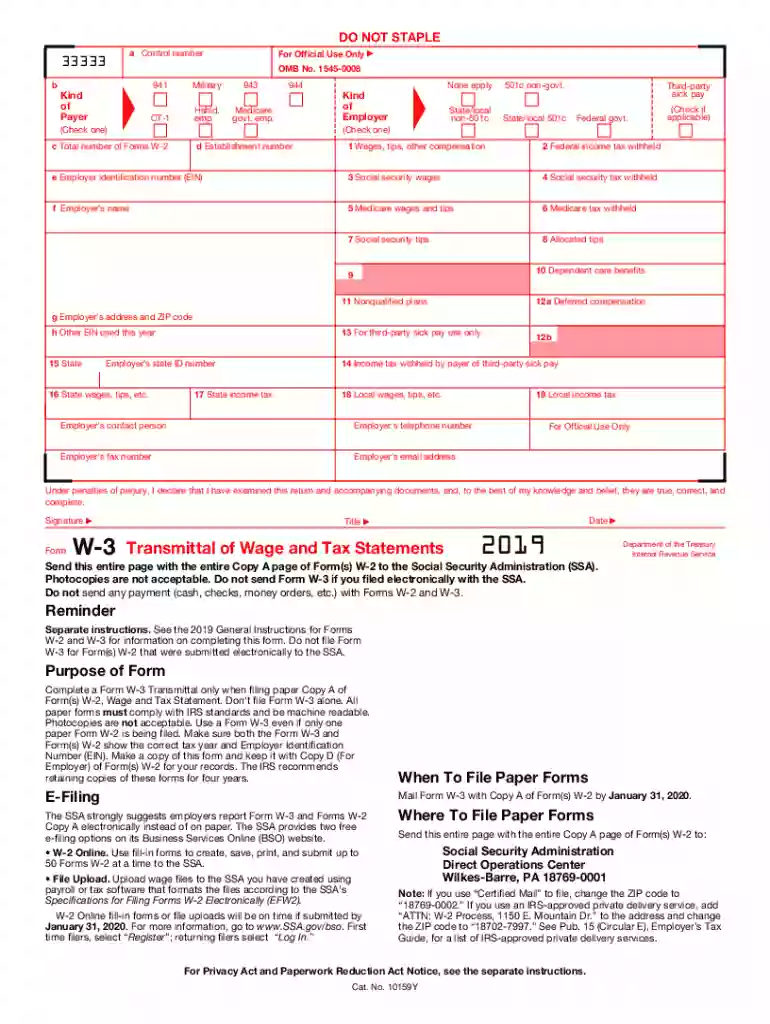
01. Edit your irs form w3 2019 online
Type text, add images, blackout confidential details, add comments, highlights and more.

Type text, add images, blackout confidential details, add comments, highlights and more.

Draw your signature, type it, upload its image, or use your mobile device as a signature pad.

Send 2019 w3 form via email, link, or fax. You can also download it, export it or print it out.
The W-3 form, officially known as the Transmittal of Wage and Tax Statements, serves as a summary document issued by employers to the Social Security Administration (SSA) in the United States. It acts as a cover page for the W-2 forms, grouping together all employee earnings, withheld taxes, and other payroll-related information from a given year. This form ensures that the totals reported on individual W-2 forms align with the summary data provided, facilitating accurate tracking and assessment of tax liabilities and contributions.
Employers can procure the W-3 form from multiple sources, including the Internal Revenue Service (IRS) and the Social Security Administration (SSA). It is available in both paper format and electronically for ease of use.
Completing the W-3 form involves several detailed steps, ensuring all relevant wage and tax information aligns with the individual W-2 forms.
The W-3 form is not just a bureaucratic requirement; it serves several key purposes:
The W-3 form is essential for a wide range of business entities across the United States:


The IRS provides specific guidelines outlining how to accurately complete and submit the W-3 form. The process may include:
Adherence to submission timelines is critical to avoid penalties and ensure compliance.
Failure to file the W-3 form correctly or by the deadline can result in significant penalties.
By understanding the W-3 form’s intricacies and ensuring precise completion and submission, employers can maintain payroll accuracy, compliance, and foster trust with their employees and federal agencies.
We've got more versions of the irs form w3 2019 form. Select the right irs form w3 2019 version from the list and start editing it straight away!
| Versions | Form popularity | Fillable & printable |
|---|---|---|
| 2024 | 4.8 Satisfied (22 Votes) | |
| 2023 | 4.2 Satisfied (48 Votes) | |
| 2022 | 4.9 Satisfied (31 Votes) | |
| 2021 | 4.8 Satisfied (161 Votes) | |
| 2020 | 4.4 Satisfied (217 Votes) | |
| 2019 | 4.4 Satisfied (274 Votes) | |
| 2018 | 4.4 Satisfied (268 Votes) | |
| 2017 | 4.4 Satisfied (830 Votes) | |
| 2016 | 4.3 Satisfied (48 Votes) | |
| 2015 | 4 Satisfied (43 Votes) | |
| 2014 | 4.1 Satisfied (48 Votes) | |
| 2013 | 4 Satisfied (54 Votes) | |
| 2012 | 4 Satisfied (27 Votes) | |
| 2011 | 4.2 Satisfied (71 Votes) | |
| 2010 | 4.2 Satisfied (30 Votes) |
Microsoft Word doesn’t have signing tools to create legitimate electronic signatures and enforceable documents. Fortunately, DocHub is an online eSignature-compliant editor that works with various file formats, such as .doc files. Sign in to your account and upload the Word version of your 2019 w3 from your device and cloud, or URL - our editor will automatically turn it into an editable PDF. Make all necessary alterations in your document and click Sign to create your own legally-binding electronic signature. There are four signing methods from which to choose.
If you store your documents in Google Drive, there is no need to download your form w 3 2019 on the computer and upload it back to our editor. A significantly simpler way is to set up a browser extension developed by DocHub to simplify this flow. The extension allows editing PDFs right in your internet browser. Alternatively, you may integrate your DocHub and Gmail accounts for more efficient modifying.
At DocHub, your data security is our priority. We follow HIPAA, SOC2, GDPR, and other standards, so you can work on your documents with confidence.
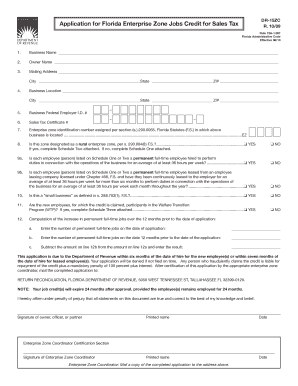

Information about Form W-3, Transmittal of Wage and Tax Statements (Info Copy Only), including recent updates, related forms, and instructions on how to
May 2, 2017 Be sure that the payers name and EIN on Forms W-2 and. W-3 are the same as those used on the Form 941,. Employers QUARTERLY Federal Tax ReturnRead more
Jan 26, 2024 Do not use these forms to report wages subject to U.S. income tax withholding. Instead, use Form W-2 to show U.S. income tax withheld. For.Read more


