




01. Edit your fillable w3 2023 online
Type text, add images, blackout confidential details, add comments, highlights and more.

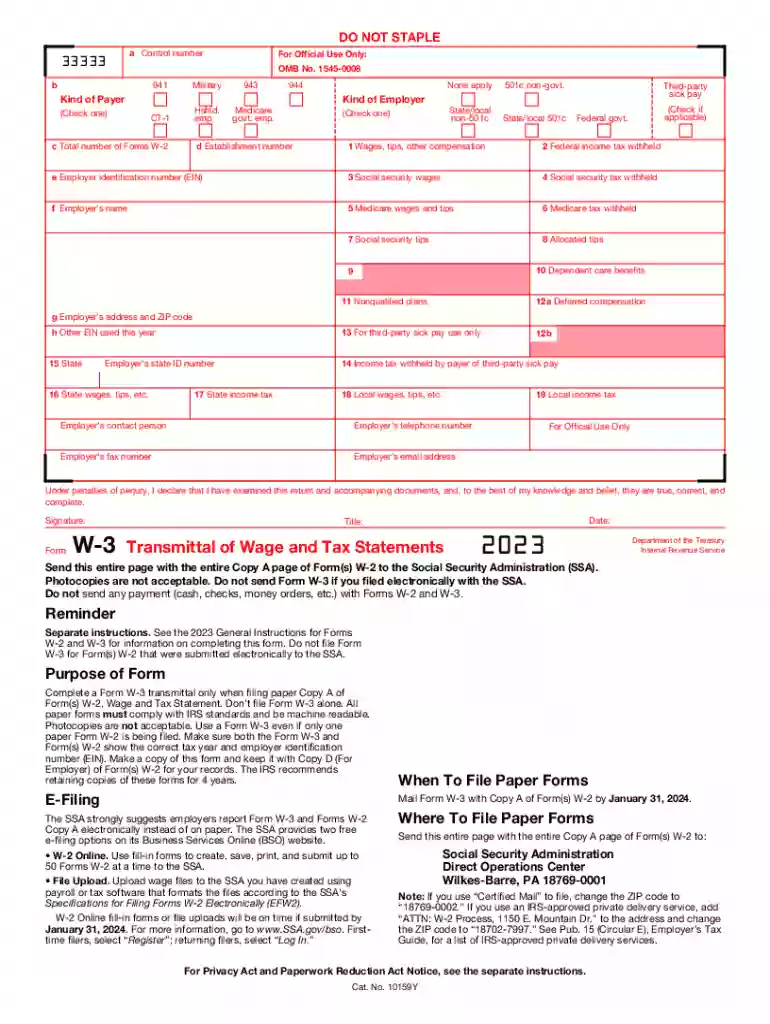
Type text, add images, blackout confidential details, add comments, highlights and more.

Draw your signature, type it, upload its image, or use your mobile device as a signature pad.

Send fillable 2023 w 3 via email, link, or fax. You can also download it, export it or print it out.
The 2018 W-3 form, officially known as the "Transmittal of Wage and Tax Statements," is used by employers in the United States to transmit Form W-2, Wage and Tax Statement, information to the Social Security Administration (SSA). This form summarizes the total earnings, Social Security wages, Medicare wages, and withholding for all employees in a calendar year. The fillable version simplifies data entry by allowing employers to input required information electronically before printing and submitting them, reducing the likelihood of errors associated with manual entries.
The primary sections of the 2018 W-3 fillable form focus on employer identification and payroll data. Essential fields include:
Understanding these elements ensures that the data accurately reflects the year’s payroll activities, aiding in compliance with tax obligations.
Completing the 2018 W-3 fillable form involves several specific steps:
Following these steps ensures completeness and compliance with SSA requirements.
The 2018 W-3 fillable form can be acquired directly through the IRS website or authorized software providers. Additionally, tax software like TurboTax or QuickBooks often includes the fillable form as part of their business tax modules, streamlining the process of preparing and submitting tax documents. These platforms offer electronic versions that are continually updated to reflect current IRS regulations, facilitating easier compliance.
Employers can submit the 2018 W-3 form via electronic filing or through the mail:
Both methods require adherence to submission deadlines to avoid penalties.
The 2018 W-3 form is primarily used by employers in various sectors, including corporations, LLCs, partnerships, and other business entities that have payroll obligations and issue multiple W-2 forms annually. In cases where multinational companies operate within the U.S., they must use this form to report wages paid to all their U.S. employees.


The IRS provides specific guidelines dictating the proper completion and submission of the W-3 form. It emphasizes the importance of accuracy in wage and tax reporting, timelines for submission, and the requirement to maintain records for a specified duration. Adhering to these guidelines helps minimize the risk of audits and ensures alignment with federal payroll tax laws.
The W-3 form carries legal implications for employers, given that it is a mandated document under U.S. tax law for reporting employee taxes. Incorrect or late submissions can lead to penalties. Employers must ensure that all information reported aligns with the data provided on individual W-2 forms to avoid discrepancies and potential legal challenges.
Failure to file the W-3 form or incorrect submissions can lead to substantial fines for employers. Penalties are based on the severity of the error and the timeliness of correction, ranging from a few hundred to thousands of dollars. Compliant submission is essential to avoid these financial repercussions and maintain smooth business operations.
We've got more versions of the fillable w3 2023 form. Select the right fillable w3 2023 version from the list and start editing it straight away!
| Versions | Form popularity | Fillable & printable |
|---|---|---|
| 2024 | 4.8 Satisfied (22 Votes) | |
| 2023 | 4.2 Satisfied (48 Votes) | |
| 2022 | 4.9 Satisfied (31 Votes) | |
| 2021 | 4.8 Satisfied (161 Votes) | |
| 2020 | 4.4 Satisfied (217 Votes) | |
| 2019 | 4.4 Satisfied (274 Votes) | |
| 2018 | 4.4 Satisfied (268 Votes) | |
| 2017 | 4.4 Satisfied (830 Votes) | |
| 2016 | 4.3 Satisfied (48 Votes) | |
| 2015 | 4 Satisfied (43 Votes) | |
| 2014 | 4.1 Satisfied (48 Votes) | |
| 2013 | 4 Satisfied (54 Votes) | |
| 2012 | 4 Satisfied (27 Votes) | |
| 2011 | 4.2 Satisfied (71 Votes) | |
| 2010 | 4.2 Satisfied (30 Votes) |
At DocHub, your data security is our priority. We follow HIPAA, SOC2, GDPR, and other standards, so you can work on your documents with confidence.


