




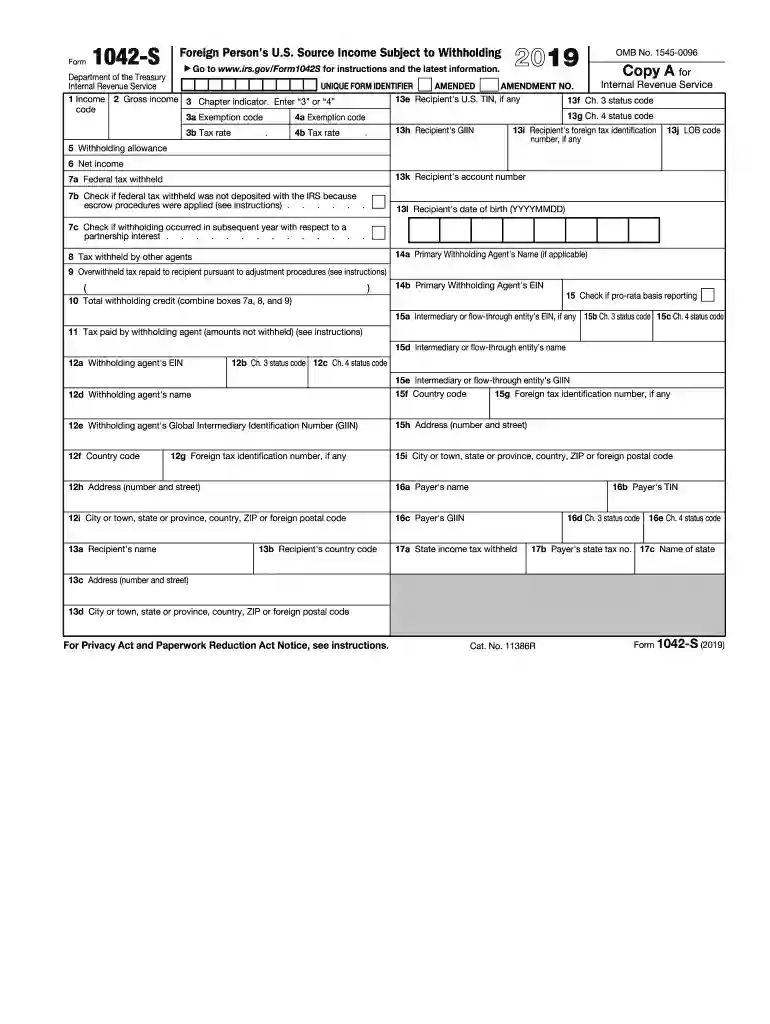
01. Edit your 2019 form 1042 s online
Type text, add images, blackout confidential details, add comments, highlights and more.

Type text, add images, blackout confidential details, add comments, highlights and more.

Draw your signature, type it, upload its image, or use your mobile device as a signature pad.

Send form 1042 s 2019 via email, link, or fax. You can also download it, export it or print it out.
Form 1042-S, known as the "Foreign Person's U.S. Source Income Subject to Withholding," is a critical document used by the IRS to report the amount of income nonresident aliens or foreign entities receive from U.S. sources. The form includes details about the type of income, applicable tax rates, and withholding details. It serves as a bridge in tax compliance between foreign income recipients and the U.S. tax system, ensuring that the correct amount of tax is withheld at the source for foreign earners.
The IRS provides comprehensive instructions for completing Form 1042-S, specifying how withholding agents report income, exemptions, and withheld amounts. It highlights the necessity to differentiate between various types of income and applicable tax treaties. The guidelines stress accuracy and completeness to avoid penalties, and they outline procedures for electronically submitting the form through the FIRE (Filing Information Returns Electronically) system if filing 250 or more forms.
Form 1042-S is due to be submitted to the IRS by March 15 each year, aligning with the reporting of income paid in the previous calendar year. Relevant withholding amounts must be deposited following the IRS’s semi-weekly or monthly deposit schedules to prevent late payment penalties. Inaccurate or late submissions can lead to significant fines, so it is imperative to adhere strictly to these deadlines.
Compliance with IRS requirements allows Form 1042-S to be completed using legally binding electronic signatures, making digital submissions a viable option. The ESIGN Act ensures that electronic signatures have the same legal standing as handwritten signatures, provided they meet specific criteria such as identification of the signer and an electronic consent agreement.
Numerous software solutions, like TurboTax and QuickBooks, support the completion and submission of Form 1042-S. These platforms often offer step-by-step guidance, built-in tax calculation tools, and electronic filing capabilities that streamline the process. Choosing compatible software ensures effortless integration of financial data, which is crucial for timely and accurate form submission.
Failing to file Form 1042-S or incorrectly reporting information can result in penalties from the IRS. These fines can be substantial, scaling up based on the delay duration and the total income involved. Additionally, withholding agents might face increased scrutiny, which can affect relationships with foreign beneficiaries. It is crucial to understand these implications and ensure that compliance with all reporting obligations is met to avoid financial repercussions.
Form 1042-S is typically used by withholding agents such as financial institutions, corporations, insurance companies, and other entities that process payments to foreign individuals or businesses. Nonresident aliens with U.S. income interests, including students, athletes, artists, or foreign shareholders of U.S. companies, also rely on this form to document their income and tax withholdings when filing taxes in the U.S.


We've got more versions of the 2019 form 1042 s form. Select the right 2019 form 1042 s version from the list and start editing it straight away!
| Versions | Form popularity | Fillable & printable |
|---|---|---|
| 2025 | 4.1 Satisfied (46 Votes) | |
| 2024 | 3.9 Satisfied (37 Votes) | |
| 2023 | 4.9 Satisfied (31 Votes) | |
| 2022 | 4.5 Satisfied (50 Votes) | |
| 2021 | 4.8 Satisfied (135 Votes) | |
| 2020 | 4.3 Satisfied (105 Votes) | |
| 2019 | 4.3 Satisfied (118 Votes) | |
| 2018 | 4.4 Satisfied (102 Votes) | |
| 2017 | 4.3 Satisfied (341 Votes) | |
| 2016 | 4.4 Satisfied (324 Votes) | |
| 2015 | 4.3 Satisfied (29 Votes) | |
| 2014 | 4.2 Satisfied (69 Votes) | |
| 2013 | 4 Satisfied (22 Votes) | |
| 2012 | 4.2 Satisfied (58 Votes) | |
| 2011 | 4 Satisfied (40 Votes) |
At DocHub, your data security is our priority. We follow HIPAA, SOC2, GDPR, and other standards, so you can work on your documents with confidence.



The taxpayers holding period with respect to the qualified securities is at least 3 years (determined as of the time of the sale).Read more
Use Form 1042 to report the following: The tax withheld under chapter 3 on certain income of foreign persons, including nonresident aliens,Read more


