




01. Edit your form 1042 online
Type text, add images, blackout confidential details, add comments, highlights and more.

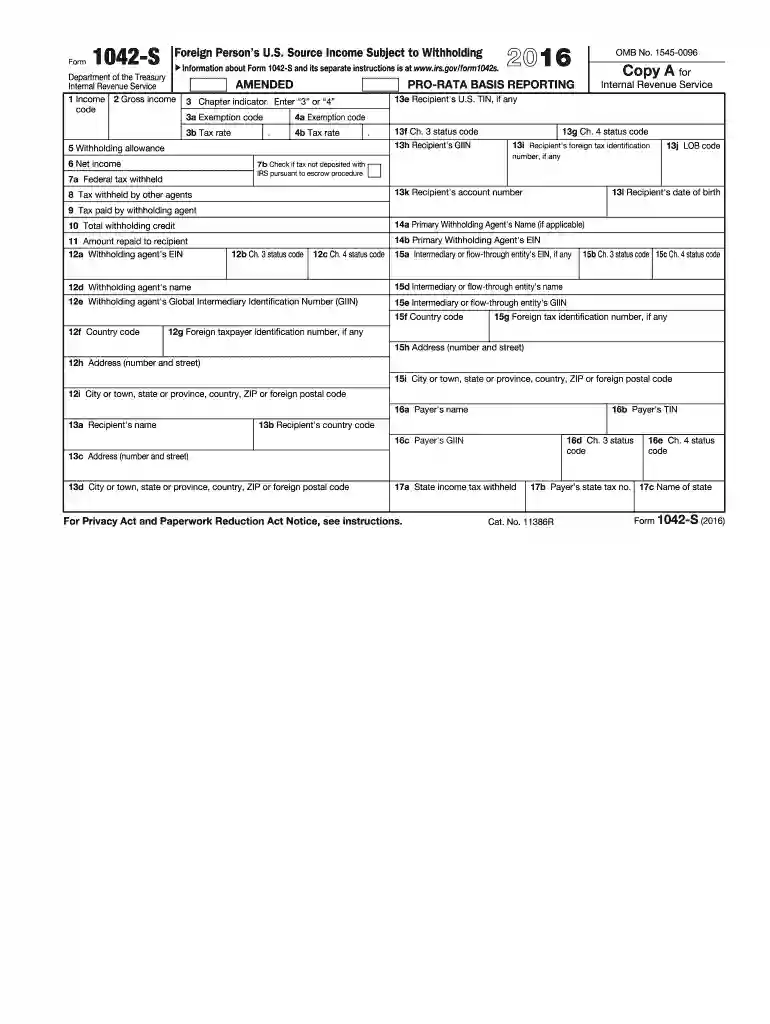
Type text, add images, blackout confidential details, add comments, highlights and more.

Draw your signature, type it, upload its image, or use your mobile device as a signature pad.

Send it via email, link, or fax. You can also download it, export it or print it out.
IRS Form 1042 is used by withholding agents to report U.S. income paid to foreign persons that is subject to withholding under Chapter 3 of the Internal Revenue Code. The form includes details about the payments, such as the recipient's name, address, and the amount of income, alongside specific tax rates and exemptions applied. Foreign persons, in this context, can include nonresident aliens, foreign corporations, and foreign partnerships. It's essential to understand the form's objective to ensure that tax obligations are accurately reported and fulfilled according to the IRS's requirements.
Retrieving IRS Form 1042 for 2016 is straightforward through several available methods:
IRS Website: The most direct method is downloading the form from the official IRS website. Navigate to the 'Forms & Instructions' section to access the downloadable PDF.
Tax Software: Popular tax software programs, like TurboTax and H&R Block, often include past versions of tax forms. Users can find the form under the business or international tax section.
Professional Tax Preparers: Those working with a CPA or tax advisor can request the form directly from their preparer, who will have access to a comprehensive library of IRS forms.
Filling out IRS Form 1042 requires precision to ensure compliance with U.S. tax laws for foreign payments:
Identifying Information: Enter the withholding agent's name, address, and Employer Identification Number (EIN).
Recipient Details: Include information about the foreign recipient of the income, which consists of their name and address.
Income Information: Report the type and amount of income paid, clearly specifying any relevant codes from the IRS instructions.
Tax Withheld: Indicate the withholding amounts based on the applicable tax rates and any exemptions or reductions applicable under tax treaties.
Signature: A responsible officer or authorized agent must sign the form, certifying the accuracy of the provided information.
Form 1042 must be filed with the IRS by March 15th of the year following the calendar year in which payments were made. This deadline ensures withholding agents' compliance with federal tax reporting responsibilities. Filing late may incur penalties, emphasizing the importance of timely submission. Extensions are available but must be requested before the original due date.
Several critical components must be understood to complete IRS Form 1042 accurately:
The legal foundation for IRS Form 1042 arises from the obligation to withhold taxes on certain types of U.S. income paid to foreign persons. Compliance requires adherence to Chapter 3 rules of the Internal Revenue Code. Incorrect filing or failure to file can lead to substantial penalties, making it essential to maintain thorough records and accurate submissions.
Failure to comply with the filing requirements for Form 1042 can result in several penalties:
IRS Form 1042 can be filed electronically or via paper submission:
Understanding these components and adhering to the related guidelines and deadlines is fundamental for withholding agents managing payments to foreign recipients. Proper completion ensures compliance with U.S. tax laws and fosters accurate international financial reporting.
We've got more versions of the form 1042 form. Select the right form 1042 version from the list and start editing it straight away!
| Versions | Form popularity | Fillable & printable |
|---|---|---|
| 2025 | 4.1 Satisfied (46 Votes) | |
| 2024 | 3.9 Satisfied (37 Votes) | |
| 2023 | 4.9 Satisfied (31 Votes) | |
| 2022 | 4.5 Satisfied (50 Votes) | |
| 2021 | 4.8 Satisfied (135 Votes) | |
| 2020 | 4.3 Satisfied (105 Votes) | |
| 2019 | 4.3 Satisfied (118 Votes) | |
| 2018 | 4.4 Satisfied (102 Votes) | |
| 2017 | 4.3 Satisfied (341 Votes) | |
| 2016 | 4.4 Satisfied (324 Votes) | |
| 2015 | 4.3 Satisfied (29 Votes) | |
| 2014 | 4.2 Satisfied (69 Votes) | |
| 2013 | 4 Satisfied (22 Votes) | |
| 2012 | 4.2 Satisfied (58 Votes) | |
| 2011 | 4 Satisfied (40 Votes) |
At DocHub, your data security is our priority. We follow HIPAA, SOC2, GDPR, and other standards, so you can work on your documents with confidence.


Box 1, Income Code, Two digit code to designate type of income. Typical codes are: 16-Scholarship or Fellowship, 17-Compensation for independent personal
Form 1042 (2016). Page 2. Form 1042 (2016). Page 2. 63. Total tax reported as withheld or paid by withholding agent on all Forms 1042-S and 1000: a Tax withheldRead more
Jan 4, 2017 the United States) or Form RRB-1042S (if you are a non- resident alien). However, if Form RRB-1099 or Form. RRB-1042S isnt required for 2016,Read more


