




01. Edit your form online
Type text, add images, blackout confidential details, add comments, highlights and more.

Type text, add images, blackout confidential details, add comments, highlights and more.

Draw your signature, type it, upload its image, or use your mobile device as a signature pad.

Send it via email, link, or fax. You can also download it, export it or print it out.
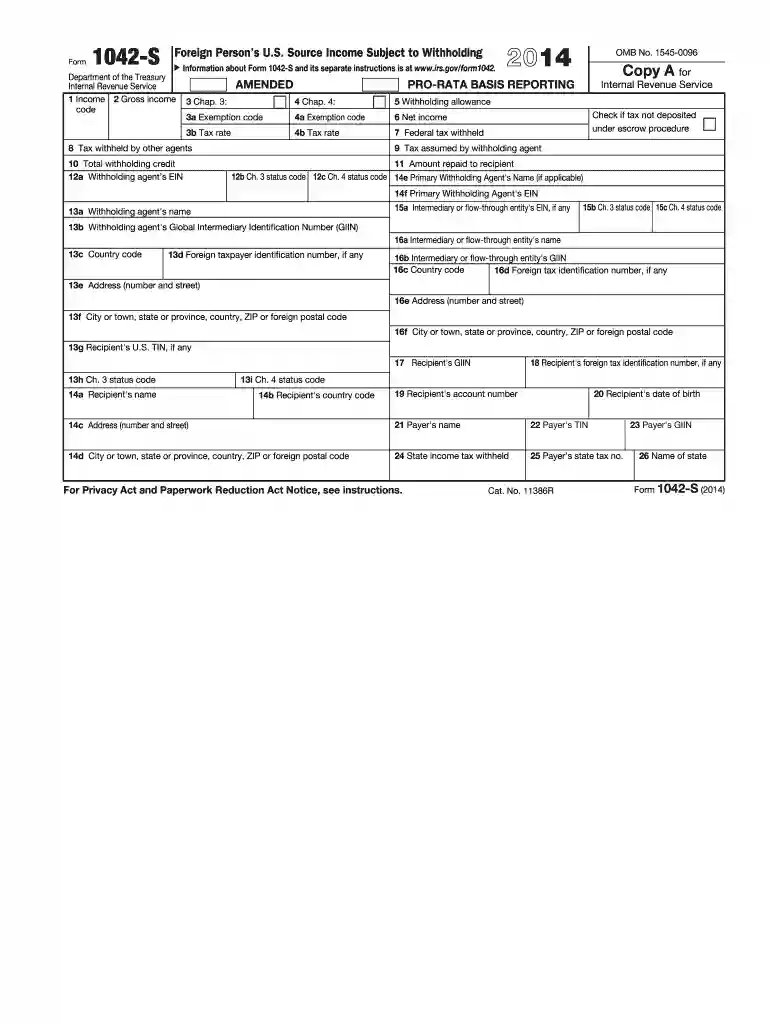
Form 1042-S is an IRS tax form used to report income derived from U.S. sources that is paid to foreign persons, including nonresident aliens, foreign corporations, or partnerships, by a U.S. withholding agent. It details income types subject to withholding, such as interest, dividends, or royalties. Form 1042-S includes critical information such as withholding rates, exemption codes, and income amounts. Withholding agents must use this form to document their compliance with U.S. tax withholding obligations.
Gather Required Information: Obtain all relevant personal and income information for both the withholding agent and the foreign recipient, including names, tax identification numbers, and addresses.
Identify Income Amounts: Precisely document each type of income paid to the foreign entity or individual, making sure to utilize the IRS income codes to specify different types of earnings.
Determine Withholding Amounts: Calculate withholding tax based on applicable tax rates and exemptions. Use exemption codes where eligible.
Fill Out Each Section: Complete all sections of the form, ensuring accuracy in recipient and withholding agent details.
Review and Submit: Double-check all information for mistakes or omissions before submission. Ensure the form is submitted via preferred methods by the filing deadline.


Businesses and individuals must ensure proper adherence to IRS guidelines to avoid punitive measures and secure accurate tax withholding and reporting status.
We've got more versions of the 2014 form 1042 s form. Select the right 2014 form 1042 s version from the list and start editing it straight away!
| Versions | Form popularity | Fillable & printable |
|---|---|---|
| 2025 | 4.1 Satisfied (46 Votes) | |
| 2024 | 3.9 Satisfied (37 Votes) | |
| 2023 | 4.9 Satisfied (31 Votes) | |
| 2022 | 4.5 Satisfied (50 Votes) | |
| 2021 | 4.8 Satisfied (135 Votes) | |
| 2020 | 4.3 Satisfied (105 Votes) | |
| 2019 | 4.3 Satisfied (118 Votes) | |
| 2018 | 4.4 Satisfied (102 Votes) | |
| 2017 | 4.3 Satisfied (341 Votes) | |
| 2016 | 4.4 Satisfied (324 Votes) | |
| 2015 | 4.3 Satisfied (29 Votes) | |
| 2014 | 4.2 Satisfied (69 Votes) | |
| 2013 | 4 Satisfied (22 Votes) | |
| 2012 | 4.2 Satisfied (58 Votes) | |
| 2011 | 4 Satisfied (40 Votes) |
At DocHub, your data security is our priority. We follow HIPAA, SOC2, GDPR, and other standards, so you can work on your documents with confidence.
Explanation of Codes. Box 1. Income code. Code. Types of Income. Interest. 01. Interest paid by U.S. obligors-general.Read more
Generally, every nonresident alien individual, nonresident alien fiduciary, and foreign corporation with United States income, including income that is.Read more
by AUA GUIDELINE 2014 Methods: The primary source of evidence for this guideline was the systematic review and data extraction conducted as part of the Agency for Healthcare.Read more


