




01. Edit your form online
Type text, add images, blackout confidential details, add comments, highlights and more.

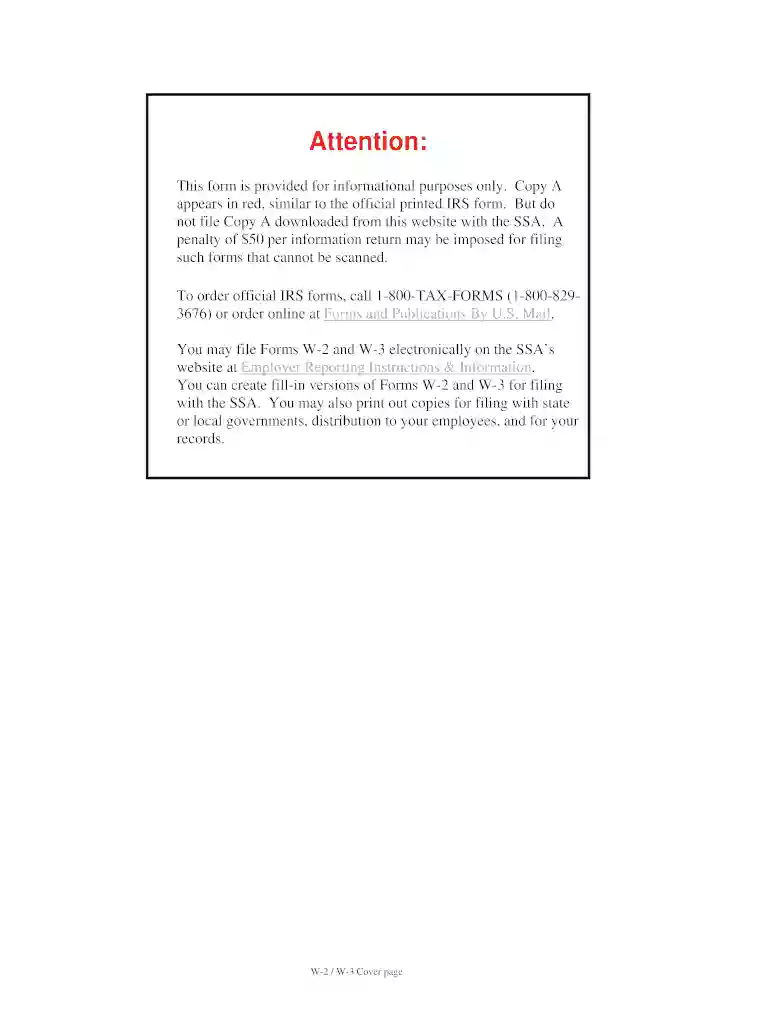
Type text, add images, blackout confidential details, add comments, highlights and more.

Draw your signature, type it, upload its image, or use your mobile device as a signature pad.

Send it via email, link, or fax. You can also download it, export it or print it out.
Form W-3, often termed the "Transmittal of Wage and Tax Statements," is integral in transmitting the W-2 forms to the Social Security Administration (SSA). The primary purpose of this form is to summarize the total earnings and taxes withheld as recorded on all employee W-2 forms. Businesses must complete and file this form to ensure compliance with tax regulations, making it essential in the annual tax reporting process. Without Form W-3, the IRS and SSA would not receive comprehensive data on employee wages and tax withholdings, potentially leading to misreported information.
To access the 2005 Form W-3, employers can utilize several methods. The IRS provides downloadable PDF versions of tax forms on its website, allowing businesses to print or save these forms for completion. Alternatively, many tax preparation software solutions, such as TurboTax and QuickBooks, include this form in their suite. These software options often assist users in filling out the form correctly, reducing human error through automated calculations and guided instructions. Another route is ordering physical copies directly from the IRS, suitable for those who prefer paper documentation.
Completing the 2005 Form W-3 involves several critical steps:
Enter Employer Information: This includes the employer’s EIN, name, address, and ZIP code. Accurate identification information is crucial for processing.
Report Employee Wages and Taxes: Aggregate the totals from all W-2 forms issued by your business, including wages paid, income tax withheld, and social security and Medicare taxes deducted.
Sign and Date the Form: A signature certifying the accuracy of the data is mandatory for legal compliance.
Send to SSA: Use only the official printed version from the IRS or order scannable copies. The form, alongside W-2 forms, must be sent to the SSA by the deadline to avoid penalties.
Form W-3 is generally used by business owners, payroll departments, and human resources professionals responsible for filing employee wage reports. Employers across various business entity types, such as corporations, LLCs, and partnerships, are required to submit this form if they have employees for whom they file W-2 forms. All businesses employing wage-earning staff must use this form to summarize withholding and payment data accurately.


EIN (Employer Identification Number): A unique identifier assigned to businesses for tax filing and reporting purposes.
W-2 Forms: Documents issued by employers to employees annually, detailing wages paid and taxes withheld throughout the tax year.
FICA Taxes: Federal Insurance Contributions Act taxes, which include Social Security and Medicare contributions deducted from employee wages.
Understanding these terms is essential for accurately completing Form W-3 and fulfilling all employer tax obligations.
The IRS has specific guidelines governing the submission of Form W-3. The form, along with Copy A of all W-2 forms, must be submitted by the end of January following the tax year in question, unless extensions have been granted. Adherence to these guidelines ensures the proper reporting of employee wage data, preventing discrepancies that could lead to audits or penalties. Incomplete or erroneous submissions may result in fines, making it crucial for employers to double-check their entries and calculations.
Failure to file Form W-3 on time or providing inaccurate information can lead to financial penalties imposed by the IRS. These penalties vary based on the severity and timing of the error:
Late Filing: Fees increase with the delay, from $50 per form if filed within 30 days to $310 if filed after August 1.
Inaccurate Information: Submitting incorrect totals or misinformation incurs additional fines, necessitating accurate calculations and verification.
Ensuring timely, precise reporting is critical to avoid severe financial repercussions and maintain good standing with tax authorities.
The filing deadline for the 2005 Form W-3, along with Copy A of W-2 forms, was January 31, 2006. This deadline is consistent with general IRS requirements for annual wage reports. Adhering to this date is crucial for meeting federal tax obligations and preventing penalties. Employers should maintain a timeline for gathering, verifying, and submitting these forms, allowing sufficient time for any necessary revisions or corrections prior to the deadline.
Employers must collect several documents before filing Form W-3:
Completed W-2 Forms: These include all copies of employee wages and tax withholdings.
Employer Identification Numbers (EIN): Information on both the employer and any subsidiary that paid wages.
Total Wage and Tax Reports: Summarized financial data from all W-2 forms issued.
Adequate preparation and organization of these documents streamline the reporting process, ensuring compliance and accuracy.
We've got more versions of the 2005 w 3 form form. Select the right 2005 w 3 form version from the list and start editing it straight away!
| Versions | Form popularity | Fillable & printable |
|---|---|---|
| 2024 | 4.8 Satisfied (22 Votes) | |
| 2023 | 4.2 Satisfied (48 Votes) | |
| 2022 | 4.9 Satisfied (31 Votes) | |
| 2021 | 4.8 Satisfied (161 Votes) | |
| 2020 | 4.4 Satisfied (217 Votes) | |
| 2019 | 4.4 Satisfied (274 Votes) | |
| 2018 | 4.4 Satisfied (268 Votes) | |
| 2017 | 4.4 Satisfied (830 Votes) | |
| 2016 | 4.3 Satisfied (48 Votes) | |
| 2015 | 4 Satisfied (43 Votes) | |
| 2014 | 4.1 Satisfied (48 Votes) | |
| 2013 | 4 Satisfied (54 Votes) | |
| 2012 | 4 Satisfied (27 Votes) | |
| 2011 | 4.2 Satisfied (71 Votes) | |
| 2010 | 4.2 Satisfied (30 Votes) |
Electronic signatures are a perfect replacement for traditional signing, as they save time, effort, and money people spend on printing, scanning, and paper delivery. You can eSign your 2005 w 3 form using a reliable and robust online document management services like DocHub. It complies with main eSignature policies (ESIGN and UETA), so all forms approved there are legally binding and have the same validity as manually signed ones.
You can easily edit and complete your 2005 w 3 form on any iOS gadget. Open an internet browser of your choice, go to the DocHub website, authorize or create a new account, add your file for editing, and make your desired alterations. Our service is mobile-friendly, so using its features on your phone will be a no-brainer, even on the first try.
At DocHub, your data security is our priority. We follow HIPAA, SOC2, GDPR, and other standards, so you can work on your documents with confidence.
Feb 12, 2026 Gallagher Generating Station is a retired power station in New Albany, Floyd, Indiana, United States. It is also known as R. Gallagher Generating Station.Read more
Give form to the requester. Do not send to the IRS. Form W-9. Request for Taxpayer. Identification Number and Certification.Read more
Use Form W-3 to transmit Copy A of Form(s) W-2, Wage and Tax Statement. Make a copy of Form W-3 and keep it with Copy D (For Employer) of Form(s) W-2 for yourRead more


