






Definition and Purpose of a Chauffeur License
A chauffeur license is a specialized permit required in many U.S. states for individuals who drive public passenger vehicles for hire. Unlike a standard driver’s license, which permits the operation of personal vehicles, a chauffeur license signifies that the holder is authorized to transport passengers professionally. This license typically mandates adherence to higher standards of safety and professionalism due to the nature of the work involved.
Chauffeur licenses often serve a critical role in the transportation sector, ensuring that drivers possess the necessary skills and knowledge to operate vehicles safely in various traffic conditions. Obtaining a chauffeur license can be seen as a professional stepping stone for individuals aiming to work with ride-sharing companies, limousine services, or other enterprises that require the transportation of paying passengers.
Steps to Complete the Chauffeur License Application
Applying for a chauffeur license involves a multistep process, ensuring that applicants meet several requirements. Here is a typical sequence followed:
-
Eligibility Confirmation: Verify that you meet the age, driving history, and residency criteria specific to your state. Often, candidates must be at least eighteen years old with a clean driving record.
-
Gather Required Documents: Required documentation generally includes identification, a valid driver's license, proof of residence, and a record of driving history. Social Security numbers or tax identification numbers are also commonly requested.
-
Criminal Background Check: Undergo a background check to demonstrate no criminal history that would disqualify you from chauffeuring, such as convictions for DUI or serious traffic offenses.
-
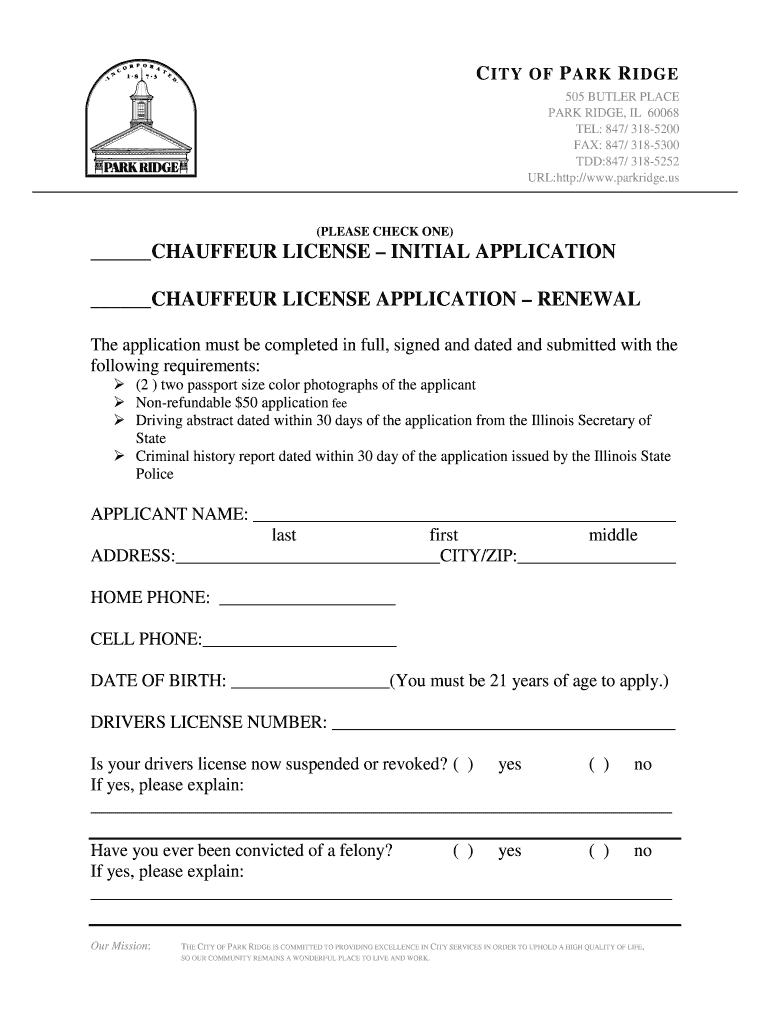
Complete Application Form: Fill out the chauffeur license application form, ensuring all sections are thoroughly completed and all information is accurate.
-
Submit Application and Fees: Submit the completed form along with any required fees. Payment can often be made online, in person, or through mail services.
-
Driver Competency Test: Successfully pass a written or practical test that assesses your knowledge of road signs, regulations, and driving skills pertinent to professional driving.
-
Attend Mandatory Training: Some jurisdictions may require applicants to attend training or driving courses that focus on enhancing skills specific to transporting passengers safely.
Required Documents for Chauffeur License Application
The application process for a chauffeur license requires several documents to establish identity and qualifications. Typical requirements include:
- Valid Driver's License: A current standard driver's license confirming your eligibility to drive.
- Identification and Proof of Residency: Government-issued ID such as a passport or state ID, along with documents like utility bills or lease agreements to verify residency.
- Driving Record: A certified copy of your driving history, which can be obtained from the state motor vehicle office.
- Social Security Number: Required for tax and identification purposes.
The requirements may vary slightly between states, so it is crucial to check specific local guidelines.
State-Specific Rules for the Chauffeur License Application
Different states have specific rules and regulations governing chauffeur licenses, reflecting varying regional needs and legal stipulations. For example, in Illinois, applicants must comply with additional safety courses, whereas, in New York, there might be stricter policies against applicants with certain traffic violations.
Being aware of state-specific rules can aid in the application process by ensuring applicants prepare adequately, adhere to different registration processes, and meet distinct legal standards. Each state's department of motor vehicles or equivalent body usually provides resources and guides on fulfilling these requirements.
Eligibility Criteria for Obtaining a Chauffeur License
Assuring eligibility before applying for a chauffeur's license saves applicants time and resources. Common criteria include:
- Minimum Age: Must typically be eighteen years of age or older.
- Clean Driving Record: No major traffic violations, such as DUIs or reckless driving, within a given timeframe, often three to five years.
- Legal Residency: Proof of living within state boundaries where the application is being made.
- Pass Background Check: No criminal convictions that would impede driving privileges, especially offenses related to traffic law violations or substance abuse.
Meeting these basic criteria is essential to progressing through the application procedures.


Application Process and Approval Timeframe
The application process and timeframe for approval can vary significantly based on the state and individual applicant circumstances. Here's a general overview:
- Application Review: After submission, the relevant authorities will review your application, confirming that all information and documents are correct and complete.
- Background Verification: Completion of background checks, which could take several days to weeks, depending on the state’s processes.
- Testing Phase: Scheduling and taking any required competency tests.
- Notification of Approval or Denial: Applicants are informed of the decision via mail or email. If successful, a temporary license often issues before the official credential is mailed. If denied, applicants may receive information on the reasons for denial and steps for correction or appeal.
In most cases, the overall process might take several weeks to a few months, taking into account all evaluations and processing times.
Important Terms Related to the Chauffeur License Application
Understanding pertinent terminology can enhance comprehension and navigation of the chauffeur license application process:
- Applicant: Individual pursuing the chauffeur license.
- Background Check: A process involving an investigation into the applicant's history to ensure legal compliance.
- Certification: Confirmation of meeting all application requirements.
- Driver Competency Test: An examination to assess driving skills specific to chauffeuring.
- Processing Fees: Charges associated with reviewing and maintaining application systems and processes.
Having a grasp of these terms can aid in effectively navigating the bureaucratic nuances of the licensing journey.
Digital Versus Paper Version of the Application
With technology integration, many states offer both digital and paper versions of the chauffeur license application. Understanding the differences and advantages of each can impact the application experience:
-
Digital Version:
- Convenience: Can often be completed online within minutes.
- Accessibility: Allows for document uploads, payments, and tracking in one interface.
- Speed: Can expedite processing time.
-
Paper Version:
- Traditional Process: Useful for those without internet access or computer literacy.
- Tangible Record: A physical copy for personal records if preferred.
Each version accommodates different user preferences, ensuring the broadest access possible.